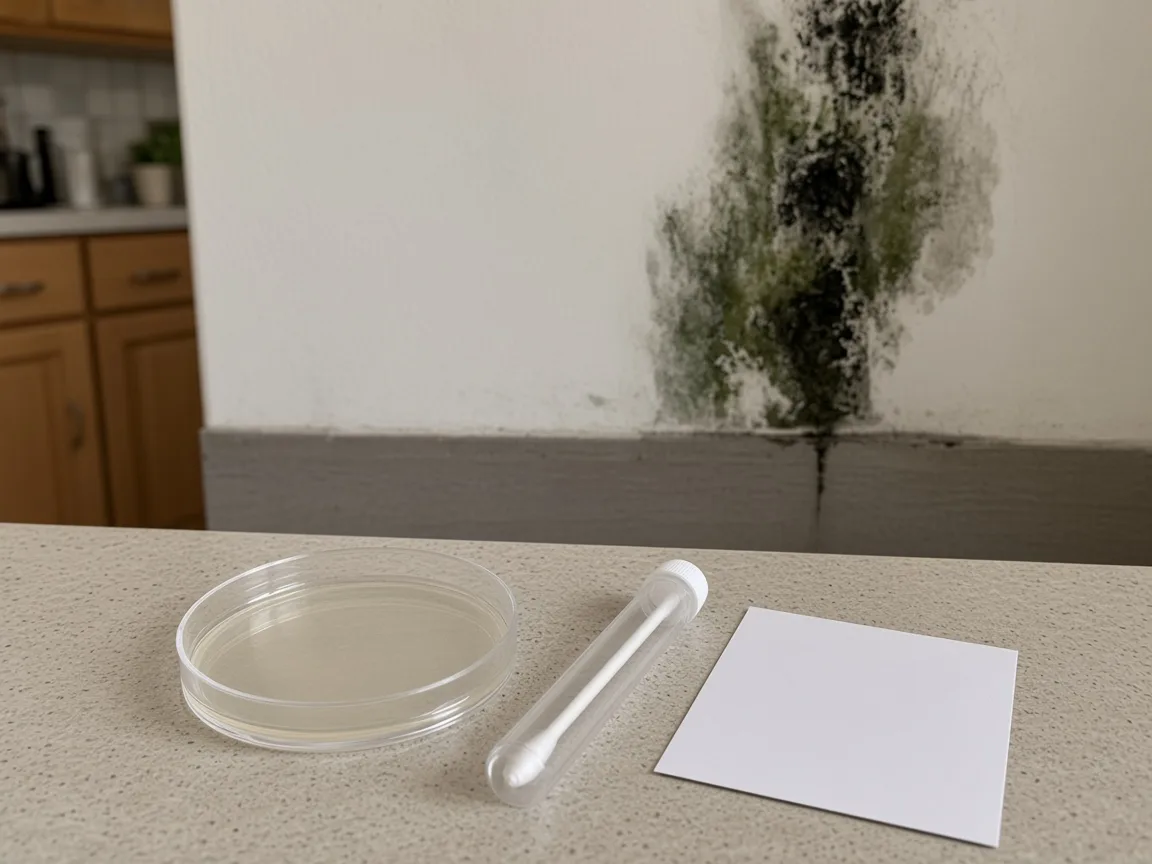
How DIY Mold Test Kits Work
Most kits use a settle plate or a swab. With a settle plate, you leave a dish of growth medium exposed to the air for a set time, then watch for colonies to form. With a swab or tape, you collect a sample from a surface and either send it to a lab or look for growth yourself.
Both approaches detect whether mold spores are present in the sample. That sounds useful until you consider how common spores are.
Why a Positive Result Doesn't Mean Much
Mold spores are in outdoor air everywhere, and they travel indoors on air, clothing, and pets. A settle plate left out in almost any home will grow something. A positive result tells you spores exist, which you already knew.
What matters is whether indoor levels are elevated compared with the outdoor air at the same time, and whether there's an indoor source feeding growth. A kit doesn't compare against an outdoor baseline, so it can't separate normal background spores from a real problem.
Why a Negative Result Can Be Falsely Reassuring
A negative result can be just as misleading. Mold can grow inside wall cavities, under flooring, in crawl spaces, and above ceilings, where a plate on a kitchen counter won't capture it. Some growth releases few spores into the air, so a short sampling window can miss an active problem.
A clean kit result doesn't rule out hidden moisture. If you smell something musty or have a known leak history, a negative kit shouldn't end the investigation.
What Kits Can't Do
- Find the source. Mold needs moisture. A kit doesn't tell you whether it's a plumbing leak, a roof problem, condensation, or ground moisture.
- Locate hidden moisture. Only instruments such as thermal cameras and moisture meters show wet material behind finished surfaces.
- Identify species reliably. Color and appearance don't identify mold, and a basic kit doesn't give you a laboratory analysis of genera and concentrations.
- Define a remediation scope. A kit gives you no documented extent of growth, which a contractor, insurer, or landlord would need.
When a Kit Is Reasonable
A kit can be a rough first look when you're curious, the stakes are low, and you understand the limits. It's not a substitute for an inspection when there's been water damage, a persistent odor, health symptoms, a real estate transaction, or a landlord-tenant dispute.
What a Professional Inspection Adds
A professional inspection answers the questions a kit can't. Thermal imaging and calibrated moisture meters find wet material without opening walls. Air samples are collected alongside an outdoor control, so indoor results are compared with the outdoor baseline. Samples go to an accredited laboratory for genera and concentrations. The written report ties the findings to a moisture source.
For more detail on how that works, see air quality testing for mold and what a mold inspection actually covers.
What Not to Do Before an Inspection
- Don't scrub, bleach, or paint over visible growth. It disturbs spores and removes the evidence needed for identification.
- Don't run a fan across the affected area, which can spread spores through the home.
- Don't tear out drywall or flooring before the moisture source and extent are documented.
- Do photograph what you see, note when you first noticed it, and keep records of any past leaks.
If a kit result has left you with more questions than answers, schedule an inspection. The written report tells you what is actually going on, where, and why.