What MVOCs Are
Microbial volatile organic compounds — MVOCs — are gases produced by mold and bacteria as byproducts of their metabolic processes. As mold grows on organic material, it breaks down cellulose, lignin, and other substrates through enzymatic activity, and this breakdown produces a range of volatile chemical compounds that off-gas into the surrounding air.
The compounds include alcohols, ketones, aldehydes, terpenes, and sulfur-containing compounds, depending on the species growing and the substrate it is metabolizing. The specific combination of compounds varies by mold genus and substrate, and researchers have identified characteristic MVOC profiles for species including Stachybotrys, Aspergillus, Penicillium, and Cladosporium.
The human nose detects MVOCs at concentrations far below what analytical instruments can measure — the odor threshold for several common MVOCs is in the parts per billion range. This is why the musty smell that signals mold is detectable well before any visible growth appears, and well before a standard spore trap air sample would show elevated counts.
Why MVOCs Appear Before Visible Mold
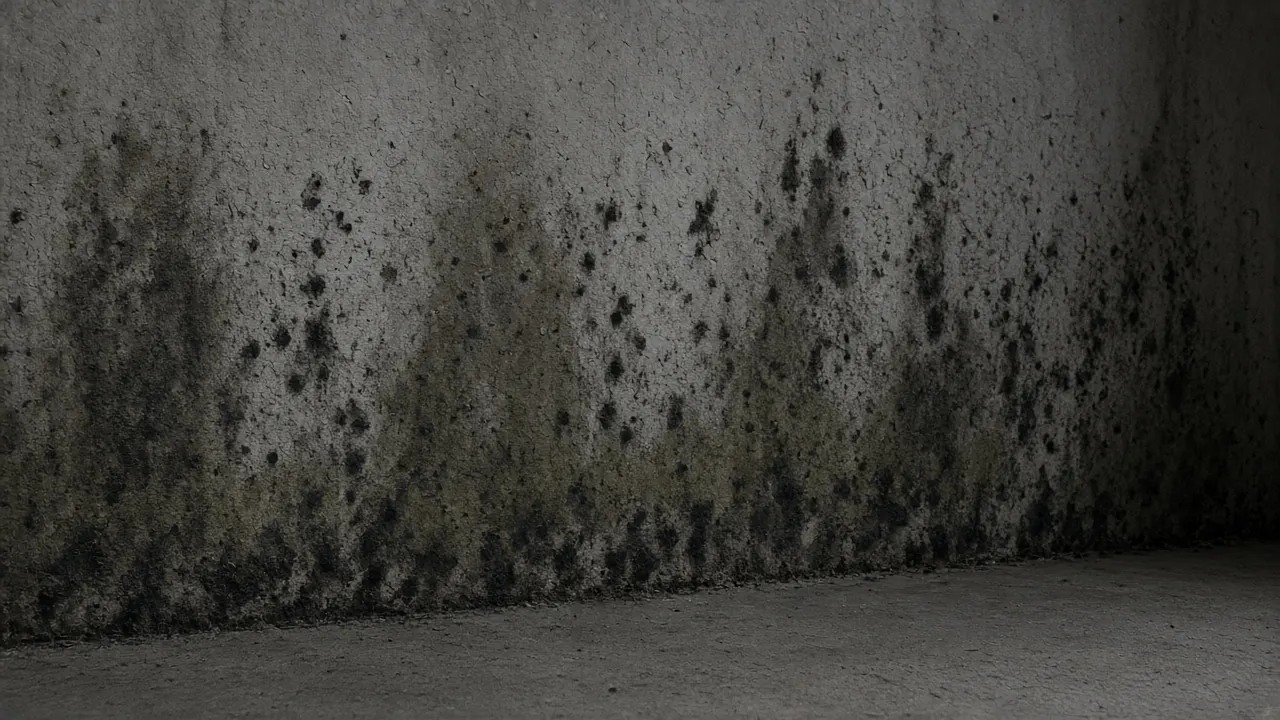
Mold growth follows a sequence. Spores land on a wet organic substrate and germinate, producing hyphae — the thread-like filaments that form the body of mold growth. The hyphae begin metabolizing the substrate almost immediately upon germination, producing MVOCs as byproducts. The visible surface growth — the patch of discoloration or fuzzy material — appears later, after enough hyphal mass has accumulated to be visible to the naked eye.
This means MVOCs are present — and detectable by smell — in the early stages of mold growth, before the colony has produced enough spores to show up significantly in a standard air sample and before the growth is large enough to be visible on the substrate.
The practical implication is that a musty smell in a space with no visible mold and a normal spore count air test result does not mean mold is absent. It may mean mold is in an early growth stage, growing on a substrate inside a wall assembly or under flooring where neither spores nor visible growth are accessible to the testing methods used.
The Limitation of Standard Spore Count Testing
Standard spore trap air sampling — the most common method used in residential mold inspection — counts fungal spores present in a measured volume of air. It is an effective tool for identifying elevated indoor spore concentrations relative to the outdoor baseline and for confirming that a known mold source is releasing spores into the living space.
It has a specific limitation relevant to MVOC-producing growth: spore counts reflect reproductive output, not metabolic activity. A mold colony actively metabolizing substrate and producing MVOCs may be releasing relatively few spores — particularly if the growth is in an early stage or if the species produces spores intermittently. Stachybotrys chartarum, the species most associated with severe mold-related health concerns, is notably poor at releasing spores into air under normal indoor airflow conditions, which is why it frequently produces negative or low spore count results even when established in a building.
A negative or normal spore count result in a building with a persistent musty odor does not rule out active mold growth. It means the specific growth present is not releasing spores into the air at elevated levels — which is a different finding from no mold present.
What MVOC Testing Measures
MVOC testing uses a different analytical approach than spore trap sampling. Air is drawn through a collection tube packed with sorbent material that captures volatile organic compounds, which are then analyzed by gas chromatography-mass spectrometry (GC-MS) in a laboratory. The results identify specific compounds present and their concentrations.
A panel of MVOC results is interpreted against known profiles for mold metabolic activity. Compounds including 1-octen-3-ol, 3-methyl-1-butanol, 2-pentanol, and geosmin — the compound primarily responsible for the characteristic earthy musty smell — are associated with active mold metabolism. Their presence at elevated concentrations in a building with no identified mold source indicates active growth somewhere in the structure.
MVOC testing does not identify the species growing. It confirms that microbial metabolic activity is occurring and at what level, which then informs the physical investigation — where to look for the growth that is producing the signal.
When MVOC Testing Is the Right Diagnostic Tool
MVOC testing is indicated in these specific situations:
- A persistent musty odor is present but no visible mold has been found and standard spore count air testing returned normal results
- Health symptoms follow the location pattern — present in the building, improved elsewhere — but spore count testing has not identified an elevated indoor source
- A property has a history of water damage and the odor persists after remediation, raising the question of whether a secondary source was missed
- A litigation or insurance context requires documentation of active microbial activity beyond what a spore count can establish
- A building has been remediated and cleared by spore count but occupants continue to report symptoms and odor
What a Musty Smell Means Chemically
The earthy, musty smell most people associate with mold is produced primarily by geosmin — a bicyclic compound produced by actinobacteria and some mold species including certain Penicillium and Aspergillus strains. The human nose detects geosmin at concentrations as low as five parts per trillion, making it one of the most potently detectable compounds in nature.
The mushroom-like smell often associated with more active mold growth is produced primarily by 1-octen-3-ol, a common MVOC across many mold species. The combination of geosmin and 1-octen-3-ol at detectable concentrations in an indoor space is a reliable chemical indicator that microbial metabolic activity is occurring — the nose is detecting the byproducts of active mold growth before any other test would confirm it.
When you smell something musty in your home and cannot find the source, the smell is not imaginary and it is not simply a function of an old building. It is a chemical signal from an active biological process. Schedule an inspection that goes beyond a standard spore count.