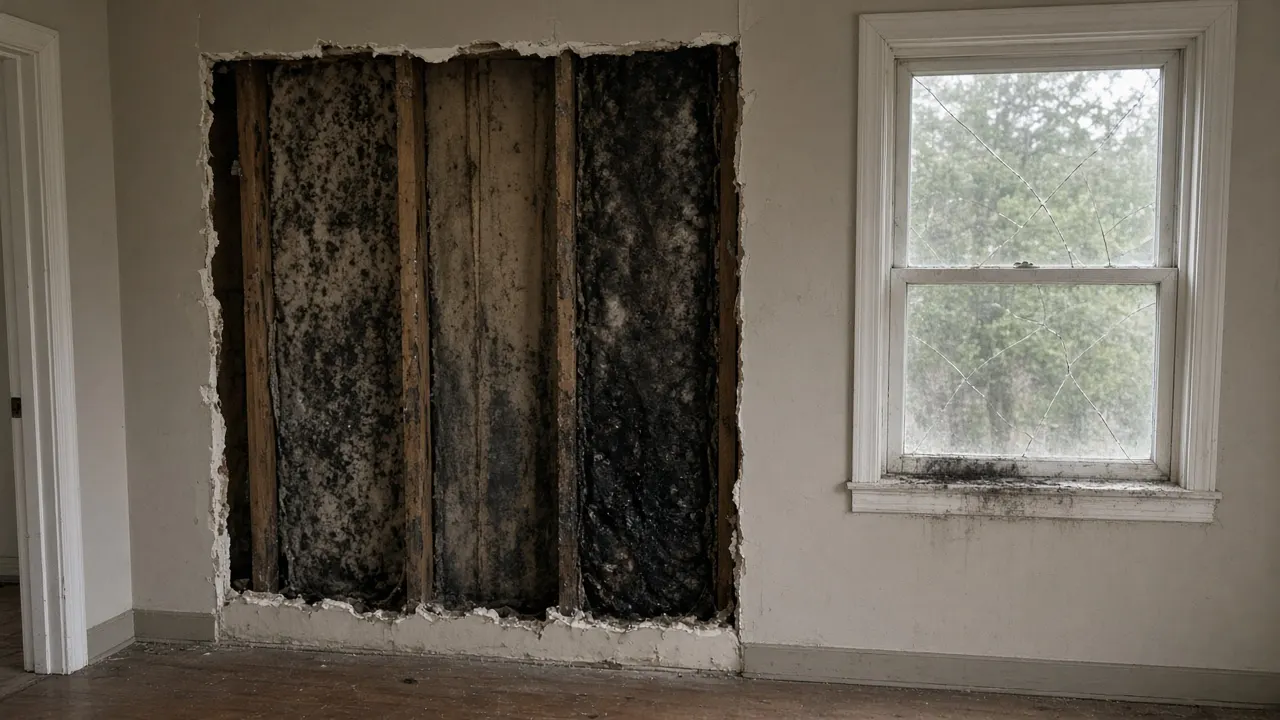
Why Fire Survivors Face Mold Risk
The instinct after a wildfire is to focus on fire damage. But properties that survive a wildfire — or that sustain partial damage without complete structure loss — face mold conditions through three distinct mechanisms that have nothing to do with flames.
Understanding these mechanisms is what determines whether a post-fire inspection finds a clean structure or one with active mold growth establishing inside wall assemblies months after the fire appeared to be over.
Mechanism 1: Fire Suppression Water
Firefighting operations deposit enormous volumes of water into and around structures. Aerial retardant drops, ground-based hose lines, and structure protection sprinklers saturate roofing, wall assemblies, crawl spaces, and attics with water that then sits in enclosed spaces with no ventilation or drying assistance.
A structure that was drenched in suppression water and then sealed up — windows closed, HVAC off, occupants not present — creates ideal mold conditions in the wall assemblies and structural framing within 24 to 48 hours. By the time the occupant returns, mold may be well-established inside walls that show no visible surface indication.
This is the most immediate post-fire mold risk and the one most commonly missed because the visible story of the property is fire damage, not water damage. A thorough post-fire inspection includes moisture mapping of the structural framing and wall assemblies to identify suppression water that has not dried.
Mechanism 2: Open Structures
Fires breach building envelopes. Even in structures that did not burn, radiant heat cracks stucco and breaks window glazing. Ember impact damages roofing and deck waterproofing. Flying debris opens gaps at roof penetrations, fascia boards, and wall transitions.
These breaches remain open through the winter rain season that follows most Southern California fires. The atmospheric river events that delivered four to eight inches of rain to the Los Angeles area in late December 2025 and early 2026 — arriving less than a year after the January 2025 fires — drove water through fire-breached envelopes into structures that had not been fully repaired. Properties in Altadena, Pacific Palisades, and the Eaton fire perimeter that survived the fire but had unrepaired envelope damage accumulated significant moisture through the subsequent wet season.
Mechanism 3: Burn-Scar Hydrology
This is the most persistent and least understood of the three mechanisms — and the one that affects properties that had no direct contact with fire, suppression water, or structural damage.
When a wildfire burns through a hillside watershed, it leaves fire-hardened soil that sheds rather than absorbs rainfall. The waxy hydrophobic layer that forms on burned soil after a fire can cause 90 to 100 percent of rainfall to run off as surface flow rather than infiltrating the ground. This transforms the hydrology of the burned watershed — runoff volumes that would normally be absorbed by soil and released slowly over weeks now arrive at the bottom of the slope within minutes of a rain event.
Properties downslope from burn areas receive this amplified runoff against their foundations, into their crawl spaces, and against their retaining walls in ways that the pre-fire hydrology never produced. The January 9, 2018 Montecito debris flow — triggered by half an inch of rain falling in five minutes on the Thomas Fire burn scar — is the extreme end of this mechanism. The chronic version is less dramatic but produces sustained elevated foundation moisture in downslope properties for the two to three years it takes for vegetation to recover and soil structure to normalize.
Why Smoke Damage and Mold Damage Require Different Assessments
Smoke damage and mold damage are assessed differently, remediating differently, and documented differently for insurance purposes. They frequently co-exist in post-fire properties, and confusing one for the other leads to incomplete remediation.
Smoke damage assessment focuses on particulate deposition, soot coverage, and odor penetration. It does not require laboratory sampling to characterize — the presence and extent of smoke damage is evaluated visually and through odor assessment.
Mold damage assessment requires instrument-based moisture mapping, air and surface sampling, and laboratory analysis to characterize. Mold that has established in a wall assembly from suppression water looks nothing like smoke damage from the outside and will not be identified by a smoke damage assessor.
A complete post-fire assessment of a surviving structure should include both: a smoke and particulate assessment for the visible fire-related damage, and a mold inspection with moisture mapping and laboratory sampling for the invisible water-related damage. These are two separate professional services.
The FAIR Plan Insurance Context
A significant proportion of properties in Southern California's high fire risk zones — including the communities most affected by the 2025 fires — are insured under California's FAIR Plan, the insurer of last resort for properties that cannot obtain coverage in the standard market. FAIR Plan covers fire damage but does not cover water damage as a separate peril.
This creates a documentation challenge for post-fire mold claims: the mold resulted from fire suppression water or burn-scar hydrology — fire-related events — but the damage presents as moisture damage. Independent inspection documentation that connects the mold condition specifically to fire suppression operations or burn-scar drainage is the evidence that ties the mold claim to the fire event rather than to an excluded water peril.
When to Schedule a Post-Fire Mold Inspection
- Immediately after reoccupying a structure that was subjected to fire suppression water, even if there is no visible mold
- Before closing walls or beginning interior reconstruction on any fire-affected property
- Before the first wet season following a fire for properties downslope from a burn area
- After any rain event that produced runoff from an adjacent burn scar toward the property
- When a musty odor develops in a post-fire property that was not present before the fire
- When filing a FAIR Plan or standard insurance claim that may involve both fire and moisture damage
If your property survived the 2025 LA fires or is downslope from any Southern California burn area and you have not had a post-fire moisture assessment, schedule an inspection. The window to document fire-related moisture damage for insurance purposes closes as reconstruction proceeds.