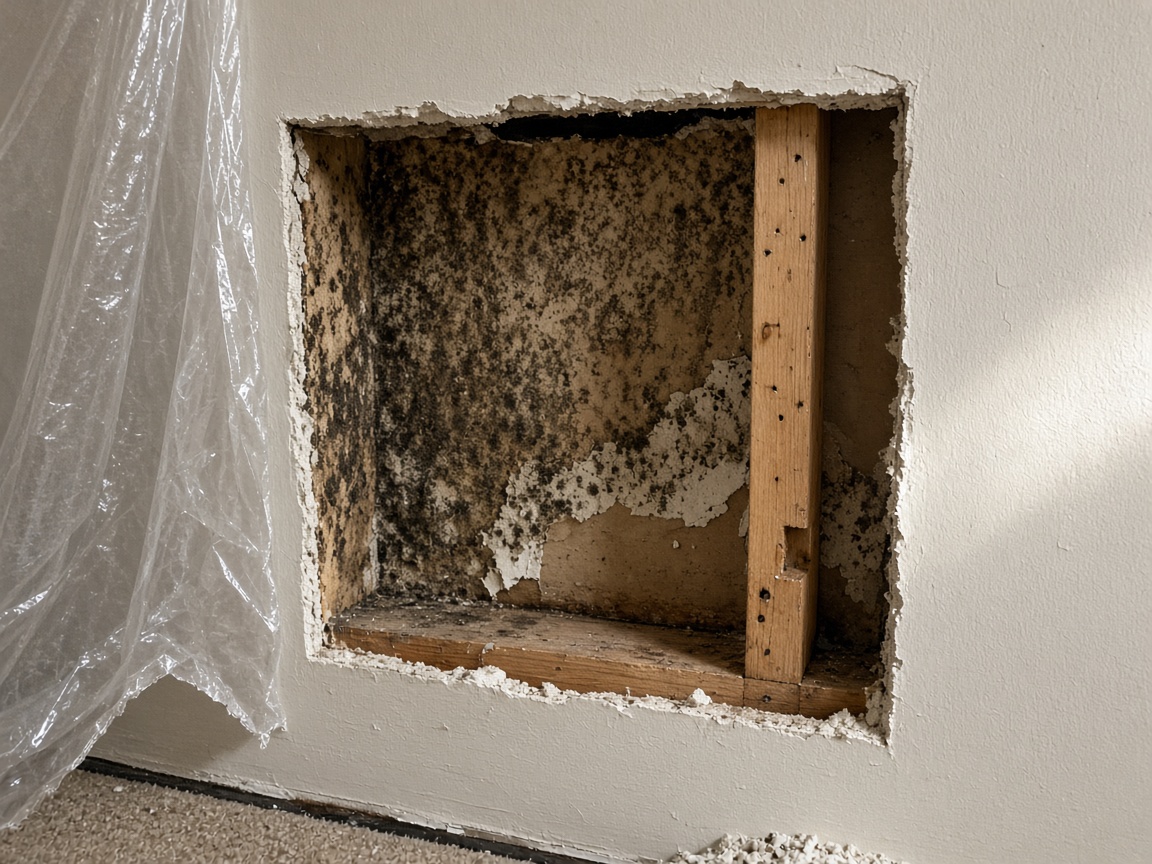
What Post-Remediation Verification Is
Post-remediation verification — also called clearance testing or post-remediation clearance — is an inspection performed after a mold remediation contractor has completed their work. Its purpose is to confirm three things: that the affected material was removed or treated to the standard defined in the remediation scope, that the moisture source driving the mold growth has been controlled, and that indoor spore counts have returned to within the normal range relative to the outdoor baseline.
The verification is distinct from the remediation itself. It is performed by a different company — an inspection company with no financial relationship to the remediation contractor — using the same instrumented methods as the initial inspection: thermal imaging, moisture meters, visual inspection of the work area, and air and surface sampling sent to an accredited third-party laboratory.
Why Independence Is the Entire Point
A remediation contractor signing off on their own completed work cannot provide credible verification. The conflict of interest is structural: the contractor has a financial stake in confirming the work succeeded, a reputational stake in avoiding a failed clearance, and no independent instrument-based standard against which their visual assessment is checked.
This matters in practice because remediation is imperfect. Containment failures during remediation can spread spores to previously unaffected areas. Incomplete drying before closing walls can leave residual moisture that supports new growth. Work that was performed correctly on the targeted area can miss a secondary source that was not part of the original scope.
An independent verifier finds these conditions because they have no stake in finding the work complete. The instruments — thermal camera, moisture meters, air sampling pump — do not adjust their readings based on who is holding them.
What the Verification Inspection Covers
The verification inspection follows the remediation scope. Every area identified in the original inspection report and addressed in the remediation is assessed in the verification.
- Visual inspection of the work area. The inspector examines the remediated surfaces for any remaining visible growth, checks that containment barriers were removed properly, and confirms that the work area appears consistent with the scope that was completed.
- Moisture verification. Thermal imaging and moisture meter readings confirm that interior moisture levels in the affected structural materials have returned to the normal baseline range for that building and climate. This is the most critical finding — a work area that was cleaned but not dried is a work area where mold will return.
- Air sampling in and adjacent to the work area. Air samples taken inside the remediated space and in the adjacent living areas, compared against an outdoor control sample, confirm that spore counts have returned to within the normal range. Elevated spore counts after remediation indicate active growth somewhere — either incomplete remediation of the original area or a secondary source that was disturbed but not treated.
- Surface sampling where indicated. If any surface in the remediated area shows conditions that raise a question — discoloration, unusual texture, a moisture reading that is higher than expected — a surface sample confirms whether growth is present.
When Post-Remediation Verification Is Required
Verification is not always legally required, but it is increasingly expected in these situations:
- Real estate transactions. Buyers and their lenders increasingly require clearance documentation before closing on a property with a disclosed mold history. A clearance report from an independent inspection company — not the remediation contractor — is what satisfies that requirement.
- Insurance claims. Insurers require independent verification before closing a mold damage claim. The claim documentation package — initial inspection report, remediation scope, clearance report — needs to come from parties with no financial relationship to each other.
- Landlord-tenant disputes. A landlord who has performed remediation following a tenant habitability complaint needs independent clearance documentation to demonstrate the work is complete and the unit is habitable. A tenant who has been displaced during remediation needs independent confirmation before returning. In both cases, documentation from the remediation contractor is insufficient.
- HOA disputes. In condominium and townhome communities where remediation was performed on shared building systems, HOA boards need independent clearance documentation to close out the association's liability to affected unit owners.
- Post-water-damage restoration. When restoration drying was performed following a water damage event, independent verification confirms that interior moisture levels are at baseline and that no mold has established in the affected areas.
What Happens When Clearance Fails
A failed clearance — elevated spore counts, residual moisture, or visible growth remaining in the work area — is not a failure of the verification process. It is the verification process working correctly.
When clearance fails, the remediation contractor returns to address the identified deficiency. The scope is defined by the verification findings — which specific areas showed elevated moisture, which surfaces showed residual growth, which air samples showed elevated counts — not by the contractor's visual assessment.
A second verification inspection after the corrective work confirms whether the deficiency was addressed. This cycle — remediation, verification, remediation if needed, re-verification — is how the process is designed to work when all parties are operating correctly.
How to Request Post-Remediation Verification
The verification should be scheduled after the remediation contractor has completed their work and declared the area ready for clearance — but before any reconstruction begins. Once walls are closed, flooring is replaced, and the space is restored to its finished condition, the ability to verify interior moisture conditions is significantly limited.
Request the verification from the inspection company that performed the initial assessment if possible, since they have the original moisture baseline for comparison. If a different company performs the verification, provide them with the original inspection report so they can compare current findings against the pre-remediation baseline.
The verification report, combined with the original inspection report and the remediation contractor's scope of work and completion documentation, constitutes the full mold event documentation package — what insurers, lenders, landlords, tenants, HOA boards, and courts need to close out a mold-related claim or dispute.
If remediation has been completed and you need independent clearance documentation, schedule post-remediation verification.