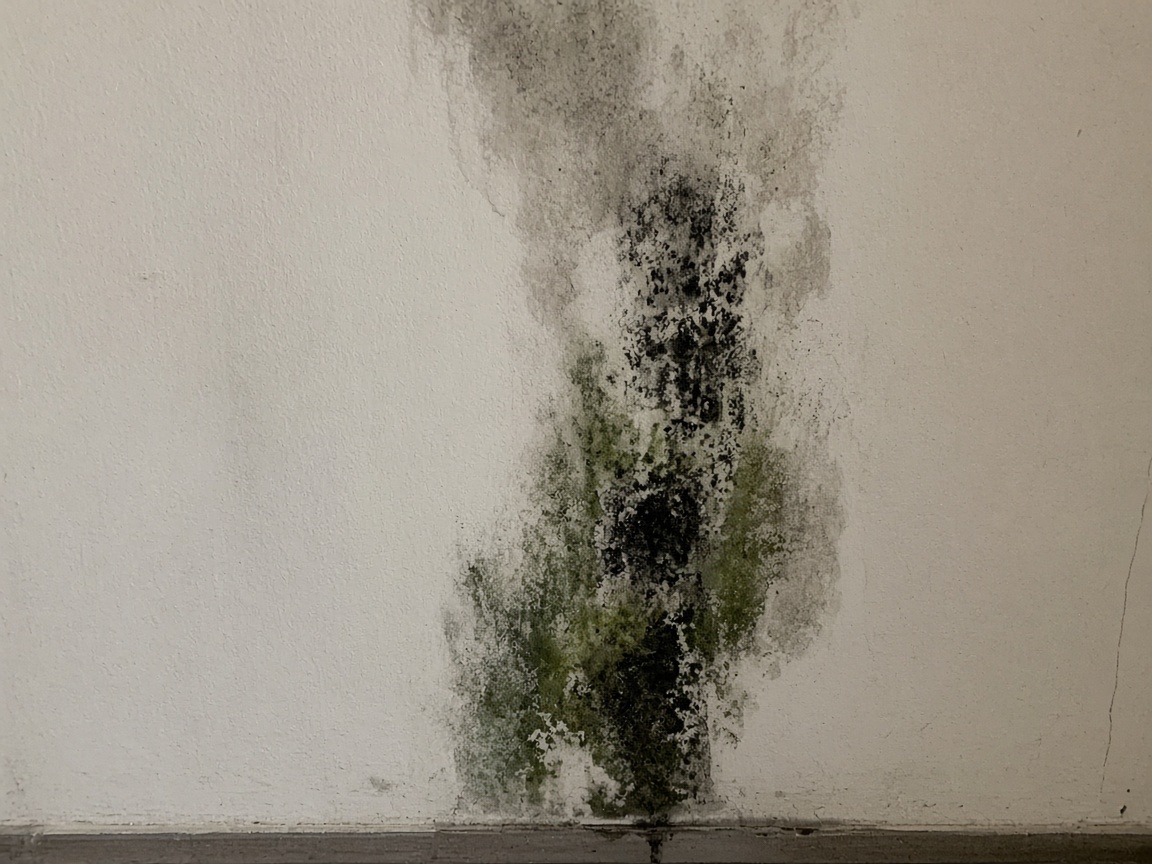
Why Water Damage Creates Mold Risk Even After Drying
Restoration drying equipment — industrial dehumidifiers, air movers, desiccant systems — is highly effective at removing moisture from surfaces and from the air in an enclosed space. It is less effective at removing moisture from inside wall assemblies, from the underside of flooring, from subfloor framing in crawl spaces, and from insulation in wall cavities.
These are the locations where mold establishes after a water damage event. A wall that reads dry at the surface can still hold enough moisture inside the assembly to support mold growth for weeks after the surface dried. A slab floor that was pumped and dried can still have wet conditions beneath it. A crawl space that was accessed and treated can still have framing at moisture content levels that support growth.
The test for whether drying was adequate is not how dry the visible surfaces feel — it is whether interior moisture levels in wall assemblies and structural framing have returned to the baseline range for that climate.
The Three Types of Water Damage and Their Mold Risk
Not all water damage carries the same mold risk. The restoration industry categorizes water damage by contamination level, and the category affects both the urgency of testing and the scope of remediation that may follow.
- Category 1 (clean water) — a burst supply line, an overflowing sink from a clean source, or appliance failure from a clean water connection. Low contamination. Mold risk is primarily from moisture duration — the longer the water sat, the higher the risk.
- Category 2 (gray water) — dishwasher overflow, washing machine discharge, toilet tank overflow without solids. Moderate contamination. Mold can establish faster and the species present may include less common genera.
- Category 3 (black water) — sewage backup, rising floodwater, storm drainage. High contamination. Mold testing after Category 3 events is essential because the contamination affects both what species establish and what remediation protocol is appropriate.
When to Schedule Mold Testing After Water Damage
The timing question has two parts: when to test during the restoration process, and when to test after restoration is complete.
During restoration. If restoration is taking more than five to seven days, or if the affected area involves wall assemblies or flooring that required opening, testing during the process can identify whether mold has already established in areas that weren't visible before demolition. This is particularly relevant in older homes where pre-existing moisture conditions may have already supported dormant growth before the water damage event.
After restoration. Post-restoration verification testing confirms that interior moisture levels have returned to baseline and that no mold growth has established in the affected areas. This testing is what the insurance company's adjuster needs to close the claim, what a property manager needs to return a rental unit to occupancy, and what a homeowner needs before closing walls or replacing flooring.
What Makes Post-Water-Damage Testing Different
Testing after a water damage event is not the same as a routine mold inspection. The inspector knows the event occurred, knows where the water entered and traveled, and focuses the inspection on those pathways and the areas most likely to have retained moisture.
Thermal imaging is essential in this context. Wet material inside a wall assembly that has been dried on its surface still holds a thermal signature — it holds temperature differently than the dry material surrounding it. Infrared imaging identifies these locations before moisture meters confirm them.
Air sampling establishes the spore count in the affected spaces relative to the outdoor baseline. Elevated indoor spore counts after a water damage event indicate active growth somewhere in the space, even when nothing is visible — the growth is inside wall cavities, under flooring, or in the HVAC system that ran through the event.
The Insurance Documentation Question
Insurance adjusters handling water damage claims need independent documentation of the mold condition — what species are present, how extensive the affected area is, and what the probable moisture source is. A report from the restoration company that also performed the drying is not independent documentation. A report from a certified mold inspection company that performed no restoration work is.
For California homeowners who experienced damage in the atmospheric river storms of late 2024 and early 2025 — the systems that dropped four to eight inches across Ventura County, Orange County, and the Los Angeles basin — independent post-restoration testing produces the documentation needed to support any ongoing insurance claim or to identify mold that established in the months since the initial damage was addressed.
What to Do Right Now If You Had Water Damage
- Do not close walls or replace flooring until moisture readings confirm interior framing is at baseline — not just until surfaces feel dry
- If restoration was performed and you have not had independent post-restoration testing, schedule it before the 90-day window closes on most insurance claims
- If you smell anything musty in a previously water-damaged area, treat it as active growth until testing proves otherwise
- Keep all documentation of the water damage event, the restoration work performed, and any testing results — you will need this if mold surfaces later
Independent post-water-damage testing is one of the most common requests received — and one of the most important, because the window to catch moisture before it becomes established mold is measured in days, not weeks. Schedule post-water-damage testing.