
Infrared cameras reveal temperature anomalies that indicate hidden leaks, condensation zones, and moisture paths behind finished surfaces.
our services
Leak & Moisture Detection
Hidden moisture is the root cause of most mold problems. We locate it precisely—without tearing into walls—so you can fix the source, not just the symptoms.
About
Why Moisture Detection Comes First
Mold needs moisture to grow, and moisture hides. We use non-destructive instruments to map water through walls, floors, and ceilings—and thermal cameras to see temperature anomalies that indicate active leaks or condensation—giving you a precise location before any repair work begins.
Moisture detection helps you:
- —Pinpoint the exact source of a leak before demolition
- —Map moisture spread behind walls and under flooring
- —Identify condensation-prone areas before mold appears
- —Confirm repairs were effective after water damage is addressed
Methodology
How We Detect Moisture
Non-destructive tools that locate water without cutting into your property.
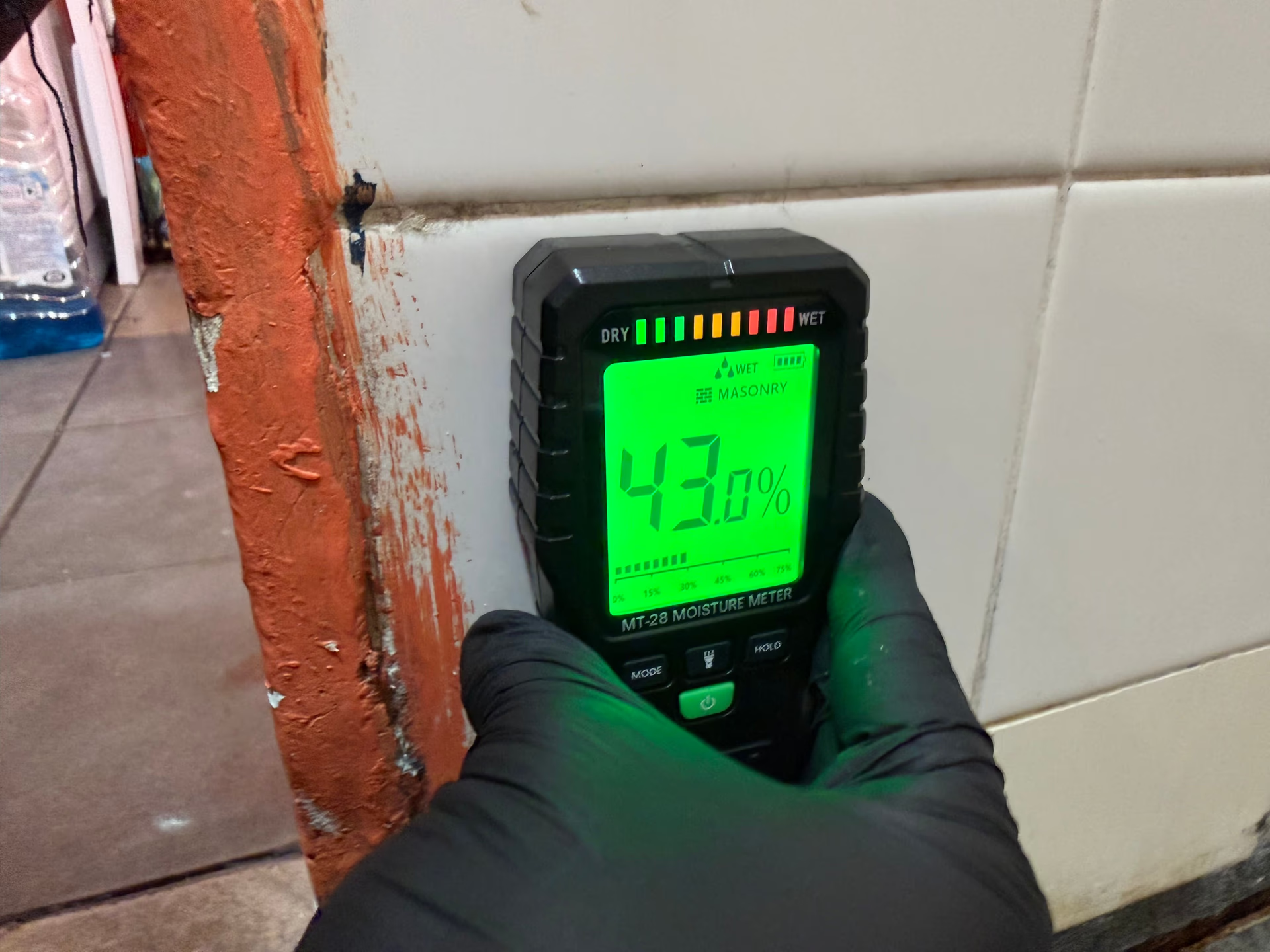
We measure the moisture content of walls, floors, and ceilings using both pin-based and non-invasive pinless meters—mapping the full extent of saturation without surface damage.
Best for:
— Drywall, wood framing, and subfloor assessment
— Mapping moisture spread after a water event
— Establishing baseline readings for monitoring
Our thermal cameras detect temperature differentials across surfaces. Water-loaded materials hold heat differently than dry materials, making leaks and saturated zones visible behind finished walls.
Best for:
— Finding active leaks behind drywall without cutting
— Locating plumbing or roof leaks not yet surface-visible
— Identifying condensation zones that feed mold
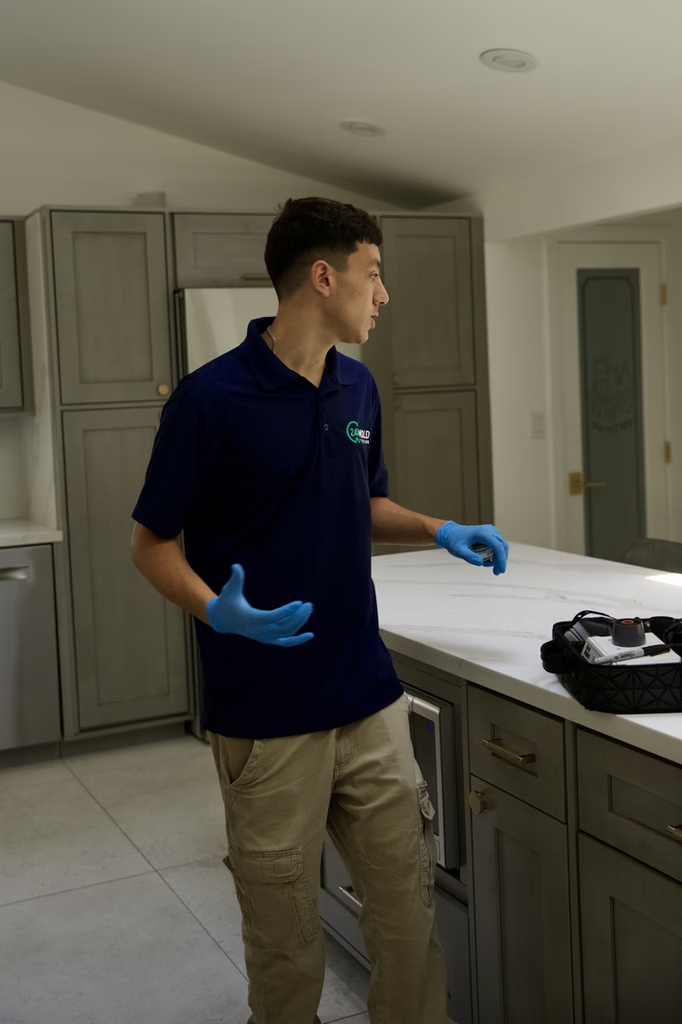
Every finding is documented with photos, moisture readings, and thermal images. You receive a clear report so contractors, insurers, or property managers can act immediately.
Report includes:
— Moisture readings mapped by room and surface
— Thermal images with annotated anomaly locations
— Probable source identification and next steps
Checklist
When Do You Need Moisture Detection?
Moisture detection is the right first step if:
- —You smell mold or dampness but can't find the source
- —You've had a plumbing leak, roof leak, or flood
- —You're buying a property and want to verify no hidden moisture
- —You had water damage and want to confirm the area is fully dry
- —Recurring mold keeps coming back after surface cleaning
Moisture detection is often the fastest and most cost-effective way to scope a mold problem before committing to testing or remediation.
Detection Services
Our Detection Methods
Two complementary tools that together give a complete picture of moisture conditions in any building.
Pin and pinless meters precisely measure moisture content in walls, floors, and ceilings—mapping the full extent of saturation without destructive investigation.
Mold inspection Norwalk FAQ
Call For An InspectionSame-day and next-day appointments are usually available across our Norwalk service area, with 24/7 emergency response for active leaks, recent water damage, or urgent real estate timelines. Standard scheduling runs 1 to 3 business days depending on availability.
Our certified mold inspectors assess bathrooms, kitchens, laundry rooms, basements, attics, crawl spaces, HVAC components, and any area showing signs of past or current water issues. Thermal imaging and moisture meters identify hidden moisture behind walls and under floors.
The San Gabriel River corridor along Norwalk's eastern boundary influences groundwater levels in the adjacent residential neighborhoods, particularly during and after significant rainfall when the river carries high volumes and recharges surrounding soils rapidly. Properties in the lower-elevation areas closest to the river experience the most direct groundwater pressure effect, but the flat basin topography means that elevated soil moisture from river-adjacent groundwater can extend for several blocks into the surrounding neighborhoods during wet conditions. Homes in these areas with slab foundations may experience slab moisture migration during high-groundwater periods, while properties with crawl spaces face the direct humidity consequences of elevated soil moisture beneath the floor system. Pre-purchase inspections for properties in the eastern portions of Norwalk should specifically assess moisture conditions at the foundation and subfloor level.
Pricing varies based on the size of the property, the scope of testing required, and whether any lab work is included. Most residential mold inspections in Norwalk fall within the standard industry range of $300 to $600, with a clear quote provided before any work begins.
Air sampling, swab testing, tape lift testing, wall cavity sampling, and HVAC mold testing. The inspector recommends the right method on-site based on what's found. Samples go to a state-certified lab, with results typically back in 24 to 72 hours.
Mold needs water to grow, so finding the moisture source is what prevents the same problem from coming back after any cleanup. Moisture detection during the inspection identifies plumbing leaks, roof leaks, condensation issues, and humidity buildup that's feeding any growth.
Yes. Post-remediation verification confirms the remediation contractor's work succeeded and the space is safe to reoccupy. Because we don't perform remediation ourselves, the verification stays independent of the remediation contractor's interests, which is what insurers and tenants look for.
Usually, if the home inspection turned up anything moisture-related. A general home inspector surveys the whole house visually, and when they find staining, white mineral deposits along a slab edge, or a musty smell, the report typically recommends evaluation by a specialist. A mold inspection is that evaluation: thermal imaging and moisture meters locate water inside walls and beneath flooring, and air or surface samples go to an accredited lab. In Norwalk the gap between the two matters because most of the city's houses are 1950s slab-on-grade tracts, and slab moisture stays invisible under carpet or laminate until the flooring comes up. Garage conversions and room additions, which many of the city's postwar houses have accumulated over the decades, are another blind spot a walkthrough rarely resolves. If your inspector flagged moisture, schedule the mold inspection inside your contingency period so the results can still affect price, repairs, or the decision to walk away.
Most of Norwalk was built in a single burst. A dairy town of about 8,400 people just after the war became one of the fastest-growing communities in the county, and by the time the city incorporated on August 26, 1957 much of its housing was already in place. That means a lot of houses of the same age with the same aging systems. The recurring mold sources we find are original or early-replacement supply lines leaking inside walls or under the slab, cast-iron drains cracking beneath bathrooms and kitchens, attic ductwork sweating through hot summers, and bathroom fans that were either never installed or vent into the attic instead of outdoors. Roofs have often been re-covered over older layers, which hides where water is getting in. Because the houses are so similar, a problem in your neighbor's home is a useful hint about yours — and a moisture survey of the slab perimeter, the plumbing walls, and the attic covers the places these houses usually fail.
Because the water is coming from beneath the house, not through the roof. Norwalk sits on flat, low basin ground with clay-bearing soils, and along the city's west side the San Gabriel River corridor keeps groundwater shallow. After a run of winter storms the clay stays saturated for weeks, and moisture moves upward through slabs poured in the 1950s without a vapor barrier. Under carpet, that shows up as a damp pad and a musty smell; under vinyl or laminate, as adhesive failure, lifting, or dark staining at the seams; along exterior walls, as growth on the bottom of the drywall and the wood sill plate. Downspouts that empty right next to the foundation and planters built against the stucco make it worse. Moisture readings taken across the slab and compared room to room tell you whether it's general vapor drive or a concentrated source like a leaking line under the floor — which changes the fix entirely.
They can, and Norwalk sits in an active area for them. The Puente Hills blind-thrust system runs beneath this part of the basin, and it produced the magnitude 5.9 earthquake of October 1, 1987, which damaged older masonry and wood-frame buildings across the region. Shaking of that kind, and the smaller quakes felt here regularly, opens hairline cracks in stucco and slabs, separates window and door flashing, and loosens plumbing joints inside walls and under floors. None of that is a mold problem on day one. It becomes one the next rainy season, when water gets behind the stucco and into the wall cavity, or when a joint stressed in the shaking starts to weep. After any quake strong enough to crack plaster or shift a door frame, it is worth checking the stucco, the slab perimeter, and the plumbing for new moisture pathways — especially in houses that are already more than 60 years old.
It starts with finding out why the attic is wet, because attic mold almost always has a specific cause. In Norwalk's single-story tract homes the common ones are roofs re-covered over old layers that leak at penetrations and valleys, bathroom and kitchen fans that terminate in the attic instead of outside, blocked eave vents that stop the space from breathing, and ductwork that sweats when the air conditioning runs through a hot summer attic. The inspector checks sheathing, rafters, and insulation with a moisture meter and thermal camera, studies the underside of the roof deck for staining and growth patterns, and takes surface or air samples where growth is suspected. Growth spread evenly across one slope usually points to ventilation; growth clustered around a single vent pipe points to a leak. The report tells you which, so the repair addresses the cause instead of just replacing the insulation.
It is one of the more frequent problems we find in the city. Many of Norwalk's postwar houses have a garage that was converted to living space at some point, and the state ADU laws that took effect from 2017 onward have made garage conversions even more common. A garage slab was poured to park a car, not to sit under a bedroom: it usually has no vapor barrier, it may slope toward the old door opening, and the new wall that replaced the garage door often sits on a sill plate directly on the concrete. Add a bathroom or kitchenette and moisture from both the ground and the occupants has nowhere to go. Growth shows up behind furniture on the old door wall, under flooring, and in the slab corners. Whether you are renting one out, living in one, or buying a house that has one, a moisture survey of the slab and the converted wall is the key part of the inspection.
Document the condition independently before anything else. California law applies in Norwalk as it does anywhere in the state: Health and Safety Code section 17920.3, as amended by SB 655, lists visible mold as a substandard housing condition, and the age of the building doesn't excuse it. Norwalk has a large rental stock, from duplexes and converted garages on tract lots to apartment complexes along its main corridors, and disputes usually come down to whether the mold is a building defect or a household habit. A third-party report answers that with moisture readings, photographs, lab results, and an identified source — a slab leak, a plumbing failure in the wall, a missing exhaust fan. Because we do no remediation, the report carries no incentive to inflate the problem. Attach it to a written repair request; if nothing changes, it is the evidence you would bring to the city's code enforcement office or to court.
No. We inspect and test only, and we keep it that way on purpose. A company that inspects and then removes is pricing the job it will be paid to do, so the scope tends to grow. Our part is to find the growth, trace the moisture feeding it, and document the extent with thermal imaging, moisture meters, and lab-analyzed samples. In Norwalk that separation pays off because the source is often under the house rather than behind the stain — a 1950s slab with no vapor barrier, a supply line leaking beneath the floor, or a garage conversion built straight on the concrete. Remediation that doesn't address those comes back. The written report gives you a defined area and cause that several remediation contractors can bid on the same terms, which usually means a smaller, better-targeted job. After the work is done, we can return for independent clearance testing.
Detection is the work of finding the water and the growth before anyone opens a wall. In a Norwalk house that means thermal imaging across walls, ceilings, and floors to flag cool, damp areas; moisture meter readings to confirm and map them; a close look at the slab perimeter, the plumbing walls, the attic, and any converted garage; and, where needed, a borescope into a wall cavity through a small opening. Testing comes after: air samples, swabs, or tape lifts sent to an accredited lab to identify what is growing and how much of it is in the air. Most Norwalk inspections combine the two, because a lab result without a moisture source tells you there is a problem but not where it lives. In the city's slab-built tracts, detection is often what separates ground moisture rising through the concrete from a leak in a line beneath it — two problems with very different repairs.
Yes, if water sat for more than a day or you can't confirm everything dried. The common causes in Norwalk are a supply line or water heater failure in a 60-year-old house, a slab leak that ran unnoticed under the flooring, a burst washing machine hose, and storm water pooling against the foundation on the city's flat lots. Slab houses are particularly unforgiving: water that soaks into carpet pad or under laminate wicks into the bottom of the drywall and the wood sill plate, and those dry far more slowly than the floor surface. Mold can start in 24 to 48 hours. An independent moisture assessment confirms whether the drying actually finished, documents any growth that started, and gives you a dated record for an insurance claim. Because we don't do restoration, that verification stays separate from the company that did the drying.
The inspector collects air through a spore trap in each room of concern and takes a matching outdoor sample during the same visit. The outdoor sample is the reference point: spores are always present outdoors, so what matters is whether the indoor count or mix of species is elevated compared with it. In Norwalk that baseline varies with location — a house a block from the 5 or the 605, or one near the Carmenita Road warehouses, reads differently from a quiet interior street — so results are never compared against a generic number. An accredited lab identifies the genera and their concentrations, usually within 24 to 72 hours. Air testing is the right place to start when someone in the household has symptoms or there's a musty odor with nothing visible, and the results are read together with the moisture survey, since a spore count confirms a problem and the moisture map shows where to look.
Our Norwalk team covers the whole city — the Norwalk Square tracts around Pioneer and Rosecrans, the older blocks near the original town site, the San Gabriel River edge on the west side, the Civic Center and Imperial Highway corridor, the Firestone Boulevard corridor, and the Carmenita Road corridor on the east side — with same-day and next-day appointments and 24/7 response for active leaks and flooding. Several nearby cities have their own 24H Mold Inspection page written for their own housing, including Downey, Bellflower, Cerritos, Whittier, Lakewood, and South Gate. If your property is in one of those, start with that city's page. If you aren't sure which team covers your address, call the number on this page and we'll route you to the right one.
Contact
Book your Norwalk mold inspection today
Tell us what's going on and we'll respond the same day
Location
24H Mold Inspection of Norwalk
Phone
(562) 729-0499Hours
- MondayOpen 24 hours
- TuesdayOpen 24 hours
- WednesdayOpen 24 hours
- ThursdayOpen 24 hours
- Friday6 AM – 6 PM
- SaturdayClosed
- SundayOpen 24 hours
Service area neighborhoods
- Norwalk
- Artesia (adjacent)
- Cerritos (adjacent)
- Santa Fe Springs (adjacent)
- Downey (adjacent)
- Bellflower (adjacent)