
Infrared cameras reveal temperature anomalies that indicate hidden leaks, condensation zones, and moisture paths behind finished surfaces.
our services
Leak & Moisture Detection
Hidden moisture is the root cause of most mold problems. We locate it precisely—without tearing into walls—so you can fix the source, not just the symptoms.
About
Why Moisture Detection Comes First
Mold needs moisture to grow, and moisture hides. We use non-destructive instruments to map water through walls, floors, and ceilings—and thermal cameras to see temperature anomalies that indicate active leaks or condensation—giving you a precise location before any repair work begins.
Moisture detection helps you:
- —Pinpoint the exact source of a leak before demolition
- —Map moisture spread behind walls and under flooring
- —Identify condensation-prone areas before mold appears
- —Confirm repairs were effective after water damage is addressed
Methodology
How We Detect Moisture
Non-destructive tools that locate water without cutting into your property.
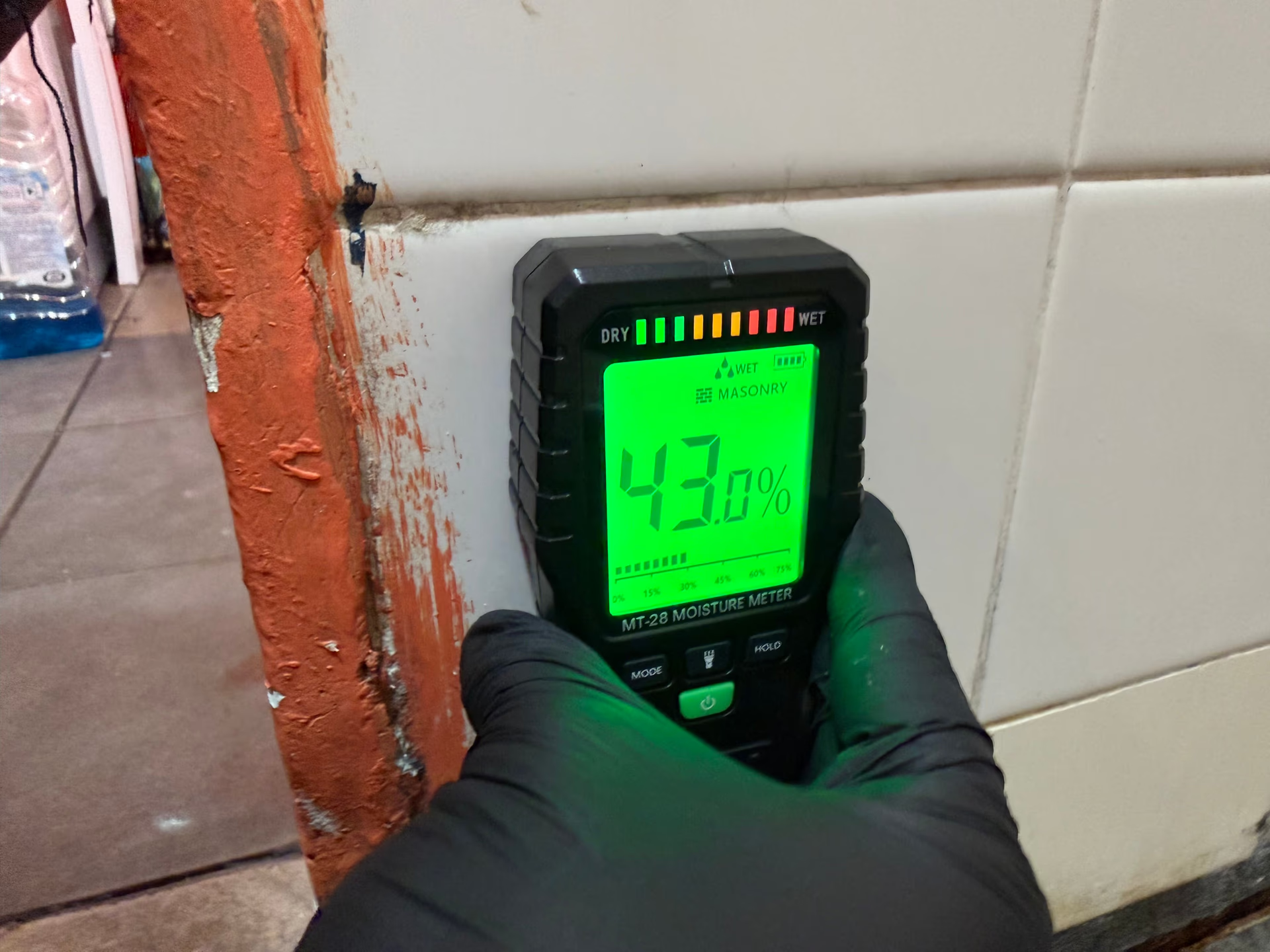
We measure the moisture content of walls, floors, and ceilings using both pin-based and non-invasive pinless meters—mapping the full extent of saturation without surface damage.
Best for:
— Drywall, wood framing, and subfloor assessment
— Mapping moisture spread after a water event
— Establishing baseline readings for monitoring
Our thermal cameras detect temperature differentials across surfaces. Water-loaded materials hold heat differently than dry materials, making leaks and saturated zones visible behind finished walls.
Best for:
— Finding active leaks behind drywall without cutting
— Locating plumbing or roof leaks not yet surface-visible
— Identifying condensation zones that feed mold
Every finding is documented with photos, moisture readings, and thermal images. You receive a clear report so contractors, insurers, or property managers can act immediately.
Report includes:
— Moisture readings mapped by room and surface
— Thermal images with annotated anomaly locations
— Probable source identification and next steps
Checklist
When Do You Need Moisture Detection?
Moisture detection is the right first step if:
- —You smell mold or dampness but can't find the source
- —You've had a plumbing leak, roof leak, or flood
- —You're buying a property and want to verify no hidden moisture
- —You had water damage and want to confirm the area is fully dry
- —Recurring mold keeps coming back after surface cleaning
Moisture detection is often the fastest and most cost-effective way to scope a mold problem before committing to testing or remediation.
Detection Services
Our Detection Methods
Two complementary tools that together give a complete picture of moisture conditions in any building.
Pin and pinless meters precisely measure moisture content in walls, floors, and ceilings—mapping the full extent of saturation without destructive investigation.
Mold inspection Bloomfield Hills FAQ
Call For An InspectionSame-day and next-day appointments are usually available across our Bloomfield Hills service area, with 24/7 emergency response for active leaks, recent water damage, or urgent real estate timelines. Standard scheduling runs 1 to 3 business days depending on availability.
Our certified mold inspectors assess bathrooms, kitchens, laundry rooms, basements, attics, crawl spaces, HVAC components, and any area showing signs of past or current water issues. Thermal imaging and moisture meters identify hidden moisture behind walls and under floors.
Yes — finished basements are the single most common site of significant mold discovery in Bloomfield Hills properties. Michigan's groundwater pressure, combined with the age of waterproofing systems in homes built before the 1990s, means that moisture seeps through foundation walls and floor slabs regularly. When these spaces are finished with drywall, carpet, and drop ceilings, the moisture is trapped between the exterior foundation and the interior finish materials — creating ideal mold conditions that can develop for years before any visible sign appears. We recommend any finished basement in a home over 20 years old be assessed for moisture intrusion and mold as part of routine property maintenance.
Pricing varies based on the size of the property, the scope of testing required, and whether any lab work is included. Most residential mold inspections in Bloomfield Hills fall within the standard industry range of $300 to $600, with a clear quote provided before any work begins.
Air sampling, swab testing, tape lift testing, wall cavity sampling, and HVAC mold testing. The inspector recommends the right method on-site based on what's found. Samples go to a state-certified lab, with results typically back in 24 to 72 hours.
Mold needs water to grow, so finding the moisture source is what prevents the same problem from coming back after any cleanup. Moisture detection during the inspection identifies plumbing leaks, roof leaks, condensation issues, and humidity buildup that's feeding any growth.
Yes. Post-remediation verification confirms the remediation contractor's work succeeded and the space is safe to reoccupy. Because we don't perform remediation ourselves, the verification stays independent of the remediation contractor's interests, which is what insurers and tenants look for.
West Bloomfield, Waterford, and Keego Harbor sit in the heart of Oakland County's lakes region, ringed by water — Cass, Sylvan, and dozens of smaller lakes — with many homes built right to the shoreline. Lakefront and near-lake properties face a permanently high water table, seawall and dock exposure, and older lake-cottage construction, so ground moisture presses into basements and crawl spaces far more than on dry inland lots. That constant hydrostatic pressure can push water through foundation walls and slabs without any plumbing failure, and finished lower levels trap it against organic materials. Lakeside homes benefit from an inspection focused on the below-grade walls, crawl spaces, and the water-facing side of the foundation.
Bloomfield Hills is anchored by Cranbrook, a 319-acre National Historic Landmark campus of 1920s Saarinen and Kahn architecture with schools, an art museum, a science institute, and 40 acres of gardens. These grand historic buildings — and the Booth-era estates around them — carry nearly a century of original stone, masonry, and roof systems where moisture moves slowly and hides behind historic finishes. A slow roof or masonry leak can wet framing and plaster for a long time before it shows, and preservation constraints can make envelope upgrades slower to carry out. An inspection of a historic estate focuses on the masonry, roof-and-drainage details, and any below-grade or finished space.
Cranbrook helped make Bloomfield Hills a cradle of American modernism, and the area holds a notable stock of architect-designed mid-century modern homes. Their signature features — flat and low-slope roofs, walls of single-pane glass, and post-and-beam construction — are exactly the elements that challenge water management, so ponding roofs and condensation at the glass are recurring issues here. Flat roofs pond and leak at seams and drains, and large single-pane windows sweat heavily in Michigan winters, feeding mold at sills and wall tops. An inspection of a mid-century modern home focuses on the roof and its drainage, the glazing and window assemblies, and the framing below.
Neighboring Pontiac is a sharp contrast — an older industrial city built around former auto manufacturing, with dense pre-war working-class housing along the Clinton River. There, aging basements, original plumbing, and decades of deferred maintenance make foundation and basement moisture the routine finding, a very different profile from the estates just to the south. Homes near the Clinton River also carry added groundwater and flood exposure. For these properties, an inspection focuses on the basement and foundation, the original plumbing, and any river-proximity water history — the moisture sources most common in older, harder-worked housing.
Beyond the marquee estates, Bloomfield Township holds post-war ranches, split-levels, and newer subdivisions on rolling, wooded lots, along with the Oakland Hills Country Club corridor. This mix of construction eras means moisture risk ranges widely — aging basements and original systems in the older homes, and sealed-envelope and roofing issues in the newer builds where tight construction traps indoor humidity. Wooded lots also slow drying after rain and snowmelt. The right inspection depends on the home's age: older homes call for a basement-and-plumbing focus, newer ones for envelope, ventilation, and roof-drainage checks.
They can. Bloomfield Hills is known for its mature tree canopy and heavily wooded lots, and that shade slows drying after rainfall and snowmelt, keeping exterior surfaces and soil moisture elevated for extended periods around the home. Persistent ground moisture presses on foundation walls and works into crawl spaces and basements, and leaf debris in gutters and against foundations holds water where it can intrude. The estate scale — complex rooflines, dormers, and multi-level construction — adds more surface area for water to find its way in. An inspection accounts for the wooded setting by focusing on drainage around the foundation, gutter and roof performance, and below-grade moisture.
The scale and age of Bloomfield Hills homes make a pre-purchase inspection here more involved than a standard walkthrough. Because most estates were custom-built between the 1940s and 1980s with large finished basements, the priorities are the below-grade space for seepage behind drywall, carpet, and drop ceilings; the complex roofline, dormers, and multi-level transitions where water intrudes; and any historic masonry or mid-century flat roof and glazing. On lakefront lots, the water-facing foundation; in wooded settings, foundation drainage. Because these homes are large and often remodeled, moisture problems can affect significant square footage before they're detected, and older water damage may have been covered over. An independent inspection — with no stake in remediation — gives a clear picture before closing.
Inspection and testing only — we do not perform removal or remediation, and the separation is the point. The company telling you how much mold you have should not be the company billing you to take it out. What you get is the diagnosis: how far the growth extends, the moisture source keeping it alive, lab confirmation of what is present, and a written report you can give to several remediation contractors so they bid identical scope rather than their own estimates. On estate properties that independence is worth real money. A large finished basement, complex rooflines, and multi-level construction give a walkthrough quote enormous latitude to assume the worst about what sits behind finished surfaces, and remediation priced that way on a house this size gets expensive quickly. A documented scope, with the moisture source identified and the affected area mapped, is what keeps the job defined rather than open-ended.
The visit begins with history — when the house was built, what has been added or renovated, and what you have observed — then moves into a systematic survey: visual inspection, thermal imaging to locate temperature differences that indicate wet material behind finishes, and pin and pinless moisture meters to confirm it. On these properties the finished basement is the priority, because it is where moisture is most often found and where it does the most damage before anyone notices: framing and insulation installed against a foundation wall under groundwater pressure can hold moisture for years behind finished surfaces with nothing visible in the room. Above grade, the complexity of the envelope drives the rest of the work — dormers, roof valleys, multiple rooflines, and the transitions between them are where water intrusion begins on a large custom home. Expect three to five hours depending on size, and longer where several HVAC zones need separate attention.
Michigan does not license mold inspectors or remediation companies. There is no state credential to look up, and anyone can call themselves a mold professional here, which makes the question worth asking before you let someone into the house. What you can verify still covers most of the ground. Confirm recognized third-party industry certification and current liability insurance. Confirm samples go to an accredited independent laboratory rather than being read on site by the person selling you something. Confirm the company does not also perform remediation, since an inspector who profits from the cleanup has a direct reason to find more of it. And confirm the deliverable is a written report with photographs, instrument readings, and marked sample locations — ask to see a redacted sample report first. Michigan does license contractors, so while the mold credential cannot be checked, the residential builder or maintenance and alteration licence of whoever performs the repair can be.
Yes — the offices and retail along the Woodward corridor, professional and medical suites, institutional and school properties, clubhouses, and the common areas of condominium and homeowner associations across Bloomfield Hills and Bloomfield Township. Commercial inspection differs from residential in where moisture hides rather than in method: low-slope roofs pond and leak above ceiling systems, rooftop and packaged HVAC units generate condensation along extended duct runs, and damage develops above occupied space or in mechanical areas that get attention only at service intervals. Association work brings the below-grade question forward, since common-area drainage, grading, and foundation waterproofing are typically the association's responsibility while everything inboard of the unit belongs to the owner — and in this climate, with groundwater pressure and freeze-thaw cycling working on those assemblies every year, documenting the water's actual path is usually what determines which budget the repair comes from.
Give every contractor the same report and ask them to bid the documented scope, so quotes differ on price and method rather than on how much mold each company claims to find. Verify state licensing — Michigan licenses residential builders and maintenance and alteration contractors, even though it does not license mold work as such — along with liability insurance and workers compensation. On an estate property, add two questions. Ask how containment will be built and how the affected HVAC zone will be isolated, because a house running several independent systems can distribute spores from an uncontained work area into wings that were never affected. And ask how the contractor approaches high-end finish work, since remediation in a finished basement or a custom interior means the restoration is frequently the larger share of the cost. Above all, confirm the moisture source repair is in the scope — on these properties that often means exterior drainage or waterproofing, not only removal.
It is the independent check performed after the cleanup and before containment comes down and finishes are restored: confirmation that the affected material was genuinely removed, meter verification that framing, subfloor, and foundation surfaces dried to a normal moisture content, and clearance air sampling compared against an outdoor control taken the same day. It should never be performed by the company that did the removal — a contractor verifying their own work is grading their own exam. In Bloomfield Hills it is the step that protects the most expensive part of the project. Refinishing a large basement or a custom interior costs far more than the remediation itself, and closing up a wall that had not fully dried means taking that finish work apart again to reach the framing. Below-grade masonry releases moisture slowly, so a surface that reads dry can still be wet behind new studs. Verification before the finishes go back is cheap insurance at exactly the right moment.
Contact
Book your Bloomfield Hills mold inspection today
Tell us what's going on and we'll respond the same day
Location
24H Mold Inspection of Bloomfield Hills
Phone
(248) 677-2677Hours
- MondayOpen 24 hours
- TuesdayOpen 24 hours
- WednesdayOpen 24 hours
- ThursdayOpen 24 hours
- Friday6 AM – 6 PM
- SaturdayClosed
- SundayOpen 24 hours
Service area neighborhoods
- Bloomfield Hills
- Bloomfield Township
- Pontiac (adjacent)
- Waterford Township (adjacent)
- West Bloomfield
- Keego Harbor