
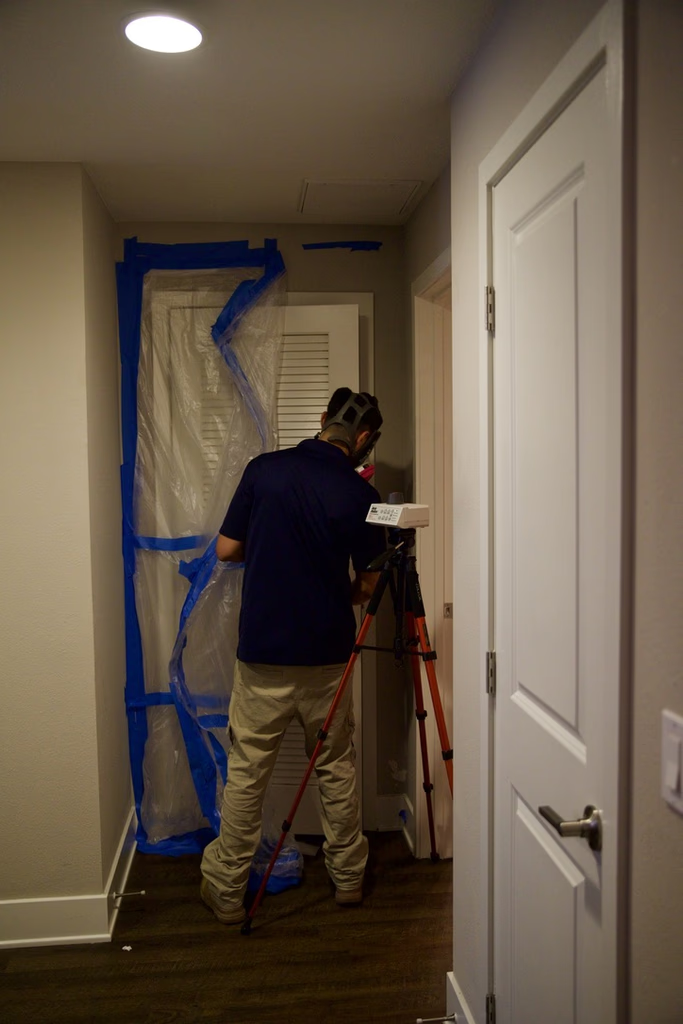
Collects airborne mold spores to assess air quality and detect hidden contamination.
our services
Mold Testing
State-certified testing that spots hidden mold—so you can act early, stay safe, and avoid costly repairs.
About
Why Mold Testing Matters
Mold isn't always visible. It hides in air vents, under floors, and inside walls. The only way to know what you're breathing—or what's spreading—is through lab-grade testing.
- —Identify mold species and spore levels
- —Detect hidden growth in "clean" areas
- —Assess the health risk to occupants
- —Decide on the right next steps
Methodology
How our mold testing works
The three sampling methods we use, chosen for what your property is showing
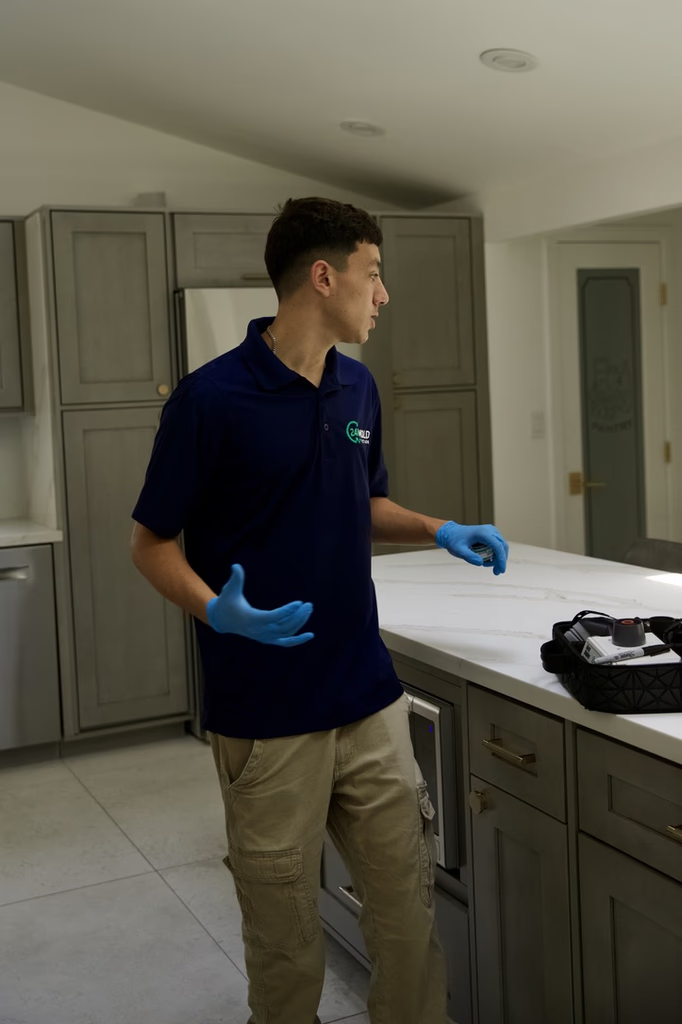
Sterile swabs and clear adhesive tape collect mold from visible spots on dry surfaces, giving the lab a clean sample for species identification. Suitable for walls, ceilings, baseboards, and furniture where the residue is what you're checking.
For damp or recently water-damaged areas, the sampling approach changes. Wet sampling captures live, actively growing colonies that dry methods underrepresent, which matters under flooring, behind tile, and around recent leaks.
A calibrated pump pulls a controlled volume of air through a spore trap cassette, capturing viable and non-viable spores from the breathing zone. The lab counts species and compares concentrations to outdoor levels, telling you whether your indoor air is healthy.
Checklist
Is Testing Right for You?
Mold testing is ideal if:
- —You suspect mold but can't see it
- —You've had water damage
- —Residents or tenants are reporting health symptoms
- —You're buying, selling, or managing a property
- —You need peace of mind after remediation
Still unsure? Let's talk. We'll help you decide which method suits your case best.
Testing Overview
Our Testing Methods
Techniques we use to collect accurate mold samples from air and surfaces.
Lifts mold samples from surfaces using clear adhesive—quick and non-destructive.
Gathers samples from damp or textured areas to identify active mold growth.
Mold inspection Sun Valley FAQ
Call For An InspectionSame-day and next-day appointments are usually available across our Sun Valley service area, with 24/7 emergency response for active leaks, recent water damage, or urgent real estate timelines. Standard scheduling runs 1 to 3 business days depending on availability.
Our certified mold inspectors assess bathrooms, kitchens, laundry rooms, basements, attics, crawl spaces, HVAC components, and any area showing signs of past or current water issues. Thermal imaging and moisture meters identify hidden moisture behind walls and under floors.
Most mold problems in Sun Valley originate from indoor moisture sources rather than outdoor humidity. Plumbing leaks, HVAC condensation, roof failures, poor bathroom ventilation, and aging building materials are far more common contributors than ambient weather conditions. Even in dry climates, mold can develop quickly when hidden moisture remains trapped within walls, ceilings, or flooring systems.
Pricing varies based on the size of the property, the scope of testing required, and whether any lab work is included. Most residential mold inspections in Sun Valley fall within the standard industry range of $300 to $600, with a clear quote provided before any work begins.
Air sampling, swab testing, tape lift testing, wall cavity sampling, and HVAC mold testing. The inspector recommends the right method on-site based on what's found. Samples go to a state-certified lab, with results typically back in 24 to 72 hours.
Mold needs water to grow, so finding the moisture source is what prevents the same problem from coming back after any cleanup. Moisture detection during the inspection identifies plumbing leaks, roof leaks, condensation issues, and humidity buildup that's feeding any growth.
Yes. Post-remediation verification confirms the remediation contractor's work succeeded and the space is safe to reoccupy. Because we don't perform remediation ourselves, the verification stays independent of the remediation contractor's interests, which is what insurers and tenants look for.
Probably yes, and here's why the two rarely overlap. A home inspection is a broad condition survey — roof, structure, electrical, plumbing — carried out visually by a generalist. When the report ends with 'evidence of past moisture, recommend evaluation by a specialist,' that specialist is us. A mold inspection is narrow and instrumented: thermal imaging and moisture meters map where water is present inside the structure, and air or surface samples go to an accredited lab. For Sun Valley's apartment and multifamily owners the distinction matters practically — a mold report documents a specific habitability condition with lab backing, which is what a tenant dispute, an insurer, or a housing authority inspection actually requires.
By looking where the water goes rather than where the stain is. In housing built between the 1940s and 1970s, which is most of Sun Valley's residential stock, the recurring locations are the wall cavities around original galvanized or early copper supply lines, the subfloor and framing beneath bathrooms and laundry areas, the attic below aging roofing and around vent penetrations, and the ductwork and the wall surfaces behind it where cooled air meets hot construction. None of those are visible from the room. Thermal imaging identifies the temperature signature that wet material leaves behind a finished wall, moisture meters confirm whether it's actually damp or just cool, and a wall-cavity sample settles it without demolition. That sequence is what separates finding the problem from finding the symptom.
An air test draws a measured volume of air through a spore trap in each area of concern, alongside a sample collected outdoors at the same visit. The outdoor sample is the part that gives the result meaning — spores exist in all outdoor air, so what matters is whether the indoor count is elevated against the local background, not the raw number. That comparison is especially worth doing carefully in Sun Valley, where the industrial corridors and heavy road traffic make the outdoor baseline different from a quiet residential street elsewhere in the Valley. An accredited lab identifies the genera present and their concentrations. Air testing is the right choice when someone has symptoms or you smell something musty but there's nothing to see, and it's read alongside the moisture findings rather than on its own.
Inspection and testing only — removal is a remediation contractor's work, and we deliberately stay out of it. For the owners and managers of Sun Valley's apartment buildings and rental houses, that independence is the practical value: a report from a company with no cleanup to sell documents the condition of a unit in a way that stands up with a tenant, an insurer, or a court, and it defines a scope that several contractors can bid on the same terms. It also means we can come back after the work is finished and verify it independently, which a contractor signing off on their own job cannot credibly do. Where the report says the fix is a repaired leak and a limited cleaning, that's what it says.
Yes, and Sun Valley has a better reason than most neighborhoods to take it seriously. Roughly 2,700 acres here were built out with no storm drain system at all, which is why the county wrote a watershed plan for the area and eventually put infiltration systems under Sun Valley Park and at the Strathern Pit — before that, runoff simply ran down the streets and stood in the low blocks around Sheldon and Strathern. Mold can start within 24 to 48 hours of that kind of wetting, and the water that matters is not the puddle you mopped up but what wicked into the bottom of drywall, under flooring, and into a converted garage. Moisture testing after a flood uses meters and thermal imaging to confirm whether the structure actually dried rather than just the surface, and it creates a dated written record for an insurance claim. Because we do not perform drying or remediation, that verification stays independent of whoever did the cleanup.
They do, and the difference is the wall itself. The Stonehurst homes went up in the 1920s and 1930s built from arroyo boulders hauled out of the Tujunga Wash, laid in mortar directly at grade with nothing beneath them that a modern builder would call a moisture barrier. Stone and mortar are porous, so these walls wick ground moisture upward and hold rain in the joints long after the face looks dry — which the original construction handled by staying breathable. The most common mistake we see in the neighborhood is a well-meant repair: sealing or painting a damp masonry wall, which traps that moisture inside the assembly and pushes it into the framing, plaster, and flooring that meet it. Because Stonehurst sits in a Historic Preservation Overlay Zone, owners also have limits on what they can change outright, so knowing precisely where water is entering matters more than it would on a stucco tract house.
It is worth doing, because attic restoration and mold inspection answer different questions and the same company usually should not answer both. An attic restoration quote is a price for work: pulling insulation, sanitizing, re-insulating, sometimes rodent proofing. An inspection determines whether that work is warranted and, more importantly, what is wetting the attic in the first place. In Sun Valley's 1940s to 1960s housing the answer is usually a roof that has been layered rather than replaced, an unsealed vent or swamp-cooler penetration left over from an older system, a bath fan discharging into the attic instead of through the roof, or ducts sweating in a space that runs extremely hot in a northeast Valley summer. Replace the insulation without fixing that and the new material wets again. We inspect and test only, so the scope our report defines is a diagnosis rather than an estimate for work we would then perform.
It looks fairly different from a house call. The industrial corridor along Tuxford and Sheldon — the gravel pits, recycling yards, and material-recovery facilities around the former Sheldon-Arleta and Bradley landfill sites — is mostly big-span, flat-roofed buildings on slab, and that changes where water shows up. We look at roof drainage first, because these roofs pond and their drains clog with the dust these operations generate, and a leak spreads sideways above a ceiling rather than dripping in one obvious spot. Then the slab and its perimeter, cold steel decking and framing where large temperature swings condense moisture, and the wash bays, break rooms, and restrooms that put water into an envelope never designed for it. Outdoor air sampling matters more here too, since the baseline on these blocks is genuinely different from a residential street, and a raw indoor number means nothing without it.
Our team works well past the Sun Valley boundaries. Shadow Hills sits immediately north, Sunland-Tujunga and La Tuna Canyon northeast, Burbank directly east, North Hollywood south, and Arleta, Pacoima, and Panorama City west — all of them minutes from a Sun Valley dispatch, which is what makes same-day appointments realistic across the northeast Valley. Several of those communities have their own 24H Mold Inspection page written for that area's housing stock, so if your property is in one of them, start there. Inside Sun Valley we cover the whole district: Sun Valley Flats, Stonehurst, Glencrest Hills, the Sheldon-Arleta area, the Tuxford and Sheldon industrial corridor, and the foothill parcels running up toward La Tuna Canyon. Emergencies — an active leak, a failed supply line, water standing in a converted garage after a storm — are handled 24/7. If you are not sure which team covers your address, call the number on this page.
Start by documenting it independently. Sun Valley has a large share of renters living in apartment buildings and rental houses that mostly predate October 1978, which puts much of that stock under the City of Los Angeles rent stabilization ordinance and under the Housing Department's Systematic Code Enforcement Program. California law is on your side on the substance: Health and Safety Code section 17920.3, as amended by SB 655, treats visible mold as a substandard condition, and a building's age is not a defense. What a written third-party report adds is evidence — moisture mapping showing where the water is actually coming from, which in older duplexes and small apartment buildings here is often a neighboring unit's plumbing rather than yours, plus lab results identifying what is present. That supports a housing complaint and any later dispute over repairs, rent, or a deposit. Tenants can arrange an inspection of their own unit directly; you do not need the owner to take part.
Detection is finding the water and the growth; testing is identifying what the growth is. Detection is the instrument work — thermal imaging to flag wet material behind finished surfaces, moisture meters to confirm it is genuinely wet and map how far it extends, a borescope into a wall cavity when there is reason to open one. Testing is the lab piece: spore-trap air samples, swabs, or tape lifts analyzed for what is growing and at what concentration. Most Sun Valley homes need both, in that order, because testing without detection produces numbers with no cause. The local wrinkle is the ground: much of the neighborhood sits on the coarse sand and gravel of the Tujunga alluvial fan, which drains quickly, so a house that stayed wet after a storm usually has a specific reason — a slab-on-grade floor that took standing water, a flat-graded lot draining back toward the foundation, or a leak that has nothing to do with the weather.
Contact
Book your Sun Valley mold inspection today
Tell us what's going on and we'll respond the same day
Location
24H Mold Inspection of Sun Valley
Phone
(818) 813-8308Hours
- MondayOpen 24 hours
- TuesdayOpen 24 hours
- WednesdayOpen 24 hours
- ThursdayOpen 24 hours
- Friday6 AM – 6 PM
- SaturdayClosed
- SundayOpen 24 hours
Service area neighborhoods
- Glencrest Hills
- Stonehurst
- La Tuna Canyon corridor
- Sun Valley Flats
- Sheldon Arleta area
- Shadow Hills adjacent area
- North Hollywood border area
- Roscoe Boulevard corridor