24H Mold Inspection
South Gate24/7 EMERGENCY(213) 971-1274
HomeOur ServicesMold Testing
our services

Mold Testing

State-certified testing that spots hidden mold—so you can act early, stay safe, and avoid costly repairs.

About

Why Mold Testing Matters

Mold isn't always visible. It hides in air vents, under floors, and inside walls. The only way to know what you're breathing—or what's spreading—is through lab-grade testing.

  • Identify mold species and spore levels
  • Detect hidden growth in "clean" areas
  • Assess the health risk to occupants
  • Decide on the right next steps
Why Mold Testing Matters

Methodology

How our mold testing works

The three sampling methods we use, chosen for what your property is showing
Sterile swabs and clear adhesive tape collect mold from visible spots on dry surfaces, giving the lab a clean sample for species identification. Suitable for walls, ceilings, baseboards, and furniture where the residue is what you're checking.

For damp or recently water-damaged areas, the sampling approach changes. Wet sampling captures live, actively growing colonies that dry methods underrepresent, which matters under flooring, behind tile, and around recent leaks.

A calibrated pump pulls a controlled volume of air through a spore trap cassette, capturing viable and non-viable spores from the breathing zone. The lab counts species and compares concentrations to outdoor levels, telling you whether your indoor air is healthy.

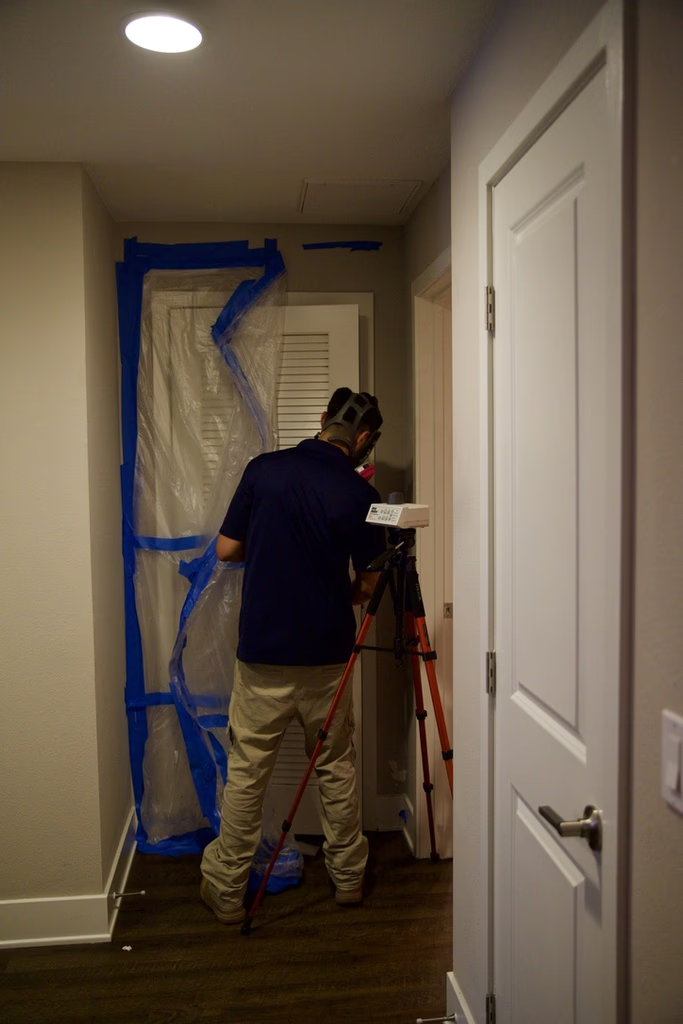
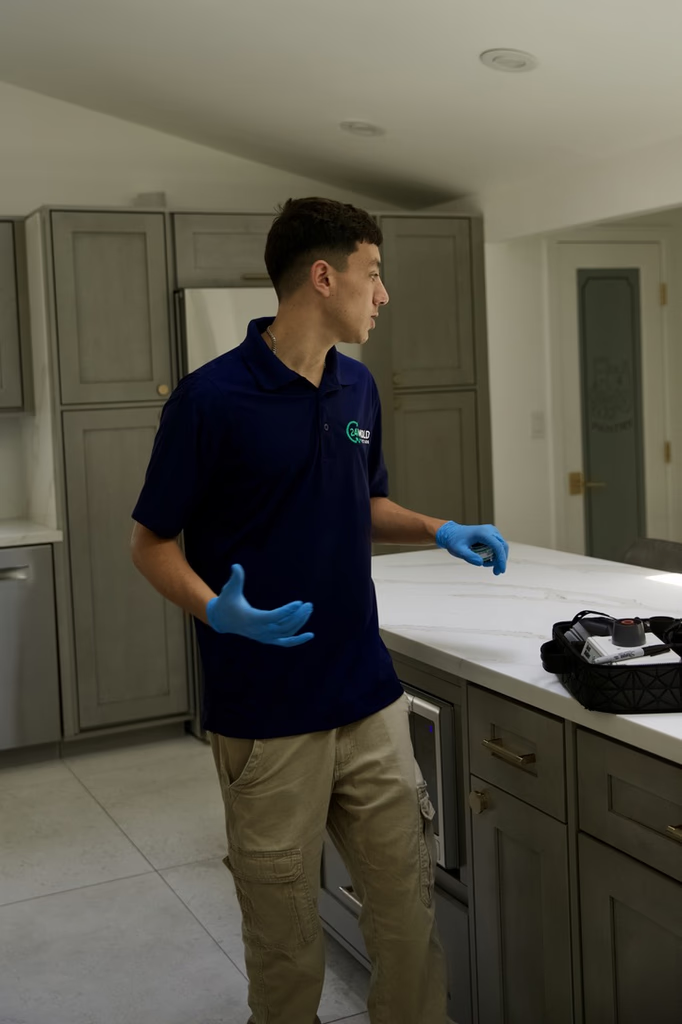
Mold inspector at work

Checklist

Is Testing Right for You?

Mold testing is ideal if:

  • You suspect mold but can't see it
  • You've had water damage
  • Residents or tenants are reporting health symptoms
  • You're buying, selling, or managing a property
  • You need peace of mind after remediation

Still unsure? Let's talk. We'll help you decide which method suits your case best.

Testing Overview

Our Testing Methods

Techniques we use to collect accurate mold samples from air and surfaces.

1Air Testing

Collects airborne mold spores to assess air quality and detect hidden contamination.

2Tape Testing

Lifts mold samples from surfaces using clear adhesive—quick and non-destructive.

3Swab Testing

Gathers samples from damp or textured areas to identify active mold growth.

Mold inspection South Gate FAQ

Call For An Inspection
No. We inspect, test, and document; we do not perform removal or remediation, and we take no referral fee from the contractors who do. In South Gate that separation does real work, because so much of the housing stock is small prewar single-family homes that have picked up rear units, converted garages, and additions over the decades. Those additions are usually where the damage is, and their boundaries are exactly where a scope of work turns vague — a contractor pricing his own diagnosis has every reason to include the entire rear structure. What we produce instead is the measurement: the moisture source, how far the wet material extends behind the finish, the containment the work requires, and lab confirmation of what the samples contain. Take that report to two or three licensed remediation contractors and have them bid the same defined scope rather than each writing their own. When the work is finished we return for independent verification, which is the part insurers and property owners actually want on paper.
We cover the whole city — Hollydale, the Tweedy Mile corridor, the Firestone Boulevard district, the Southern Avenue and Gardendale blocks, the California and Independence Avenue corridors, and the streets around South Gate Park. Nearly all of it sits inside a single ZIP code, 90280, one of the most densely populated in California, so a ZIP-based search narrows almost nothing here. One boundary causes constant confusion: Firestone Park is a Los Angeles neighborhood on the far side of Alameda Street, and South Gate's Firestone Boulevard district is a different place entirely — people searching for mold detection in Firestone Park are frequently standing in South Gate, and the reverse happens just as often. Neighboring cities have their own 24H Mold Inspection pages, including Huntington Park, Lynwood, Downey, Compton, Bellflower, and Los Angeles. Scheduling here is usually same-day or next-day, with 24/7 response for active leaks, sewer backups, and storm intrusion.
Detection is two separate jobs. The first is finding the water: thermal imaging across walls and ceilings, pin and pinless moisture meters in framing and subfloor, and humidity and dew point readings taken room by room rather than one number at the thermostat. The second is identifying what is growing, through air, swab, tape lift, or wall-cavity samples analyzed by a state-certified lab. In South Gate the first job usually decides the outcome, because the housing is overwhelmingly one-story prewar and postwar stucco carrying additions built across several permit eras. The wet material tends to sit at a junction — where a rear unit was attached to the original house, where a garage slab meets the older foundation, where a re-roof crossed over an addition. Those seams are invisible from either side of the wall. If you are calling about a smell rather than a stain, say so when you book; odor with no visible mark almost always means the source is inside a cavity, and it changes where the inspector starts.
It does, and Hollydale carries most of it. The flood of March 1938 killed more than a hundred people across the county and is the reason the river beside this city runs in a concrete channel today — the Army Corps rebuilt it as a flood-control works rather than a river. That protection is real but not absolute: the levees along this reach were later found short of modern certification standards, the Corps answered by raising parapet walls, and parcels in the southern part of the city spent years being mapped in and out of the 100-year floodplain while the certifications were argued. The history matters at the parcel level. If a lender or insurer has ever placed you in a flood zone, your crawl space has very likely taken standing water at some point, and water under a raised floor leaves only by evaporating upward into the subfloor. Have the sub-area opened and metered after any major storm, not only after visible flooding.
Color does not identify a species. A great deal of ordinary indoor growth is dark, and Stachybotrys chartarum — the organism people mean by black mold — is confirmed only by a lab examining a swab, tape lift, or air sample under magnification. What is worth knowing is what it takes to grow: Stachybotrys needs cellulose that has stayed wet for days or weeks, not a bathroom that gets steamy. In South Gate that condition turns up in a few predictable places — a cast-iron drain lateral cracked under a prewar slab, a water heater standing on the floor of a converted garage with no pan or drain, a rear unit whose roof ties into the main house at a valley nobody flashed properly. Photograph the growth, leave it undisturbed, and do not spray or wipe it before sampling. Once a surface has been cleaned or painted over, the lab loses the ability to tell you what was there or how long it had been growing.
Yes, and the tenancy is what makes doing it properly worthwhile. A tenant can commission an independent inspection of the unit they occupy without the owner's permission; you are paying for a measurement of your own living space. South Gate has an unusually high share of housing in rear structures and converted garages, some permitted and some not, and the moisture problems in them are structural rather than behavioral: a garage slab poured with no vapor barrier beneath it, walls framed and drywalled directly against uninsulated masonry, and no exhaust ventilation added when the space became habitable. Whether the unit was permitted does not change habitability rights — California Health and Safety Code section 17920.3 lists visible mold growth as a substandard condition either way. Get a dated report with photographs and lab results before you raise it with the owner, and keep the inspection independent of any contractor who would profit from the repair; that independence is what makes the document difficult to dispute.
No, though the two come from the same cause. A wood-destroying organism report flags decay fungi — dry rot, in the usual shorthand — which consume the wood itself and get listed as Section 1 items because the damage is structural. Mold grows on the surface of damp material and does not eat framing. What they share is a requirement for sustained moisture, so a termite inspector writing up fungus damage in a sub-area has told you indirectly that something under the house has been wet long enough to matter. That is a common finding in South Gate, where most prewar housing sits on raised foundations over shallow crawl spaces in an area with a high water table and limited sub-area ventilation. If your report lists fungus at girders, posts, or joist ends, treat it as a moisture finding and have the sub-area inspected before you accept a repair bid — replacing rotted wood is worth nothing while the water source is still running.

Contact

Book your South Gate mold inspection today

Tell us what's going on and we'll respond the same day

Location

24H Mold Inspection of South Gate

Service area neighborhoods

  • Hollydale
  • Tweedy Mile corridor
  • Firestone Boulevard district
  • Southern Avenue area
  • Gardendale
  • Independence Avenue corridor
  • California Avenue district
  • South Gate Park vicinity
Call For Service(213) 971-1274