
Infrared cameras reveal temperature anomalies that indicate hidden leaks, condensation zones, and moisture paths behind finished surfaces.
our services
Leak & Moisture Detection
Hidden moisture is the root cause of most mold problems. We locate it precisely—without tearing into walls—so you can fix the source, not just the symptoms.
About
Why Moisture Detection Comes First
Mold needs moisture to grow, and moisture hides. We use non-destructive instruments to map water through walls, floors, and ceilings—and thermal cameras to see temperature anomalies that indicate active leaks or condensation—giving you a precise location before any repair work begins.
Moisture detection helps you:
- —Pinpoint the exact source of a leak before demolition
- —Map moisture spread behind walls and under flooring
- —Identify condensation-prone areas before mold appears
- —Confirm repairs were effective after water damage is addressed
Methodology
How We Detect Moisture
Non-destructive tools that locate water without cutting into your property.
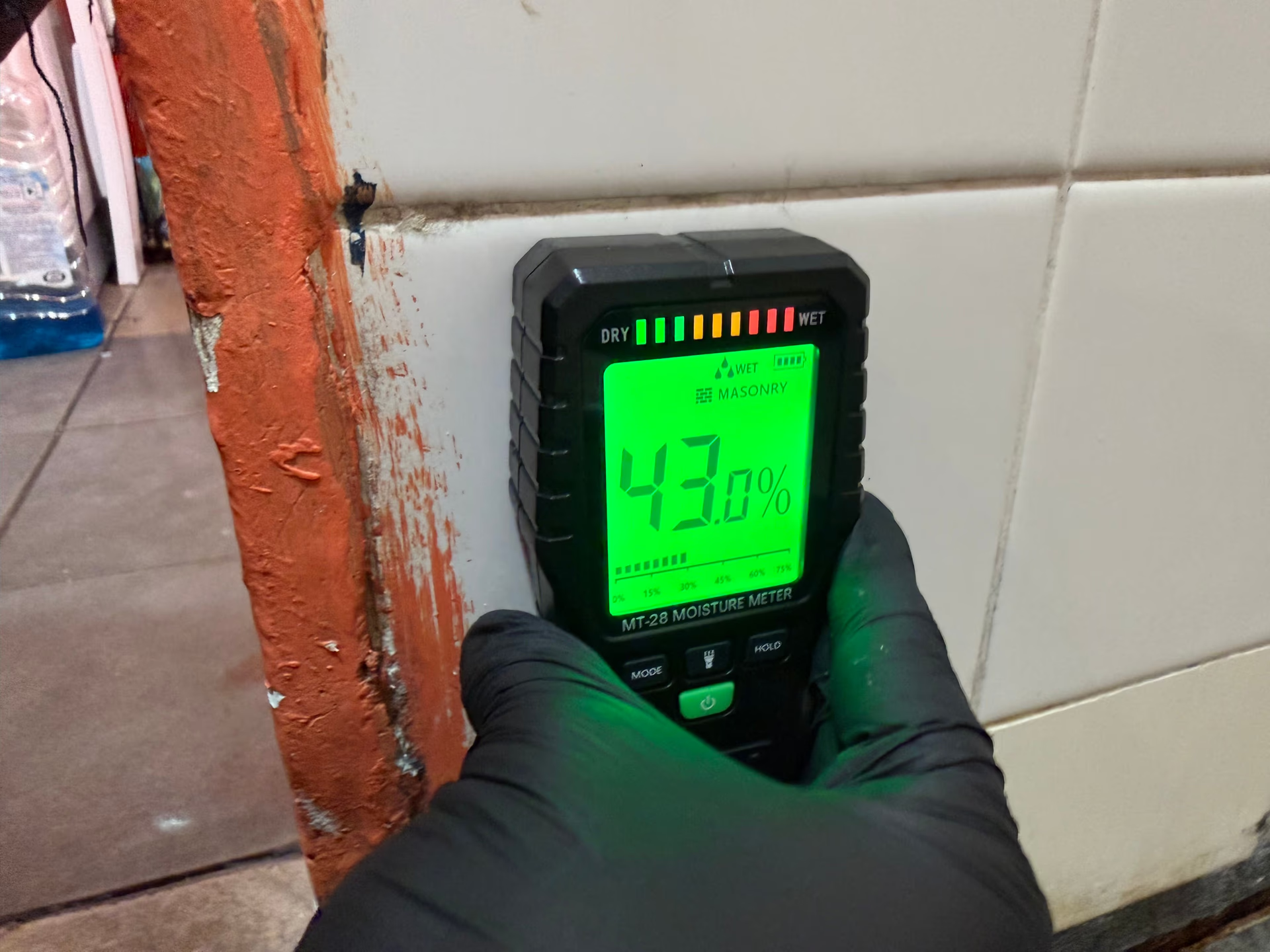
We measure the moisture content of walls, floors, and ceilings using both pin-based and non-invasive pinless meters—mapping the full extent of saturation without surface damage.
Best for:
— Drywall, wood framing, and subfloor assessment
— Mapping moisture spread after a water event
— Establishing baseline readings for monitoring
Our thermal cameras detect temperature differentials across surfaces. Water-loaded materials hold heat differently than dry materials, making leaks and saturated zones visible behind finished walls.
Best for:
— Finding active leaks behind drywall without cutting
— Locating plumbing or roof leaks not yet surface-visible
— Identifying condensation zones that feed mold
Every finding is documented with photos, moisture readings, and thermal images. You receive a clear report so contractors, insurers, or property managers can act immediately.
Report includes:
— Moisture readings mapped by room and surface
— Thermal images with annotated anomaly locations
— Probable source identification and next steps
Checklist
When Do You Need Moisture Detection?
Moisture detection is the right first step if:
- —You smell mold or dampness but can't find the source
- —You've had a plumbing leak, roof leak, or flood
- —You're buying a property and want to verify no hidden moisture
- —You had water damage and want to confirm the area is fully dry
- —Recurring mold keeps coming back after surface cleaning
Moisture detection is often the fastest and most cost-effective way to scope a mold problem before committing to testing or remediation.
Detection Services
Our Detection Methods
Two complementary tools that together give a complete picture of moisture conditions in any building.
Pin and pinless meters precisely measure moisture content in walls, floors, and ceilings—mapping the full extent of saturation without destructive investigation.
Mold inspection Santa Monica FAQ
Call For An InspectionSame-day and next-day appointments are usually available across our Santa Monica service area, with 24/7 emergency response for active leaks, recent water damage, or urgent real estate timelines. Standard scheduling runs 1 to 3 business days depending on availability.
Our certified mold inspectors assess bathrooms, kitchens, laundry rooms, basements, attics, crawl spaces, HVAC components, and any area showing signs of past or current water issues. Thermal imaging and moisture meters identify hidden moisture behind walls and under floors.
Santa Monica's proximity to the Pacific Ocean means that mold risk here does not follow the seasonal pattern that applies to most of Southern California. While inland communities see their primary risk concentrated in the rainy season, Santa Monica properties face elevated ambient humidity from the marine layer throughout the year — including during the dry summer and fall months when homeowners are least likely to be thinking about moisture. Salt-laden coastal air also degrades exterior building materials faster than in non-coastal locations, accelerating the failure of stucco, window seals, and roofing components that prevent moisture from entering wall assemblies. For Santa Monica property owners, treating mold inspection as a periodic routine rather than a reactive response to a specific water event is the most effective approach.
Pricing varies based on the size of the property, the scope of testing required, and whether any lab work is included. Most residential mold inspections in Santa Monica fall within the standard industry range of $300 to $600, with a clear quote provided before any work begins.
Air sampling, swab testing, tape lift testing, wall cavity sampling, and HVAC mold testing. The inspector recommends the right method on-site based on what's found. Samples go to a state-certified lab, with results typically back in 24 to 72 hours.
Mold needs water to grow, so finding the moisture source is what prevents the same problem from coming back after any cleanup. Moisture detection during the inspection identifies plumbing leaks, roof leaks, condensation issues, and humidity buildup that's feeding any growth.
Yes. Post-remediation verification confirms the remediation contractor's work succeeded and the space is safe to reoccupy. Because we don't perform remediation ourselves, the verification stays independent of the remediation contractor's interests, which is what insurers and tenants look for.
No. We inspect, test, and document; we do not remove mold, perform remediation, or take referral fees from the contractors who do. In Santa Monica that boundary has practical consequences. A large share of the housing here is rent-controlled multifamily built before April 1979, where a single wet wall is shared by two tenancies and the measured extent of the damage decides whether occupants have to be relocated while the work happens. When the company diagnosing the problem also bids the demolition, the affected area has a way of expanding. Our report fixes it in writing first: the moisture source, the extent behind the finish, the containment the job requires, and lab confirmation of what the samples contain — all of it before anyone quotes a price. Take that document to two or three licensed remediation contractors and have them bid identical scope. When the work is finished we return for independent post-remediation verification, which carries weight with insurers, owners, and tenants precisely because we had no part in the removal.
We cover all five Santa Monica ZIP codes, 90401 through 90405: Downtown and the Promenade blocks, Ocean Park, Sunset Park, Mid-City, North of Montana, and the Wilshire Boulevard corridor. Two boundaries cause regular confusion here. The city line meets Venice near Navy Street, so two addresses a block apart on the same stretch of beachfront can sit in different jurisdictions with different building departments and different rent rules — Venice is on the Los Angeles side and is covered by our Los Angeles page. And Mid-City names a Santa Monica neighborhood as well as a separate Los Angeles one several miles east, so a search for mold inspection in Mid-City can mean either place. Neighboring cities have their own 24H Mold Inspection pages — Pacific Palisades, Malibu, Beverly Hills, and Los Angeles — and starting on the right one keeps the report pointed at the correct permit authority. Scheduling is typically same-day or next-day, with 24/7 response for active leaks and storm intrusion.
No, and the gap matters more here than in most cities. A general home inspection is a broad condition survey — roof, electrical, plumbing, appliances — and most contracts exclude mold outright; its moisture coverage stops at what is visible in accessible areas. A mold inspection is narrow and instrument-driven: thermal imaging and moisture meters to find wet material behind stucco and drywall, attic and sub-area entry, and lab-analyzed air or surface samples when something turns up. In Santa Monica the inventory that changes hands is heavily pre-1979 wood-frame stucco, much of it repaired after January 17, 1994 under emergency permits by crews of varying quality, and that work now sits behind finishes a condition survey is not scoped to open. The city building department holds the permit history, including post-earthquake and retrofit records, and it is worth pulling before either appointment. Most buyers here book both: the home inspection for overall condition, and a mold inspection when it flags staining, odor, past water damage, or a sealed sub-area.
Because Santa Monica took damage far out of proportion to its distance from the epicenter on January 17, 1994. Seismologists later attributed the concentration to subsurface structure beneath the city that focused the waves upward; hundreds of buildings were red-tagged, and Providence Saint John's on the Wilshire corridor was damaged badly enough that it was ultimately rebuilt. Three decades on, the part that still matters is the plumbing. Shaking that cracked stucco and shifted framing also cracked cast-iron drain lines and copper joints inside walls, and a great deal of that repair work was done fast under emergency permits. Those slow leaks have had thirty years to work on the framing around them. The city's 2017 seismic retrofit ordinance is now reopening many of the same walls across roughly two thousand soft-story, unreinforced masonry, and non-ductile concrete buildings. If your building is in the retrofit program, book moisture readings while the cavities are open — it is the only time you will see inside them without paying for demolition.
You can commission an independent inspection of the unit you occupy. You do not need the owner's permission to have your own air tested, and many tenants do it precisely because they want a document their property manager did not write. Santa Monica makes this unusually consequential: rent control, adopted by voter charter amendment in 1979, covers units with a certificate of occupancy issued before April 10 of that year, which is most of the multifamily stock in Ocean Park, Mid-City, and along Wilshire. Habitability disputes in those buildings run through the Rent Control Board as well as the building department, and both bodies respond to documentation rather than description. California Health and Safety Code section 17920.3 lists visible mold growth as a substandard housing condition. Get a dated report with lab results and photographs before you file anything, and keep the inspection independent of any contractor who stands to profit from the repair — that independence is what makes the report difficult to argue with.
Detection covers two different jobs, and separating them is worth doing. The first is finding the water: thermal imaging across walls and ceilings, pin and pinless moisture meters in framing and subfloor, and relative humidity and dew point readings taken room by room rather than one number at the thermostat. The second is identifying what is growing, through air, swab, tape lift, or wall-cavity samples analyzed by a state-certified lab. On this coastline the second step depends on the first being done properly, because every indoor air sample is compared against an outdoor control taken at the same property the same day — and the marine layer keeps outdoor spore counts elevated year-round here rather than seasonally, so a raw indoor number means very little on its own. A count that would read as alarming in a desert city can be ordinary against a Santa Monica baseline. When the lab report arrives, read the indoor and outdoor columns side by side; a report with no outdoor control cannot support a conclusion in either direction.
No. Nothing is sprayed, fogged, applied, or encapsulated at any point, because we do not perform remediation of any kind — the visit is measurement only. An inspection is a walkthrough, thermal imaging, moisture and humidity readings, and air or surface samples drawn on a calibrated pump. It is non-destructive apart from a small wall-cavity probe hole where one is genuinely needed, and that gets discussed before anything is drilled. The one request that affects your household is scheduling: air sampling requires closed-house conditions for roughly twelve hours beforehand, meaning exterior windows and doors shut and no whole-house fan running. That matters more in Santa Monica than it sounds, because a great many homes here are ventilated by the ocean breeze rather than air conditioning, and leaving windows open until the inspector arrives flattens the indoor-to-outdoor comparison the lab result depends on. Book a morning appointment and close the house the night before; children and pets can stay home throughout.
Photographs, thermal images where they show something, moisture and humidity readings by location, a description of the moisture source, the mapped extent of affected material, sample locations, and the accredited lab's findings with genera and concentrations. It is written for someone who was not in the room: an insurer, an escrow file, a building owner, a property manager, or a tenant's representative. In Santa Monica that last audience matters more than it does inland, because so much of the housing stock is rent-controlled multifamily built before April 1979, and disputes over a wet shared wall are settled on documentation rather than recollection. A report from a company that performs no removal carries weight in that setting for a simple reason: nothing in it is written to enlarge a job we would be paid to do. Lab results return in 24 to 72 hours.
Yes, and here the sequence has a direct financial consequence. In pre-1979 rent-controlled buildings the measured extent of the damage decides how much of a unit gets opened and whether occupants have to be relocated while the work proceeds. That measurement should come from someone who is not being paid to perform the demolition. We inspect and test only, so nothing in the report is scoped to work we would sell. Once the moisture source, the extent behind the finish, and the lab results are documented, two or three licensed remediation contractors can bid identical scope instead of each writing their own findings. Where the answer is a repaired supply line and a limited cleaning, that is what the report says, and the smaller scope is the one everyone prices.
California issues no single statewide license for mold inspectors, so verification is on the person hiring. Confirm recognized industry certification and current insurance; that samples go to an accredited independent laboratory rather than being read on site; that the company does not also sell remediation, since an inspector who profits from cleanup has a reason to find more of it; and that you receive a written report with photographs, instrument readings, and sample locations rather than a verbal summary. Ask to see a sample report before booking. The free inspection offered by a removal company is the thing to watch for — the person performing it earns money only if you buy cleanup, and in a city where a mold finding can trigger relocation, notice requirements, and a rent dispute, that conflict is not a small detail. Comparing two sample reports tells you more than comparing two prices.
Yes — offices and creative space through downtown and the Silicon Beach corridor, retail around the Third Street Promenade, restaurants, hotels, medical suites, and HOA common areas in the mid-rise condo stock. Two features of building here change where the water is. Subterranean parking under much of the newer construction puts occupied space against below-grade walls where hydrostatic pressure and a failed waterproofing membrane produce steady, undramatic wetting. And the marine air that ventilates this city carries salt, which shortens the life of flashing, window seals, and roofing well before their nominal service life is up. Commercial findings usually land in front of a landlord, a tenant, or an insurer, and a report from a company with no remediation to sell is what holds up in that exchange.
Hand the same report to three of them so they bid identical scope rather than three different diagnoses. Ask each whether they will correct the water source or only remove material — along the coast the source is often a failed window seal, stucco intrusion at a head or sill, or a below-grade wall in a subterranean garage, and each of those brings a different trade into the sequence. In an occupied rental, ask how containment, negative air, and access will be handled and how much notice tenants receive, since that logistics answer drives the real cost in an occupied building. Confirm license classification and insurance, and require a written scope rather than a lump sum. When the work is finished, have clearance testing done by someone who had no part in the removal.
If water sat for more than a day, or if you cannot confirm the structure dried through, yes. Growth can start within 24 to 48 hours, and what matters is the water inside the assembly rather than the water on the floor. The local causes repeat: a supply line or angle stop failing in a stacked plumbing wall, a winter storm driving rain past an aging window seal, a subterranean garage taking water through a wall or a drain that backed up, and a flat roof over an older apartment building that ponds. Restoration crews dry what they can reach, but the bottom plate behind baseboard and the cavity of a shared wall commonly stay wet. An independent moisture assessment verifies the drying worked and produces a dated record for a claim or a habitability file, and it stays independent because we did not perform the drying.
Contact
Book your Santa Monica mold inspection today
Tell us what's going on and we'll respond the same day
Location
24H Mold Inspection of Santa Monica
Phone
(310) 620-6065Hours
- MondayOpen 24 hours
- TuesdayOpen 24 hours
- WednesdayOpen 24 hours
- ThursdayOpen 24 hours
- Friday6 AM – 6 PM
- SaturdayClosed
- SundayOpen 24 hours
Service area neighborhoods
- Downtown Santa Monica
- Ocean Park
- Sunset Park
- Mid-City Santa Monica
- North of Montana
- Wilshire Boulevard corridor
- Venice (adjacent)
- Pacific Palisades (adjacent)