
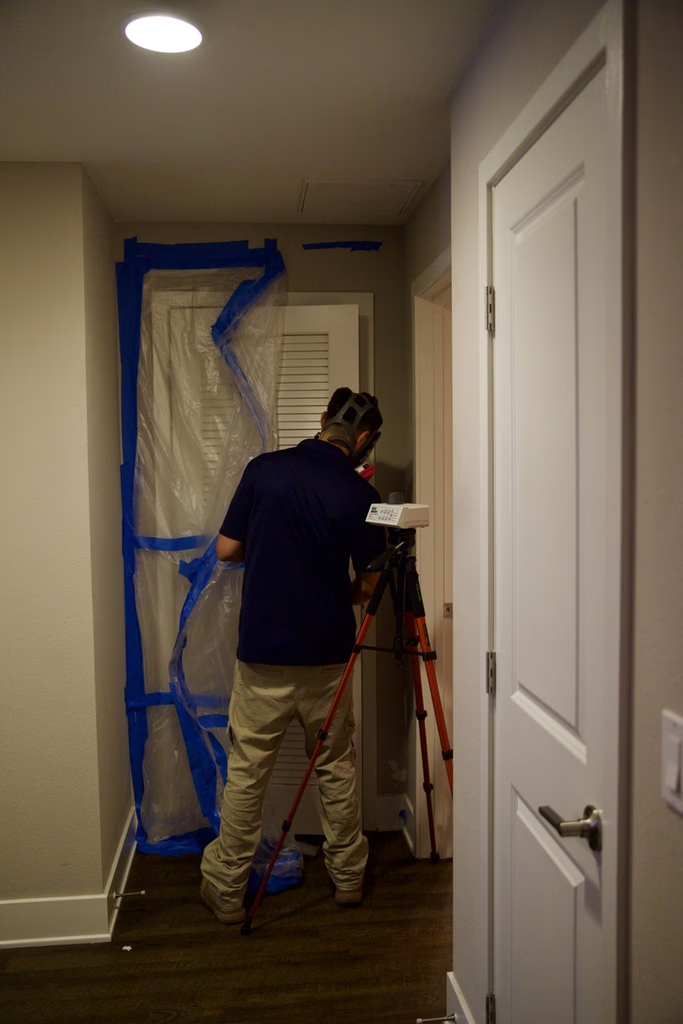
Collects airborne mold spores to assess air quality and detect hidden contamination.
our services
Mold Testing
State-certified testing that spots hidden mold—so you can act early, stay safe, and avoid costly repairs.
About
Why Mold Testing Matters
Mold isn't always visible. It hides in air vents, under floors, and inside walls. The only way to know what you're breathing—or what's spreading—is through lab-grade testing.
- —Identify mold species and spore levels
- —Detect hidden growth in "clean" areas
- —Assess the health risk to occupants
- —Decide on the right next steps
Methodology
How our mold testing works
The three sampling methods we use, chosen for what your property is showing
Sterile swabs and clear adhesive tape collect mold from visible spots on dry surfaces, giving the lab a clean sample for species identification. Suitable for walls, ceilings, baseboards, and furniture where the residue is what you're checking.
For damp or recently water-damaged areas, the sampling approach changes. Wet sampling captures live, actively growing colonies that dry methods underrepresent, which matters under flooring, behind tile, and around recent leaks.
A calibrated pump pulls a controlled volume of air through a spore trap cassette, capturing viable and non-viable spores from the breathing zone. The lab counts species and compares concentrations to outdoor levels, telling you whether your indoor air is healthy.
Checklist
Is Testing Right for You?
Mold testing is ideal if:
- —You suspect mold but can't see it
- —You've had water damage
- —Residents or tenants are reporting health symptoms
- —You're buying, selling, or managing a property
- —You need peace of mind after remediation
Still unsure? Let's talk. We'll help you decide which method suits your case best.
Testing Overview
Our Testing Methods
Techniques we use to collect accurate mold samples from air and surfaces.
Lifts mold samples from surfaces using clear adhesive—quick and non-destructive.
Gathers samples from damp or textured areas to identify active mold growth.
Mold inspection Riverside FAQ
Call For An InspectionSame-day and next-day appointments are usually available across our Riverside service area, with 24/7 emergency response for active leaks, recent water damage, or urgent real estate timelines. Standard scheduling runs 1 to 3 business days depending on availability.
Our certified mold inspectors assess bathrooms, kitchens, laundry rooms, basements, attics, crawl spaces, HVAC components, and any area showing signs of past or current water issues. Thermal imaging and moisture meters identify hidden moisture behind walls and under floors.
The dry climate in Riverside actually contributes to delayed mold detection rather than preventing mold growth — which makes the historic neighborhoods particularly susceptible to extensive, long-standing mold problems by the time they are identified. Crawl spaces beneath the Wood Streets and Victoria Avenue craftsman homes lack the vapor barriers that modern construction requires, allowing ground moisture from the River Valley's underlying water table to migrate into foundation spaces year-round. Original cast-iron and galvanized plumbing in these properties develops slow leaks behind walls that, in a dry climate, evaporate quickly enough that surface water staining doesn't appear — but the sustained moisture in the wall cavity supports mold growth for months or years before any visible indicator appears. HVAC condensation in Riverside's hot-summer climate adds a second, independent moisture source inside the building envelope that operates regardless of exterior conditions.
Pricing varies based on the size of the property, the scope of testing required, and whether any lab work is included. Most residential mold inspections in Riverside fall within the standard industry range of $300 to $600, with a clear quote provided before any work begins.
Air sampling, swab testing, tape lift testing, wall cavity sampling, and HVAC mold testing. The inspector recommends the right method on-site based on what's found. Samples go to a state-certified lab, with results typically back in 24 to 72 hours.
Mold needs water to grow, so finding the moisture source is what prevents the same problem from coming back after any cleanup. Moisture detection during the inspection identifies plumbing leaks, roof leaks, condensation issues, and humidity buildup that's feeding any growth.
Yes. Post-remediation verification confirms the remediation contractor's work succeeded and the space is safe to reoccupy. Because we don't perform remediation ourselves, the verification stays independent of the remediation contractor's interests, which is what insurers and tenants look for.
They have more places for it to hide than newer construction. Frank Miller built the Mission Inn in seven major phases between 1902 and 1931, and the downtown around it holds blocks of early-twentieth-century masonry commercial buildings, many now converted to restaurants, offices, lofts, and condominiums above ground-floor shops. Brick and unreinforced or lightly reinforced masonry wick water and hold it, flat roofs pond behind parapets, and conversions add showers and kitchens to buildings designed for retail or storage, often over slabs with no vapor barrier. Seismic retrofits and remodels over the decades have also opened and closed walls that may have hidden old water damage. The usual findings are moisture at roof-to-wall transitions and parapet flashing, growth in ceiling cavities above wet rooms, and leaks from upper units surfacing in the space below. An inspection focuses on those paths, and the report helps owners, tenants, and associations settle who is responsible for the repair.
It is often worth it, whether you are the student, a parent, or the owner. The neighborhoods around UC Riverside carry a large stock of houses rented by the room and apartment complexes that turn over every academic year. High occupancy means more showers, cooking, and laundry than many of these buildings were designed to vent, and the gaps between tenants are when slow leaks, failed bathroom fans, and window condensation go unnoticed. In stacked apartment buildings, a leak in one unit often surfaces in the one below, which is why apartment-wide mold complaints tend to follow plumbing stacks. California law treats visible mold as a substandard housing condition under Health and Safety Code section 17920.3, as amended by SB 655, and a building's age is not a defense. An inspection at move-in or after a reported leak documents conditions with moisture readings, photos, and lab results — the record that settles deposit and repair disputes and helps an owner fix the cause.
Some are, especially on the lowest ground. In March 1938 the river overtopped its banks and flooded part of northwest Riverside, forcing families from their homes in the northern part of the city, and the flood-control work that followed changed the river corridor but not the geography beneath it. The neighborhoods on the low land near the river and around Fairmount Park — the park the Olmsted firm was hired to design in 1911 — sit where the water table runs higher and storm runoff collects fastest. Moisture there tends to arrive from below: damp crawl space soil under older raised-foundation homes, vapor rising through slabs poured without vapor barriers, and growth along the bottom of drywall on exterior walls after a wet winter. A moisture survey that compares readings across the slab or crawl space tells you whether it is ground moisture, which calls for drainage and vapor control, or a concentrated leak a plumber can fix.
They often do. Riverside's citrus industry started with the parent navel orange trees Eliza Tibbets planted in 1873 — one still grows at Magnolia and Arlington avenues — and Victoria Avenue was laid out in 1892 to connect Arlington Heights to downtown, landscaped under pioneer designer Franz Hosp. The older houses in Arlington Heights and along the former grove lands range from ranch-era homes to mid-century houses, many on lots once irrigated as orchards, some on raised foundations, many enlarged over the years. The moisture sources fit that setting: landscape and remnant grove irrigation keeping soil damp against the house, mature trees sending roots into sewer laterals and dropping debris into gutters, outbuildings and garages converted to living space on unsealed slabs, and additions joined to older walls. An inspection on these properties covers the crawl space or slab edge on the irrigated sides, the attic beneath tree cover, and any converted space.
If the home inspection mentioned staining, a musty smell, or signs of past leaks, a mold inspection is the follow-up that note is pointing to. A general inspection surveys the whole property visually; a mold inspection measures moisture inside walls, under flooring, and in the attic or crawl space with thermal imaging and moisture meters, and sends air or surface samples to an accredited lab. In Riverside the gap matters most in a few kinds of houses: the early-1900s homes of the Wood Streets and the older central neighborhoods, where the crawl space is where problems live; postwar slab homes in Magnolia Center and La Sierra, where a slab leak can run for months under carpet; and hillside homes in Canyon Crest, where runoff collects against uphill walls. Riverside's dry summers can make an active leak look harmless on the surface. Book the mold inspection inside your contingency window so the findings can still change the price or the repair requests.
These neighborhoods filled in with single-story stucco homes on slabs during the postwar decades, and the houses now share the failures of their age. The recurring moisture sources are copper or galvanized supply lines leaking inside walls or under the slab, cast-iron drains cracking beneath bathrooms and kitchens, roofs re-covered over older layers, and roof-mounted evaporative coolers leaking at their curbs or run during humid monsoon weather in late summer. Many homes that later added central air kept the old cooler duct, which then sweats in summer and admits rain in winter. Bathroom fans that were never installed or that vent into the attic are common too, and garage conversions on unsealed slabs add another layer. The first signs are usually small — a musty closet, a swelling baseboard, staining around a ceiling register, a warm spot on the floor. A moisture survey of the plumbing walls, slab perimeter, attic, and cooler opening covers where these houses usually fail.
They do, mostly because of the slope. Canyon Crest climbs toward the Box Springs Mountains on the city's east side, and many homes there sit on graded pads with retaining walls, terraced yards, and long downhill drainage runs. The granitic hillsides shed water quickly instead of absorbing it, so a heavy storm concentrates runoff against uphill walls and into the joint between slab and foundation on homes cut into the grade. Terrace drains and V-ditches clogged with debris turn an ordinary rain into a wet wall, and irrigation on steep yards keeps the uphill side damp year-round. Condominium and townhome complexes on the slopes add shared walls and roofs, where water from one unit reaches the next. Inside, the signs are mineral deposits on the slab edge, swelling baseboards on the hill side, and a musty smell in the lowest rooms. An inspection focused on the uphill wall, retaining-wall drainage, and the slab perimeter is the right scope here.
Only inspection and testing. We don't remediate, and that is what keeps our findings independent: a company that inspects and then removes the mold is pricing its own job. We locate the growth, trace the moisture behind it, and document the extent with thermal imaging, moisture meters, and lab-analyzed samples. In Riverside the cause is often somewhere a removal crew isn't hired to look: a crawl space under a Wood Streets bungalow, a slab leak in a postwar Magnolia Center house, an evaporative cooler leaking into the attic, runoff against the uphill wall of a Canyon Crest home, or a plumbing stack in an apartment building near the university. Remove the mold without fixing that and it returns. The written report gives you a defined scope that several remediation contractors can bid on equally, which usually means a smaller job. Once the work is done, we can return for independent clearance testing before the area is closed up or reoccupied.
Our indoor air quality testing is focused on mold: airborne spores and the moisture conditions that produce them. The inspector draws a measured volume of air through a spore trap in each room of concern, collects an outdoor sample on the same visit as a baseline, and measures humidity and surface moisture in the areas sampled. An accredited lab identifies genera and concentrations, typically within 24 to 72 hours. The outdoor comparison matters in Riverside because dry winds, dust, open hillsides, and remnant groves move outdoor levels considerably from one day and one neighborhood to the next, so indoor numbers are never judged against a generic standard. Air testing is the right first step when someone has symptoms or there's a musty smell with nothing visible — common in older homes where the source is a crawl space or wall cavity. The cost depends mainly on the number of samples, and you get a quote before any sampling begins.
A residential inspection follows water through the house rather than stopping at what is visible. It starts with history — past leaks, odors, symptoms, remodels — then works room by room with a thermal camera and moisture meter: bathrooms and kitchens, the water heater and supply lines, laundry, windows, the slab perimeter or crawl space, and the attic. In Riverside's early-1900s neighborhoods the crawl space gets particular attention; in the postwar tracts, the slab and the evaporative cooler opening; on the hillsides of Canyon Crest, the uphill walls and retaining-wall drainage. HVAC equipment and ducts are checked for condensation. Where growth is suspected, air samples with an outdoor baseline and surface swabs or tape lifts go to an accredited lab. The report documents findings, the moisture source, photographs, lab results, and the recommended scope if remediation is needed — with no remediation work of our own riding on the size of that scope.
Yes, and they make up a large share of our Riverside work, from older complexes in the central neighborhoods to student housing near UC Riverside and newer apartments across the city. Multifamily buildings move water in ways single-family homes don't: stacked bathrooms and kitchens carry leaks down through floor assemblies, shared walls let moisture cross between units, and a single roof or plumbing failure can affect several households. That is why a complaint in one unit often needs a look at the units above and beside it. We map moisture across the affected units, sample where growth is suspected, and document the source and its path, so owners and managers know which repair actually stops the problem and which units need remediation. Reports are written to serve owners, managers, tenants, and insurers alike, and after remediation we provide independent clearance testing before units are turned over or reoccupied.
Our team serves Riverside, California, in the Inland Empire — Downtown and the Mission Inn district, the Wood Streets, Victoria Avenue and Arlington Heights, Magnolia Center, La Sierra, Canyon Crest and the UC Riverside area, Hawarden Hills, Orangecrest, and the northwest neighborhoods near Fairmount Park — with same-day and next-day appointments and 24/7 response for active leaks and water damage. Several nearby cities have their own 24H Mold Inspection page written for their own housing, including Corona, Moreno Valley, Fontana, and Ontario. If your property is in one of those, start with that city's page. If you aren't sure which team covers your address, call the number on this page and we'll route you to the right one.
Contact
Book your Riverside mold inspection today
Tell us what's going on and we'll respond the same day
Location
24H Mold Inspection of Riverside
Phone
(951) 899-0339Hours
- MondayOpen 24 hours
- TuesdayOpen 24 hours
- WednesdayOpen 24 hours
- ThursdayOpen 24 hours
- Friday6 AM – 6 PM
- SaturdayClosed
- SundayOpen 24 hours
Service area neighborhoods
- Wood Streets
- Historic Downtown
- Victoria Avenue corridor
- Canyon Crest
- Hawarden Hills
- La Sierra
- Magnolia Center
- Orangecrest