1
Mold inspection
- Moisture detection
- Infrared technology
- Certified mold inspectors
- No conflict of interest

Certified mold inspection and testing in Rancho Cucamonga. Same-day appointments, lab-verified reports, and no financial stake in any remediation work that follows.
(909) 901-5334What We Do
Air and surface samples analyzed in a state-certified lab. You receive mold species ID, spore count data, and lab-verified documentation that holds up with insurers, attorneys, or counsel.
About
At 24H Mold Inspection of Rancho Cucamonga, we know no two buildings respond to moisture the same way.
Rancho Cucamonga occupies the base of the San Gabriel Mountains at an elevation and position that creates specific moisture conditions not typically associated with the Inland Empire's reputation for heat and aridity. The alluvial fan topography of the city's northern neighborhoods means that stormwater and snowmelt from the mountains above concentrate and move through the subsurface toward the valley floor, maintaining a more active groundwater environment than flat, lower-elevation Inland Empire communities. The city's significant concentration of 1980s and 1990s master-planned residential development — built during a period of rapid growth that prioritized speed over moisture management detail — carries a characteristic set of HVAC condensation and builder-grade vapor barrier vulnerabilities that surface as properties age.
Rancho Cucamonga is predominantly single-family residential, with a housing stock concentrated in the 1980s through 2000s master-planned community development that defines the city's character. These homes share a characteristic risk profile: slab-on-grade foundations, forced-air HVAC systems of varying ages and maintenance histories, and builder-grade exterior finishes that have aged at different rates across the city's multiple master-planned communities. The northern neighborhoods of Alta Loma and Etiwanda, which include older foothill properties predating the city's incorporation, add a different risk layer — older construction on more complex topography, with mountain drainage channeled toward foundations on downslope lots.
Services
Mold inspection, mold testing, and environmental risk assessments for Rancho Cucamonga properties. Available 24/7, with no remediation work to bias the findings.

Why Us
24H Mold Inspection of Rancho Cucamonga combines local field experience with state-certified methods and lab analysis. Reports get back to you quickly and clearly, with no upsell tacked on to the findings.
We don't stop at surface-level findings. Active leaks, health symptoms, post-remediation work, and pre-purchase due diligence each call for a different inspection approach. Our certified mold inspectors guide you through the specific situation rather than running a generic checklist.
Strengths
We check every box, then go further. Book your inspection today
Licensed inspectors with proven field experience in Rancho Cucamonga.
FLIR thermal cameras, calibrated moisture meters, and lab-verified sampling.
Straightforward updates and honest reporting throughout the process.
5.0 stars from 32+ Rancho Cucamonga homeowners and businesses.
Testimonials
Thousands of Rancho Cucamonga property owners have come to us for reliable, detailed mold assessments
Roy was excellent and was very thorough with the whole process he was very professional I definitely recommend 24h Mold
Henry R.
5 Step Process
Choose a date and time that fits your schedule.
Flexible scheduling means same-day and next-day appointments are usually available, with 24/7 emergency response when the situation needs it.
Our certified mold inspectors assess every mold-prone area.
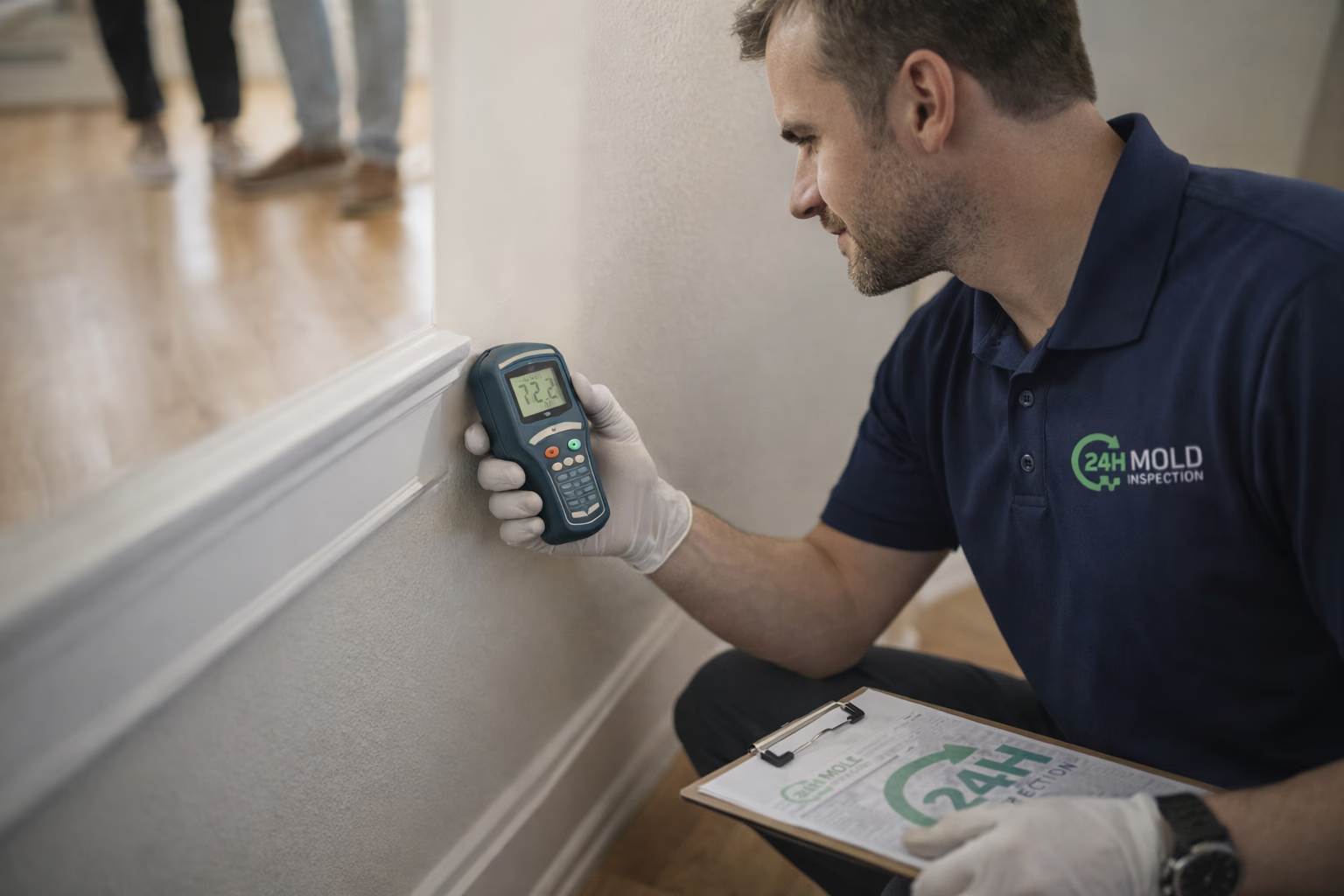
We walk the property identifying visible mold and moisture issues, using thermal imaging and moisture meters to catch what's hidden behind walls and under flooring.
Air and surface samples collected for lab analysis.
Our certified mold inspectors collect targeted samples from key areas to find mold spores both visible and hidden, with sample sites documented on a property map.
Lab testing returns precise results.
Samples go to a state-certified lab for detailed analysis identifying mold species and contamination levels, typically returned within 24 to 72 hours.
Insights and clear next steps from our experts.
You receive a written report with lab results, inspector findings, and specific recommended action steps to resolve any mold issues safely.
Who We Serve
24H Mold Inspection of Rancho Cucamonga brings clear answers to HOAs, hotels, commercial buildings, and homes through certified mold inspection and testing services.
George and William Chaffey bought their first 1,000 acres here on Thanksgiving Day 1881, subdivided the land into 10-acre parcels early in 1882, and piped irrigation water down from the mountain canyons — Etiwanda was the test bed for the mutual water company model later copied across Southern California, and the Chaffey-Garcia house had electric lights by December 4, 1882. Rows of eucalyptus planted as windbreaks still line the older streets. The surviving older houses, many on raised foundations and enlarged over generations, carry crawl spaces, aging plumbing, and joints between original walls and additions where moisture collects out of sight — a different profile from the slab tracts around them.
Alta Loma climbs the upper alluvial fan below the front range of the San Gabriel Mountains, where streets end at the basins and channels that catch runoff from Cucamonga and Deer canyons. In October 2003 the Grand Prix Fire burned the slopes directly above for six days and destroyed 13 homes in Alta Loma, and the Christmas Day storm that followed sent debris flows off burned ground across the region. The soil is coarse, boulder-filled fan material that drains fast at the surface but carries groundwater downhill beneath it, so the uphill wall, the slab edge, and the retaining walls of a hillside home take the moisture load long after a storm passes.
Foothill Boulevard is Route 66 through the city, and the old Cucamonga community grew up along it — the restored 1915 Cucamonga Service Station still stands on the route. This corridor holds the city's oldest commercial building stock and some of its earliest residential blocks, alongside newer shopping centers that replaced vineyards and groves. Older storefronts and service buildings carry flat roofs, masonry walls, and slabs poured without vapor retarders, while nearby mid-century homes have aging plumbing and roofs replaced over older layers. Ponding roof drains, and leaks that travel along a roof deck before showing up far from where they started, are the typical pattern along the commercial frontage.
Terra Vista and the Victoria villages to the east were built out mostly in the 1980s and 1990s as master-planned neighborhoods: stucco-clad slab homes, townhomes, and condominiums under concrete tile roofs, organized around greenbelts and HOA-maintained common areas, with Victoria Gardens added at Foothill Boulevard and Day Creek in 2004. Three decades on, the original underlayment beneath many of those tile roofs is reaching the end of its service life even where the tiles look fine, original water heaters and supply lines are failing, and attic air handlers clog their condensate lines. In attached buildings, water crosses shared walls, and the question of whether the HOA or the owner is responsible follows.
The newest neighborhoods spread across north and east Etiwanda in the late 1990s and 2000s, up toward the Day Creek channel and the debris basin completed above it in 1988. These are larger two-story homes on graded pads cut into the fan, built with tight envelopes, house wraps, and high-efficiency HVAC. Their mold risks are newer-construction ones: interior humidity trapped when ventilation is undersized, condensation in second-floor ducts running through hot attics, and irrigation and drainage on terraced lots directing water toward slab edges and below-grade retaining walls. On a graded lot, the uphill neighbor's yard drainage often becomes part of the picture.