
Collects airborne mold spores to assess air quality and detect hidden contamination.
our services
Mold Testing
State-certified testing that spots hidden mold—so you can act early, stay safe, and avoid costly repairs.
About
Why Mold Testing Matters
Mold isn't always visible. It hides in air vents, under floors, and inside walls. The only way to know what you're breathing—or what's spreading—is through lab-grade testing.
- —Identify mold species and spore levels
- —Detect hidden growth in "clean" areas
- —Assess the health risk to occupants
- —Decide on the right next steps
Methodology
How our mold testing works
The three sampling methods we use, chosen for what your property is showing
Sterile swabs and clear adhesive tape collect mold from visible spots on dry surfaces, giving the lab a clean sample for species identification. Suitable for walls, ceilings, baseboards, and furniture where the residue is what you're checking.
For damp or recently water-damaged areas, the sampling approach changes. Wet sampling captures live, actively growing colonies that dry methods underrepresent, which matters under flooring, behind tile, and around recent leaks.
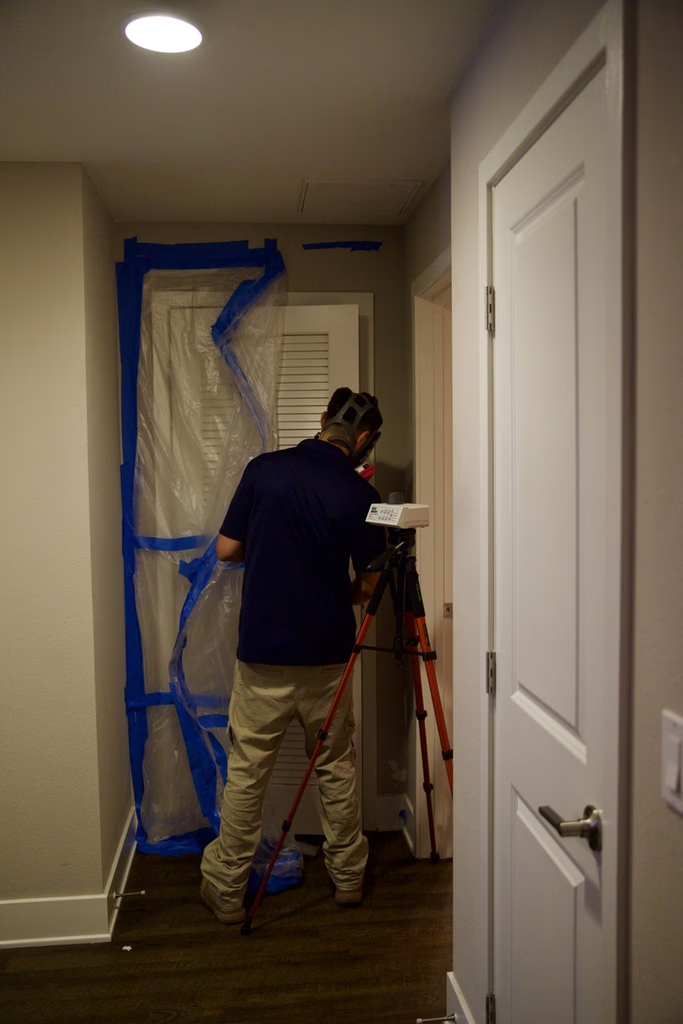
A calibrated pump pulls a controlled volume of air through a spore trap cassette, capturing viable and non-viable spores from the breathing zone. The lab counts species and compares concentrations to outdoor levels, telling you whether your indoor air is healthy.
Checklist
Is Testing Right for You?
Mold testing is ideal if:
- —You suspect mold but can't see it
- —You've had water damage
- —Residents or tenants are reporting health symptoms
- —You're buying, selling, or managing a property
- —You need peace of mind after remediation
Still unsure? Let's talk. We'll help you decide which method suits your case best.
Testing Overview
Our Testing Methods
Techniques we use to collect accurate mold samples from air and surfaces.
Lifts mold samples from surfaces using clear adhesive—quick and non-destructive.
Gathers samples from damp or textured areas to identify active mold growth.
Mold inspection Lancaster FAQ
Call For An InspectionSame-day and next-day appointments are usually available across our Lancaster service area, with 24/7 emergency response for active leaks, recent water damage, or urgent real estate timelines. Standard scheduling runs 1 to 3 business days depending on availability.
Our certified mold inspectors assess bathrooms, kitchens, laundry rooms, basements, attics, crawl spaces, HVAC components, and any area showing signs of past or current water issues. Thermal imaging and moisture meters identify hidden moisture behind walls and under floors.
Yes. Mold growth depends on moisture availability rather than outdoor humidity alone. Plumbing leaks, HVAC condensation, roof failures, and improperly maintained evaporative cooling systems can all create conditions that support mold growth indoors.
Pricing varies based on the size of the property, the scope of testing required, and whether any lab work is included. Most residential mold inspections in Lancaster fall within the standard industry range of $300 to $600, with a clear quote provided before any work begins.
Air sampling, swab testing, tape lift testing, wall cavity sampling, and HVAC mold testing. The inspector recommends the right method on-site based on what's found. Samples go to a state-certified lab, with results typically back in 24 to 72 hours.
Mold needs water to grow, so finding the moisture source is what prevents the same problem from coming back after any cleanup. Moisture detection during the inspection identifies plumbing leaks, roof leaks, condensation issues, and humidity buildup that's feeding any growth.
Yes. Post-remediation verification confirms the remediation contractor's work succeeded and the space is safe to reoccupy. Because we don't perform remediation ourselves, the verification stays independent of the remediation contractor's interests, which is what insurers and tenants look for.
An inspection first, because attic mold in Lancaster almost always has a specific cause, and cleanup without fixing it doesn't last. High-desert attics are extreme environments: well past 140 degrees on summer afternoons and below freezing on winter nights. The common moisture sources we find are bathroom and kitchen fans venting into the attic instead of outdoors, an evaporative cooler leaking at its roof curb, condensation forming on ductwork and the underside of the roof deck during cold nights, and roof leaks where high-desert wind events lifted shingles or tiles. Each leaves a different pattern — growth spread across a whole slope suggests ventilation and condensation, while growth clustered around one penetration suggests a leak. The inspector checks sheathing, rafters, insulation, and ducts with a moisture meter and thermal camera, and samples where needed. The report tells you what actually needs to be removed and what has to be fixed so it doesn't come back.
Yes, and in the Antelope Valley it is one of the most common causes we see in older homes. Evaporative coolers work well in Lancaster's dry heat because they add water to the air — which is exactly why they cause problems when something goes wrong. A cooler run during monsoon humidity in July and August, or with the house closed up so the moist air can't exhaust, raises indoor humidity to levels where mold grows on closet walls and inside ducts. The unit itself fails in predictable ways: a corroded pan or float valve leaking onto the roof, a cracked curb seal around the duct opening letting water into the attic, and stagnant water and pads left over winter. Many homes that later added central air kept the cooler duct, which then sweats in summer and admits rain in winter. Staining around the ceiling register below the cooler is the sign to look for, and the attic at that opening is where to start.
They can, and many people moving up from the LA basin don't expect it. Winter nights in the Antelope Valley regularly drop below freezing, and occasional cold snaps bring hard freezes and even snow. Supply lines in exterior walls, attics, garages, and unheated crawl spaces can freeze and split — and the leak often doesn't show until the line thaws, sometimes days later, behind drywall. Irrigation lines and hose bibs that freeze can crack where they penetrate the wall and leak inside. Homes left vacant or unheated during a cold spell are the most exposed, because no one is there to notice the water. Once a wall cavity is wet, mold can start within 24 to 48 hours even in cold weather, and the dry desert air does not reach inside the wall to dry it. After any burst pipe, a moisture map of the surrounding walls and floor shows how far the water traveled before it was stopped.
If water reached the house, yes. Lancaster sits on the flat floor of the Antelope Valley, where summer monsoon thunderstorms can drop heavy rain in an hour and the water has very little slope to run off. Streets, low lots, and properties near Amargosa Creek take the worst of it — the town flooded repeatedly in the 1910s when Amargosa and Littlerock creeks overflowed, with 1914 the most severe. Today the water that matters is the water that reaches the foundation: pooling against stucco and slab edges, running under garage and patio doors, and wicking into the bottom of drywall and the wood sill plate. Because the storms are brief and the air dries quickly afterward, it is easy to assume everything dried. The wall bottoms and the slab under carpet or laminate don't. A moisture assessment within a few days of the storm shows whether water got in and whether it actually dried.
It can contribute. The USGS has documented long-term land subsidence across the Antelope Valley, caused by compaction of fine-grained aquifer sediments as groundwater was pumped, along with fissures and cracks in the land surface; near Edwards, water levels have dropped some 90 feet since substantial development began in the late 1950s. Ground movement of that kind, along with ordinary settlement and the valley's expansive clay soils, stresses slabs and foundations. The cracks that result give water a path from the soil into the house — under flooring, into the bottom of walls, and around plumbing that passes through the slab — and can strain buried supply and drain lines. Not every crack is a mold problem, but a crack combined with a musty smell, lifting floor tile, or efflorescence at the slab edge is worth investigating. A moisture survey of the slab and the walls around the crack tells you whether water is actually coming through.
Lancaster's older neighborhoods grew with the military and aerospace work in the valley — the base 32 miles north that became Edwards Air Force Base after World War II drew workers and their families, and housing followed through the postwar decades. Those homes are now 60 to 70 years old. They are mostly single-story stucco houses on slabs, many with roof-mounted evaporative coolers, gas wall furnaces or early forced air, and copper or galvanized supply lines. The recurring moisture sources are slab leaks, cast-iron drains cracking beneath bathrooms, coolers leaking at the roof curb, and roofs that have been re-covered over earlier layers. Garage conversions on unsealed slabs are common too. The first signs are usually small — a musty closet, a warm spot on the floor, swelling at a baseboard — and a moisture survey around the plumbing walls, the cooler opening, and the slab perimeter covers the places these homes usually fail.
Yes. Lancaster was hit hard by the foreclosure wave: in December 2010 alone, about one in every 91 homes in the city received a foreclosure filing, and many houses sat empty for months or years. Vacant homes still turn up on the market, and they share a pattern. With no one living there, a slow leak under a sink, a cooler left running, a pipe that split during a winter freeze, or a roof leak during a monsoon storm can run unnoticed for a long time. Utilities shut off means no air movement and no heat, and the house is often cleaned and painted before listing, which can cover staining without fixing the cause. A mold inspection before closing checks the plumbing walls, the slab, the attic, and the HVAC for active and past moisture, and samples the air if the house has been sealed up. Schedule it inside your contingency window so the results can still affect the deal.
Only inspection and testing — we don't perform remediation in Lancaster or anywhere else, and that is deliberate. A company that inspects and then does the removal is pricing its own job. We find the growth, trace the moisture behind it, and document the extent with thermal imaging, moisture meters, and lab-analyzed samples. In Lancaster the cause is often something a cleanup crew isn't hired to fix: an evaporative cooler leaking into the attic, a bathroom fan venting into the attic space, a pipe that split in a winter freeze, or a slab crack letting water in after a monsoon storm. Remove the mold without addressing that and it returns by the next season. The written report gives you a defined scope that several remediation contractors in the Antelope Valley can bid on equally, which usually keeps the job smaller. Once remediation is complete, we can return for independent clearance testing before the area is closed up.
Testing starts with the moisture survey, because samples are only useful when taken in the right place. The inspector uses thermal imaging and a moisture meter to find wet or cool areas behind walls, under floors, and in the attic, then chooses the sampling method: air samples through a spore trap in each area of concern, surface swabs or tape lifts where growth is visible, or a wall-cavity sample where moisture is confirmed but nothing is showing. An outdoor air sample is taken on the same visit as a baseline. In Lancaster that baseline matters, because wind events, dust, and open desert land raise outdoor particle and spore levels unevenly from day to day. Samples go to an accredited lab, with results typically back in 24 to 72 hours. The report explains what was found, how indoor levels compare with outdoors, where the moisture source is, and what scope of work, if any, is needed.
If water sat for more than a day or nobody can confirm everything dried, yes. The common causes in Lancaster are a pipe split by a winter freeze, a water heater or supply line failing in an older house, an evaporative cooler or attic condensate line overflowing in summer, and monsoon runoff reaching the slab and wall bottoms. The desert air dries surfaces fast, which is exactly what makes water damage here deceptive: the floor and wall face feel dry within a day, while the inside of the wall cavity, the sill plate, the carpet pad, and the slab beneath stay wet much longer. Mold can start within 24 to 48 hours in that hidden moisture. An independent moisture assessment confirms whether drying actually finished, documents any growth that started, and gives you a dated record for an insurance claim. Since we don't do restoration, that verification is separate from whoever did the drying.
Air testing measures the spores in the air you are breathing, compared against the outdoor air at the same time. The inspector draws a measured volume of air through a spore trap in each room of concern and collects an outdoor sample on the same visit; an accredited lab identifies the genera and their concentrations. The comparison is especially important in Lancaster, where high-desert wind events and dust can push outdoor levels up sharply on one day and down the next, so indoor numbers are never judged against a generic standard. Air testing is the right first step when someone in the household has symptoms, when there is a musty smell with nothing visible, or after water damage to see whether growth has spread into the air. In homes with evaporative coolers, we also look at the cooler and its duct, since the system can circulate spores from a wet attic through the whole house.
Our Lancaster, California team covers the whole city — Downtown and The BLVD, East and West Lancaster, the Avenue K corridor, the Antelope Valley College area, the Fox Field area, and the rural west side out toward Antelope Acres and Quartz Hill — with same-day and next-day appointments and 24/7 response for burst pipes, active leaks, and storm water. Several nearby cities have their own 24H Mold Inspection page written for their own housing, including Palmdale and Santa Clarita. If your property is in one of those, start with that city's page. Many Antelope Valley addresses sit in unincorporated communities that carry a Lancaster mailing address; if you aren't sure which team covers you, call the number on this page and we'll route you to the right one.
Contact
Book your Lancaster mold inspection today
Tell us what's going on and we'll respond the same day
Location
24H Mold Inspection of Lancaster
Phone
(661) 899-7997Hours
- MondayOpen 24 hours
- TuesdayOpen 24 hours
- WednesdayOpen 24 hours
- ThursdayOpen 24 hours
- Friday6 AM – 6 PM
- SaturdayClosed
- SundayOpen 24 hours
Service area neighborhoods
- Quartz Hill vicinity
- West Lancaster
- East Lancaster
- Antelope Valley College area
- Fox Field area
- Antelope Acres area
- Downtown Lancaster
- Avenue K corridor