
Collects airborne mold spores to assess air quality and detect hidden contamination.
our services
Mold Testing
State-certified testing that spots hidden mold—so you can act early, stay safe, and avoid costly repairs.
About
Why Mold Testing Matters
Mold isn't always visible. It hides in air vents, under floors, and inside walls. The only way to know what you're breathing—or what's spreading—is through lab-grade testing.
- —Identify mold species and spore levels
- —Detect hidden growth in "clean" areas
- —Assess the health risk to occupants
- —Decide on the right next steps
Methodology
How our mold testing works
The three sampling methods we use, chosen for what your property is showing
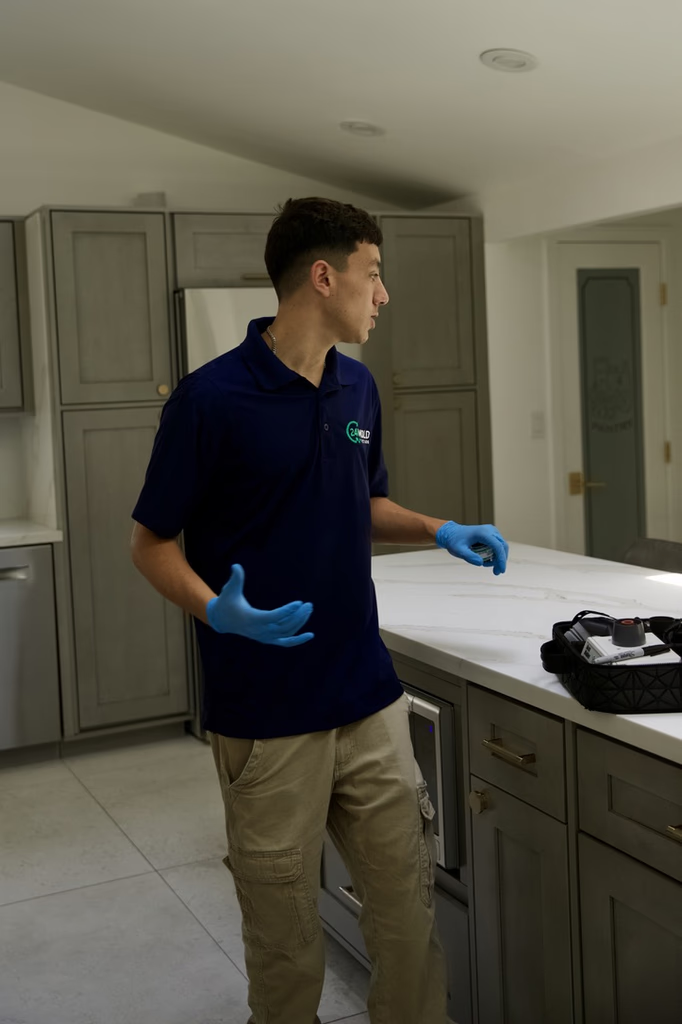
Sterile swabs and clear adhesive tape collect mold from visible spots on dry surfaces, giving the lab a clean sample for species identification. Suitable for walls, ceilings, baseboards, and furniture where the residue is what you're checking.
For damp or recently water-damaged areas, the sampling approach changes. Wet sampling captures live, actively growing colonies that dry methods underrepresent, which matters under flooring, behind tile, and around recent leaks.
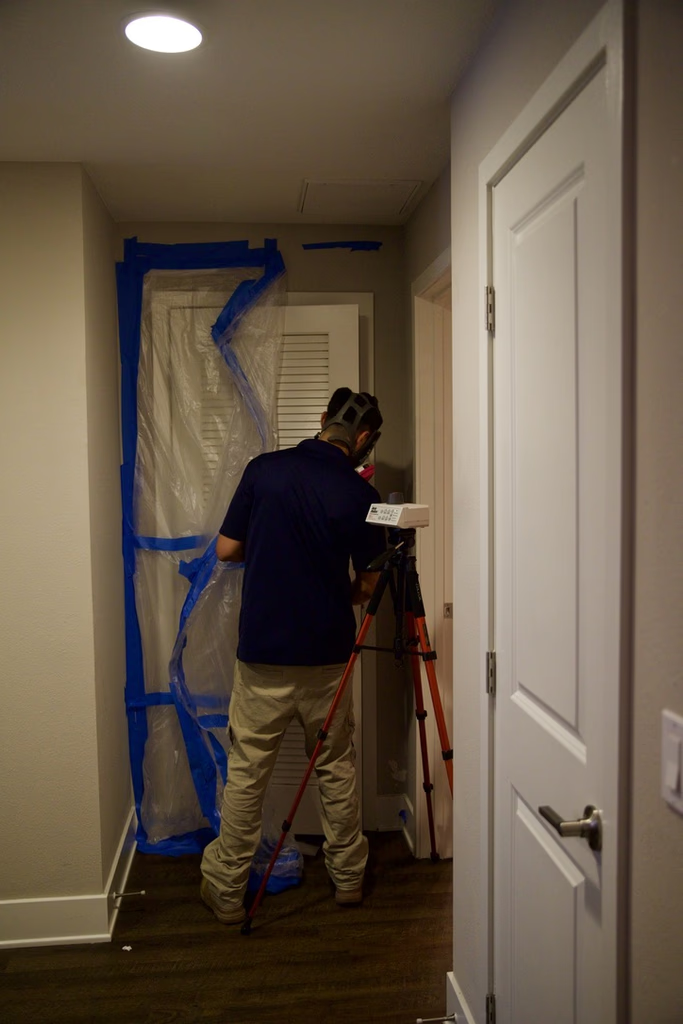
A calibrated pump pulls a controlled volume of air through a spore trap cassette, capturing viable and non-viable spores from the breathing zone. The lab counts species and compares concentrations to outdoor levels, telling you whether your indoor air is healthy.
Checklist
Is Testing Right for You?
Mold testing is ideal if:
- —You suspect mold but can't see it
- —You've had water damage
- —Residents or tenants are reporting health symptoms
- —You're buying, selling, or managing a property
- —You need peace of mind after remediation
Still unsure? Let's talk. We'll help you decide which method suits your case best.
Testing Overview
Our Testing Methods
Techniques we use to collect accurate mold samples from air and surfaces.
Lifts mold samples from surfaces using clear adhesive—quick and non-destructive.
Gathers samples from damp or textured areas to identify active mold growth.
Mold inspection Fountain Valley FAQ
Call For An InspectionSame-day and next-day appointments are usually available across our Fountain Valley service area, with 24/7 emergency response for active leaks, recent water damage, or urgent real estate timelines. Standard scheduling runs 1 to 3 business days depending on availability.
Our certified mold inspectors assess bathrooms, kitchens, laundry rooms, basements, attics, crawl spaces, HVAC components, and any area showing signs of past or current water issues. Thermal imaging and moisture meters identify hidden moisture behind walls and under floors.
Slab foundations can conceal plumbing leaks beneath the structure, making moisture problems more difficult to detect until symptoms such as flooring damage, elevated humidity, or visible staining appear.
Pricing varies based on the size of the property, the scope of testing required, and whether any lab work is included. Most residential mold inspections in Fountain Valley fall within the standard industry range of $300 to $600, with a clear quote provided before any work begins.
Air sampling, swab testing, tape lift testing, wall cavity sampling, and HVAC mold testing. The inspector recommends the right method on-site based on what's found. Samples go to a state-certified lab, with results typically back in 24 to 72 hours.
Mold needs water to grow, so finding the moisture source is what prevents the same problem from coming back after any cleanup. Moisture detection during the inspection identifies plumbing leaks, roof leaks, condensation issues, and humidity buildup that's feeding any growth.
Yes. Post-remediation verification confirms the remediation contractor's work succeeded and the space is safe to reoccupy. Because we don't perform remediation ourselves, the verification stays independent of the remediation contractor's interests, which is what insurers and tenants look for.
No. 24H Mold Inspection of Fountain Valley inspects and tests only, and we never perform remediation — the separation is deliberate. It matters more than usual on this ground. Nearly every home here is slab-on-grade on a former floodplain with a shallow water table, so the question that decides the size of a job is whether the water is a supply line failing under the concrete, vapor driving up through a slab poured without a retarder, or irrigation soaking a planter bed against the stucco. Those three look identical from inside the room and cost wildly different amounts to fix, and a company paid for the cleanup has a financial reason to keep finding more of it. What we produce is the diagnosis — what is growing, what is feeding it, how far it runs behind the wall or under the flooring, and lab confirmation of the samples. You take that to remediation contractors and collect comparable bids on one defined scope. When the work is done we can verify it independently, which carries weight with insurers precisely because we had no part in the removal.
All of Fountain Valley and the central Orange County cities around it. Inside the city that means Green Valley, Westmont, Park Place, Fountain Valley Estates, the Mile Square Park area, the Brookhurst corridor, the Ellis Avenue district, and the Los Caballeros vicinity — the whole city is under ten square miles and we can cross it in fifteen minutes, which is what makes same-day appointments realistic here rather than aspirational. Huntington Beach, Costa Mesa, Westminster, Garden Grove, Santa Ana, Newport Beach, Seal Beach, Los Alamitos, Stanton, Tustin, and Irvine each have their own 24H Mold Inspection page written around that city's housing stock and moisture patterns, so if your property sits across one of those lines, start there instead. Anaheim and the rest of north county are handled by this team directly. Emergency response for an active leak, a slab break, or a flooded unit runs 24/7 — the night it happens, not the next business morning.
Detection is what happens before anyone takes a sample. Visible growth needs identification, not detection; the harder job is locating water in a house that only smells wrong. It starts with history — what leaked, when, what was repaired — then an exterior walk for grade and drainage, moisture meters along baseboards and slab-adjacent walls, and thermal imaging to find the temperature signature wet material leaves behind a finished surface. In Fountain Valley the shortlist is short and consistent. Flat lots with almost no fall send irrigation and storm water toward the house instead of away from it. Slabs poured in the 1960s and 1970s sit over a shallow basin and drive vapor upward into flooring and carpet pad. And the copper under those slabs is now old enough that pinhole leaks announce themselves as a warm patch underfoot or a meter that will not stop turning. Spore sampling comes last, only where the walk-through justifies it and always against an outdoor baseline, because a spore count with no moisture source attached is not something a contractor can bid on.
Yes, and not only during storms. The city was built on the floodplain of the channel that forms its western edge — ground so wet before the war that it was farmed as marsh and known locally as Gospel Swamp, and where artesian wells flowed at the surface with no pump on them. Decades of federal flood-control work on that river system eventually let FEMA redraw the maps and pull much of the city out of the high-risk flood zone, which changed insurance requirements but did not change the soil. It is still flat, still organic and compressible in places, and the water table is still close to the surface. What that produces year to year is not dramatic flooding but slow, persistent moisture: yards that hold standing water for days after rain, vapor driving up through slabs, and settlement cracks that let irrigation in. If your home was mapped out of the flood zone and you dropped the flood policy, that is a good moment to have the slab perimeter and flooring checked once — the map changed, the ground did not.
No — they answer different questions. A general home inspection is a broad condition survey: roof, electrical, plumbing, appliances, structure. Its mold coverage stops at what is visible from accessible areas, most contracts exclude mold outright, and none of them include lab work. A mold inspection is narrow and instrument-driven: thermal imaging and moisture meters across walls and floors, attic entry, and air or surface samples read by a state-certified lab. The gap is wider here than in most of California because Fountain Valley homes have no basement and no crawl space to walk. Everything a home inspector would normally use as a window into a building's moisture history is sealed under a concrete slab, so the evidence is a warm spot in a hallway floor, an unexplained jump in the water bill, cupping at the edge of a plank floor, or a musty closet on an interior wall. Most buyers here do both: the home inspection for overall condition, then a mold inspection when it flags staining, odor, past water damage, or flooring that has moved.
We do not — encapsulation is remediation work, and we only inspect, test, and verify. It is worth understanding what it does, though, because it is often sold as the cheaper alternative to removal. Encapsulation seals a treated surface under a coating so residual material is bound in place. That is a legitimate final step on framing which has already been properly cleaned and dried. It is not a substitute for either of those things, and coating material that is still wet or still growing hides the problem behind a finish while trapping moisture inside the assembly. That failure mode turns up often in Fountain Valley for a specific reason: on slab-on-grade construction over a shallow water table, the moisture is frequently still arriving from below, so nothing applied to the surface will stop it. Before accepting any encapsulation bid, get moisture readings showing the material is genuinely dry and a source that has genuinely been fixed — then have the finished work verified by someone who was not paid to perform it.
They help, and they solve nothing on their own. Paperless and fiberglass-faced gypsum board removes the paper facing that ordinary drywall offers as food, and mold-resistant paints add a surface inhibitor. Both are worth specifying in a bathroom, a laundry, or any wall being rebuilt after water damage. Neither addresses water. Give a mold-resistant wall a steady moisture supply and growth simply moves to what sits behind and around it — the paper facing on the insulation batt, the dust film on the framing, the carpet pad, the underside of glued-down flooring. In this city that supply is often the slab itself: 1960s and 1970s pours over a shallow basin, no vapor retarder underneath, and a modern sealed finish on top that traps whatever comes up. So if you are rebuilding after a leak, spend on the moisture side first — fix the source, confirm the assembly is dry with meter readings rather than by eye, and put a vapor barrier under the new flooring. The resistant materials are worth having after that, not instead of it.
The assessment is the on-site evaluation — the visual inspection, the moisture mapping with thermal imaging and meters, and the diagnosis of what is actually driving the growth. Testing is the laboratory component within it: air samples collected on spore traps, or surface samples taken by swab, tape lift, or bulk, analyzed by an accredited independent laboratory for species identification and spore counts. The assessment produces the answer; the testing confirms and quantifies it. Not every Fountain Valley property needs both. Where growth is visible and the source is obvious — a failed water heater, an air handler overflowing its pan, a roof leak above a known stain — sampling frequently adds cost without changing the next step. Where there is odor or symptoms with nothing visible, which is the common presentation for the slab leaks that dominate findings in this city, or where an insurer or buyer needs documentation that will hold up, lab results are what make the findings defensible. Turnaround runs twenty-four to seventy-two hours.
There is no statewide license to look up. California's Toxic Mold Protection Act of 2001 directed the state to establish permissible exposure limits for indoor mold, those limits were never set, and no agency issues or revokes a mold inspector credential as a result. What you can verify is more useful anyway. Confirm recognized third-party industry certification and current liability insurance. Confirm that samples go to an accredited independent laboratory rather than being read on site. Confirm the company does not also perform remediation, since an inspector who profits from the cleanup has a direct financial reason to find more of it. And confirm the deliverable is a written report with photographs, instrument readings, and marked sample locations rather than a verbal summary at the door. Ask to see a redacted sample report before you schedule — anyone working to a real standard has one ready, and comparing two reports tells you considerably more than comparing two prices.
Yes — the medical and professional office buildings that make up a significant share of the city's commercial stock, neighbourhood retail along the Brookhurst and Ellis corridors, townhome and condominium associations, and apartment communities. Commercial inspection differs mainly in where the moisture hides: low-slope roofs pond and leak above ceiling systems, packaged rooftop HVAC units generate condensation across long duct runs, and damage develops above occupied space or inside mechanical areas that see attention only at service intervals. Medical and dental suites bring an additional consideration, since sterilization equipment, lab sinks, and specialized plumbing add moisture sources a standard office does not have, frequently in rooms with limited ventilation. In attached townhomes and condominiums the shared-plumbing problem applies as it does anywhere: a failure inside one wall pushes moisture into the neighbouring unit's cavities, and the resident who reports the smell is often not the resident with the leak.
Give every contractor the same report and ask them to bid the scope it documents, so quotes differ on price and method rather than on how much mold each company claims to find. Confirm a current CSLB license, required on any job over five hundred dollars in labor and materials, plus workers compensation and liability coverage. Then ask the question that matters most on this housing stock: how the moisture source will actually be repaired. Fountain Valley is overwhelmingly slab-on-grade construction from the 1960s through the 1980s, which means a large share of what we document traces to supply or drain lines running beneath or within the slab. Repairing that is a different trade and a different decision — reroute overhead or open the slab — and a remediation bid that removes damp flooring and baseboard without addressing it is quoting half a job. Make sure the plumbing repair and the remediation scope are coordinated before either one starts.
It is the independent check performed after the cleanup and before containment comes down and new flooring and drywall go in: confirmation that the affected material was genuinely removed, meter verification that the structure dried to a normal moisture content, and clearance air sampling compared against an outdoor control taken the same day. It should come from someone other than the remediation company, for the straightforward reason that a contractor verifying their own work is grading their own exam. In Fountain Valley it matters most after a slab leak, and for a specific technical reason: concrete releases moisture slowly, so a slab whose surface reads dry can still hold enough moisture underneath to damage new flooring installed over it and to feed a recurrence. Verification with a proper moisture measurement before the new floor goes down is what prevents paying for that floor twice. It also gives you documentation at resale that the event was resolved rather than merely paid for.
The report documents what was found and where, the photographs and instrument readings supporting it, the moisture source behind the growth, and any laboratory results with sample locations marked. That combination is what makes it useful to somebody other than you. Adjusters want the moisture source and a dated record of the condition, because policies distinguish sharply between a sudden failure and long-term seepage — a distinction that comes up constantly with slab leaks, where a pinhole failure can weep for months before anything is visible and the timeline becomes the whole argument. Remediation contractors want a defined scope so their bids are comparable. Buyers, sellers, and agents want findings from a party with no stake in the transaction, and associations and owners want a record neither produced. Laboratory results generally return within twenty-four to seventy-two hours, so the complete report follows within days of the visit rather than weeks.
Contact
Book your Fountain Valley mold inspection today
Tell us what's going on and we'll respond the same day
Location
24H Mold Inspection of Fountain Valley
Phone
(657) 756-6884Service area neighborhoods
- Green Valley
- Westmont
- Park Place
- Fountain Valley Estates
- Mile Square Park area
- Brookhurst corridor
- Ellis Avenue district
- Los Caballeros vicinity