Collects airborne mold spores to assess air quality and detect hidden contamination.
our services
Mold Testing
State-certified testing that spots hidden mold—so you can act early, stay safe, and avoid costly repairs.
About
Why Mold Testing Matters
Mold isn't always visible. It hides in air vents, under floors, and inside walls. The only way to know what you're breathing—or what's spreading—is through lab-grade testing.
- —Identify mold species and spore levels
- —Detect hidden growth in "clean" areas
- —Assess the health risk to occupants
- —Decide on the right next steps
Methodology
How our mold testing works
The three sampling methods we use, chosen for what your property is showing
Sterile swabs and clear adhesive tape collect mold from visible spots on dry surfaces, giving the lab a clean sample for species identification. Suitable for walls, ceilings, baseboards, and furniture where the residue is what you're checking.
For damp or recently water-damaged areas, the sampling approach changes. Wet sampling captures live, actively growing colonies that dry methods underrepresent, which matters under flooring, behind tile, and around recent leaks.
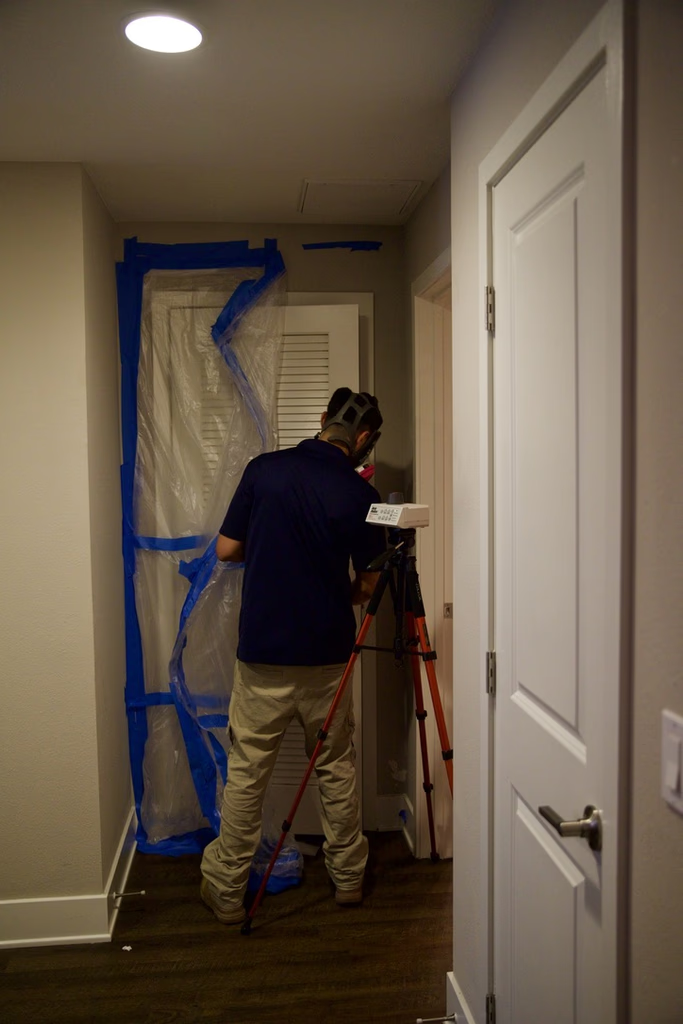
A calibrated pump pulls a controlled volume of air through a spore trap cassette, capturing viable and non-viable spores from the breathing zone. The lab counts species and compares concentrations to outdoor levels, telling you whether your indoor air is healthy.
Checklist
Is Testing Right for You?
Mold testing is ideal if:
- —You suspect mold but can't see it
- —You've had water damage
- —Residents or tenants are reporting health symptoms
- —You're buying, selling, or managing a property
- —You need peace of mind after remediation
Still unsure? Let's talk. We'll help you decide which method suits your case best.
Testing Overview
Our Testing Methods
Techniques we use to collect accurate mold samples from air and surfaces.
Lifts mold samples from surfaces using clear adhesive—quick and non-destructive.
Gathers samples from damp or textured areas to identify active mold growth.
Mold inspection Renton FAQ
Call For An InspectionSame-day and next-day appointments are usually available across our Renton service area, with 24/7 emergency response for active leaks, recent water damage, or urgent real estate timelines. Standard scheduling runs 1 to 3 business days depending on availability.
Our certified mold inspectors assess bathrooms, kitchens, laundry rooms, basements, attics, crawl spaces, HVAC components, and any area showing signs of past or current water issues. Thermal imaging and moisture meters identify hidden moisture behind walls and under floors.
Properties in Renton's lower-elevation areas near the Cedar River and the southern Lake Washington shoreline sit in a zone where the water table is seasonally elevated and where flood events — even minor ones — can introduce moisture into crawl spaces and lower-level areas that persists long after the water recedes. The Cedar River corridor specifically has a history of flooding that affects homes in the valley-floor neighborhoods, and even properties that have not flooded in recent years may carry residual moisture damage in crawl spaces and subfloor systems from earlier events. We recommend any property within the flood-influence zone of the Cedar River receive a crawl space inspection as a baseline, regardless of visible symptoms.
Pricing varies based on the size of the property, the scope of testing required, and whether any lab work is included. Most residential mold inspections in Renton fall within the standard industry range of $300 to $600, with a clear quote provided before any work begins.
Air sampling, swab testing, tape lift testing, wall cavity sampling, and HVAC mold testing. The inspector recommends the right method on-site based on what's found. Samples go to a state-certified lab, with results typically back in 24 to 72 hours.
Mold needs water to grow, so finding the moisture source is what prevents the same problem from coming back after any cleanup. Moisture detection during the inspection identifies plumbing leaks, roof leaks, condensation issues, and humidity buildup that's feeding any growth.
Yes. Post-remediation verification confirms the remediation contractor's work succeeded and the space is safe to reoccupy. Because we don't perform remediation ourselves, the verification stays independent of the remediation contractor's interests, which is what insurers and tenants look for.
The Renton Highlands and adjacent neighborhoods built primarily in the 1950s and 1960s for Boeing workers represent a housing era where the original systems are now aging simultaneously. The galvanized supply lines common in this construction era corrode from the inside out and develop slow leaks inside wall cavities that are invisible until the drywall shows damage. The original forced-air furnace systems from this era develop condensate drain failures and duct leaks as they approach end of life. First-generation asphalt roofing has typically been replaced once but the replacement may not have addressed flashing details at the original roofline. When three or four of these systems begin failing in the same decade, the moisture accumulation accelerates.
Yes — and for a specific reason that flat-lot properties don't share. Talbot Hill, Kennydale, and the Cascade neighborhoods sit on hillside lots where the original cut-and-fill grading directed drainage away from foundations using subdrains and retaining wall weep holes that are now 50 to 70 years old. When those systems fail — weep holes plug with mineral deposits and root intrusion, subdrain lines crush under mature root pressure, grading settles in ways that direct water toward rather than away from the structure — the hillside moisture that was being managed actively redirects toward foundations. The failure is gradual and invisible, and it surfaces as a damp crawl space or basement that appears seasonally before becoming chronic.
Most of Renton's older housing stock has raised foundations with crawl spaces rather than slab-on-grade construction, which means crawl space inspection is a standard part of most assessments here. The crawl space is where Pacific Northwest ground moisture accumulates first — soil moisture migrates upward through the ground and through concrete if the vapor barrier has failed or was never installed, wood subfloor framing sits in elevated humidity, and the combination produces the conditions where mold takes hold years before it's visible from the living space above. The inspection maps moisture readings across the subfloor framing and joists, checks the vapor barrier condition and coverage, and evaluates cross-ventilation — findings that define whether the condition is a maintenance issue or an active growth problem requiring remediation.
Pre-purchase inspection in the Highlands is worth doing specifically because the housing era creates predictable risk patterns that are worth verifying rather than assuming. The inspection goes beyond what a standard home inspection covers: thermal imaging identifies moisture behind walls that a visual inspection misses, crawl space assessment documents the subfloor and vapor barrier condition, and attic inspection checks whether the roofing replacement history left any unaddressed moisture entry points at penetrations or valleys. In a neighborhood where many homes have the same construction vintage, finding a property whose systems are in genuinely good condition versus one that has deferred maintenance across multiple systems simultaneously is exactly what the inspection distinguishes.
Yes — and the timing matters. Mold can begin establishing within 24 to 48 hours of sustained moisture in the right conditions, which means a water damage event that isn't fully dried within that window creates real risk. Testing after a water damage event establishes whether mold growth has begun, where it's active, and which species are present — information that determines the scope and urgency of any remediation work. In Renton's older housing stock, where a slow leak behind a wall may have been running for weeks before the visible damage appeared, testing also establishes the extent of growth that the visible stain doesn't fully reveal. The report is also what an insurer needs to authorize remediation work.
Our Renton team covers all Renton neighborhoods — Renton Highlands, Kennydale, Talbot Hill, Cascade, Downtown Renton, Benson Hill, and Fairwood — with same-day and next-day appointments and 24/7 emergency response for active water intrusion. Several neighboring cities have their own dedicated 24H Mold Inspection pages with local teams: Seattle, Bellevue, Tacoma, and Everett each have separate coverage with their own local phone numbers and area expertise. If your property is in one of those cities, that page will have the most relevant local information.
Yes — office and retail buildings in Downtown Renton and the Rainier Avenue corridor, multifamily residential throughout the city, and commercial properties in the Landing and Southport mixed-use developments near the lake. Renton's commercial mold cases most often involve older masonry downtown buildings where moisture migrates through degraded mortar joints, rooftop HVAC systems on flat commercial roofs with standing water issues, and below-grade mechanical and storage areas in buildings that sit close to the Cedar River and Lake Washington water table.
Inspection and testing only. In Renton's Boeing-era housing stock, where a moisture source is often a combination of aging systems — galvanized plumbing, original HVAC condensate, deteriorated crawl space vapor barrier — failing in the same decade, the remediation scope can be substantial. A company with cleanup work to sell has a financial reason to find more of it. What you receive is the diagnosis: extent of growth, moisture source, lab-confirmed species, and a written scope you can use to get comparable bids from multiple contractors on the same terms. Because we perform no remediation, our post-remediation verification is independent — we have no stake in confirming the work succeeded.
Insurance claims for water damage and mold require documentation of the condition, its probable cause, and the scope of affected material. A lab-verified inspection report from an independent company — one with no remediation work to sell — provides exactly that documentation in a form insurers can work with. The distinction between sudden and accidental damage versus long-term seepage matters for coverage: the inspection report documents the moisture source and its probable duration, which is the information the adjuster needs to make that determination. For Renton properties where a slow crawl space or plumbing leak has been running longer than the visible damage suggests, that documentation protects the claim.
Same-day and next-day inspection appointments are usually available. The written report with lab results is typically delivered within two to three business days of the inspection — lab analysis takes one to two business days, and the report is written after the results are received so findings and lab data appear together. For urgent situations — active water intrusion, pre-closing real estate deadlines, tenant habitability complaints — we can prioritize scheduling and expedite report delivery. 24/7 emergency response is available for active leaks and water damage.
Yes — property management is a significant part of our Renton work, particularly in the Highlands rental corridors and the multifamily stock along Rainier Avenue. What we provide is documentation: a written, lab-verified report that establishes the condition of a unit at a specific point in time, identifies the moisture source, and defines what remediation is needed. For a landlord responding to a tenant habitability complaint under Washington State's Residential Landlord-Tenant Act, that documentation either confirms the problem and defines the fix or provides defensible evidence that the unit met habitability standards. Because we perform no remediation, the report carries no financial interest in its findings.
Contact
Book your Renton mold inspection today
Tell us what's going on and we'll respond the same day
Location
24H Mold Inspection of Renton
Phone
(425) 962-8267Hours
- MondayOpen 24 hours
- TuesdayOpen 24 hours
- WednesdayOpen 24 hours
- ThursdayOpen 24 hours
- Friday6 AM – 6 PM
- SaturdayClosed
- SundayOpen 24 hours
Service area neighborhoods
- Renton Highlands
- Kennydale
- Talbot Hill
- Cascade
- Downtown Renton
- Benson Hill
- Fairwood