
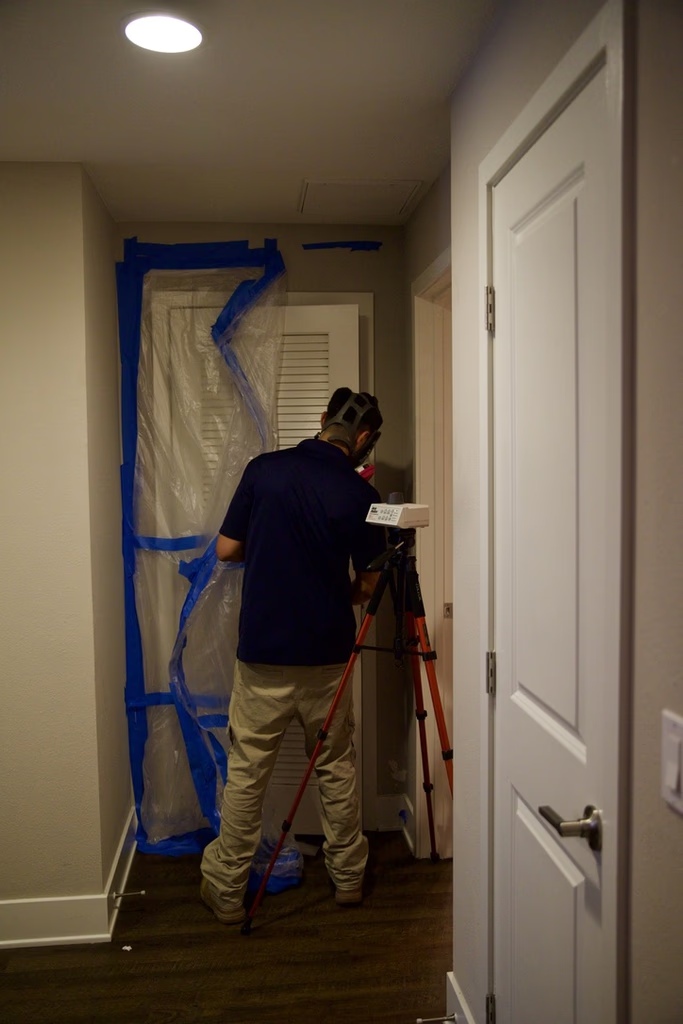
Collects airborne mold spores to assess air quality and detect hidden contamination.
our services
Mold Testing
State-certified testing that spots hidden mold—so you can act early, stay safe, and avoid costly repairs.
About
Why Mold Testing Matters
Mold isn't always visible. It hides in air vents, under floors, and inside walls. The only way to know what you're breathing—or what's spreading—is through lab-grade testing.
- —Identify mold species and spore levels
- —Detect hidden growth in "clean" areas
- —Assess the health risk to occupants
- —Decide on the right next steps
Methodology
How our mold testing works
The three sampling methods we use, chosen for what your property is showing
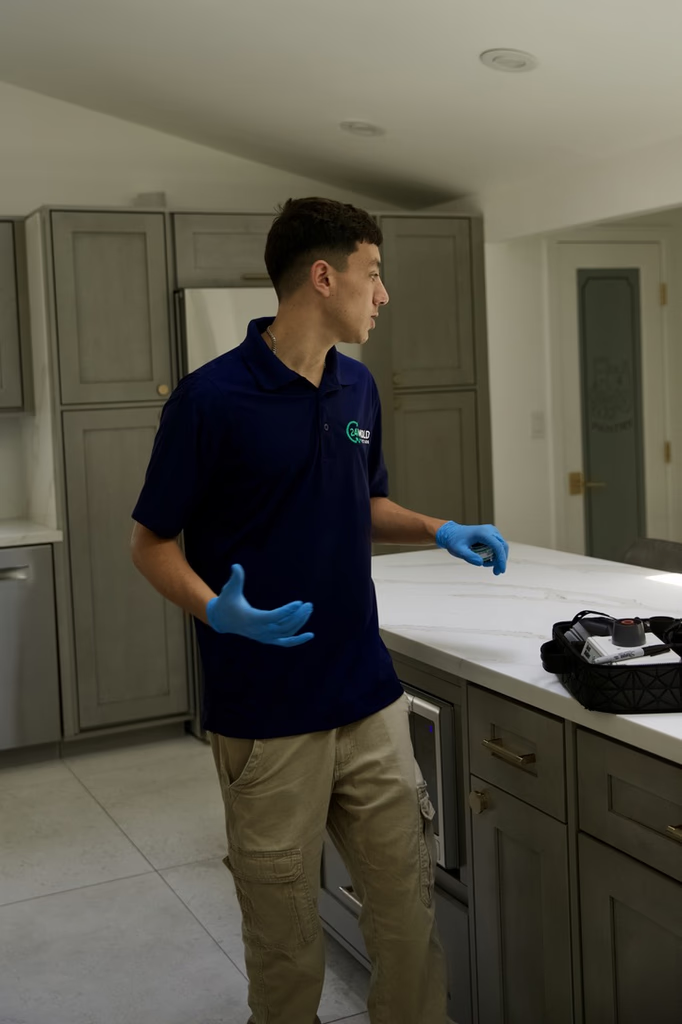
Sterile swabs and clear adhesive tape collect mold from visible spots on dry surfaces, giving the lab a clean sample for species identification. Suitable for walls, ceilings, baseboards, and furniture where the residue is what you're checking.
For damp or recently water-damaged areas, the sampling approach changes. Wet sampling captures live, actively growing colonies that dry methods underrepresent, which matters under flooring, behind tile, and around recent leaks.
A calibrated pump pulls a controlled volume of air through a spore trap cassette, capturing viable and non-viable spores from the breathing zone. The lab counts species and compares concentrations to outdoor levels, telling you whether your indoor air is healthy.
Checklist
Is Testing Right for You?
Mold testing is ideal if:
- —You suspect mold but can't see it
- —You've had water damage
- —Residents or tenants are reporting health symptoms
- —You're buying, selling, or managing a property
- —You need peace of mind after remediation
Still unsure? Let's talk. We'll help you decide which method suits your case best.
Testing Overview
Our Testing Methods
Techniques we use to collect accurate mold samples from air and surfaces.
Lifts mold samples from surfaces using clear adhesive—quick and non-destructive.
Gathers samples from damp or textured areas to identify active mold growth.
Mold inspection Santa Ana FAQ
Call For An InspectionSame-day and next-day appointments are usually available across our Santa Ana service area, with 24/7 emergency response for active leaks, recent water damage, or urgent real estate timelines. Standard scheduling runs 1 to 3 business days depending on availability.
Our certified mold inspectors assess bathrooms, kitchens, laundry rooms, basements, attics, crawl spaces, HVAC components, and any area showing signs of past or current water issues. Thermal imaging and moisture meters identify hidden moisture behind walls and under floors.
Santa Ana's older housing stock — particularly the pre-1960s bungalows and multi-family buildings in its historic neighborhoods — carries a combination of mold risk factors that are largely absent in newer construction. Original galvanized steel or cast-iron plumbing in these properties has exceeded its useful life and develops slow, behind-wall leaks that are invisible until mold growth becomes extensive. Raised wood-frame foundations with crawl spaces, common in the city's older single-family homes, create a ground moisture pathway that requires active venting and vapor barrier management that is frequently absent or has degraded over time. Original single-pane aluminum or wood-frame windows in these properties lack the thermal break of modern glazing, generating condensation on interior surfaces during temperature swings that maintains a sustained moisture source on interior walls and window sills.
Pricing varies based on the size of the property, the scope of testing required, and whether any lab work is included. Most residential mold inspections in Santa Ana fall within the standard industry range of $300 to $600, with a clear quote provided before any work begins.
Air sampling, swab testing, tape lift testing, wall cavity sampling, and HVAC mold testing. The inspector recommends the right method on-site based on what's found. Samples go to a state-certified lab, with results typically back in 24 to 72 hours.
Mold needs water to grow, so finding the moisture source is what prevents the same problem from coming back after any cleanup. Moisture detection during the inspection identifies plumbing leaks, roof leaks, condensation issues, and humidity buildup that's feeding any growth.
Yes. Post-remediation verification confirms the remediation contractor's work succeeded and the space is safe to reoccupy. Because we don't perform remediation ourselves, the verification stays independent of the remediation contractor's interests, which is what insurers and tenants look for.
No. 24H Mold Inspection of Santa Ana inspects and tests only, and we never perform remediation or removal — that separation is deliberate. In Santa Ana's older housing, the pre-1960 bungalows in Heninger Park, Wilshire Square, and Washington Square and the dense apartment stock across the central neighborhoods, the visible patch is usually the smaller half of the problem, and a company that bills for the cleanup has a financial reason to keep finding more of it. What we produce is the diagnosis: what is growing, which moisture source is feeding it, how far it extends behind walls or under flooring, and lab confirmation of what the samples contain. You take that report to remediation contractors and get comparable bids on a defined scope instead of a walkthrough guess. When the work is done, we can return for independent verification — which carries weight with insurers, landlords, and buyers precisely because we had no part in the removal.
Santa Ana is the county seat and sits at the geographic center of Orange County, so our team works well past the city limits. Orange, Tustin, Garden Grove, Costa Mesa, Fountain Valley, Irvine, and Anaheim are all a short drive from a Santa Ana dispatch, which is what makes same-day appointments realistic across central OC. Several of those cities have their own 24H Mold Inspection page with coverage written for that city's housing stock, so if your property is in one of them, start there. Inside Santa Ana we cover the whole city — Floral Park and West Floral Park, Downtown and French Park, Heninger Park, Wilshire Square, Washington Square, Park Santiago and Cabrillo Park, the west-side neighborhoods along the river, and the South Coast Metro towers. If you are not sure which team fits your address, call the number on this page and we will point you to the right one.
Spore testing means drawing a measured volume of air through a spore trap in each area of concern and taking a matching outdoor sample as the baseline. That outdoor comparison is what makes the numbers readable — spores are always present in the air, and it is an indoor count elevated above the outdoor count that points to an indoor source. The baseline matters more here than people expect, because Santa Ana sits in the flat middle of the county under the marine layer, and a Santa Ana wind event days earlier can load the outdoor air with dust and spores that skew a raw indoor number. Samples go to a state-certified lab that identifies the genera present and their concentrations, typically back within 24 to 72 hours. Air testing is the right call when someone has symptoms or there is a musty smell with nothing visible, which in the city's raised-foundation homes and shared-wall apartments usually means the source is a crawl space or wall cavity rather than the room you are standing in.
No. A general home inspection is a broad condition survey — roof, electrical, plumbing, appliances — and its mold coverage stops at what is visible in accessible areas; most contracts exclude mold outright. A mold inspection is narrow and instrument-driven: thermal imaging and moisture meters to find wet material behind stucco, tile, and drywall, entry into crawl spaces and attics, and lab-analyzed air or surface samples when something turns up. That gap matters in Santa Ana because so much of the for-sale inventory is pre-1960 — bungalows in Wilshire Square, Heninger Park, and Floral Park sitting on raised foundations, with decades-old galvanized supply lines and additions built across several eras. Those are precisely the conditions a visual-only walkthrough misses. Most buyers here do both: the home inspection for overall condition, and a separate mold inspection when the general report notes staining, a musty odor, past water damage, or an unvented crawl space.
Start by documenting it. About half of Santa Ana households rent, and much of that stock is dense mid-century apartment and duplex construction where a leak in one unit surfaces in a neighbor's wall — so where the water is coming from is a real question, and an independent inspection answers it with moisture mapping and lab results instead of opinion. California law puts habitability on the owner: Health and Safety Code section 17920.3, as amended by SB 655, treats visible mold as a substandard condition, and a building's age is not an excuse. Santa Ana also has a rent stabilization and just-cause ordinance and a code enforcement division that responds to habitability complaints, so a written third-party report supports both a city complaint and any later dispute over repairs, rent, or a deposit. Tenants can arrange an inspection of their own unit directly; you do not need the owner to participate.
If water got in, yes. Santa Ana sits low on the coastal plain with the river channel along its west side and Santiago Creek cutting through the east, and the flat central and west-side neighborhoods have a long history of street flooding in heavy rain — the recent atmospheric-river winters pushed water into garages, ground-floor units, and slab homes across the city. Mold can start within 24 to 48 hours of that kind of wetting, and the water that matters is what wicked into the bottom of drywall, under flooring, and into the crawl spaces beneath the older raised-foundation homes. Restoration crews dry what their equipment can reach; independent moisture testing verifies whether the structure actually dried, using meters and thermal imaging on wall cavities and subfloor. It also creates a dated written record for an insurance claim. Because we do not perform restoration or remediation, that verification stays independent of whoever did the drying.
Leave it alone. Do not scrub it, bleach it, or cut it out — disturbing growth pushes spores through the rest of the house and destroys the evidence needed to scope the cleanup. Close off the room, shut down any HVAC that circulates through it so the ductwork does not spread it, and photograph what you see. Then have it sampled: dark growth is frequently a common species such as Cladosporium or Aspergillus rather than Stachybotrys, and no one can tell them apart by eye, so a surface sample for identification plus air samples for spread is what turns a guess into a plan. The water source matters just as much. In Santa Ana's pre-1960 homes it is usually original galvanized or cast-iron plumbing failing behind a wall, an unvented crawl space under a raised foundation, or a roof-to-wall detail on an old addition; in an apartment or duplex it is often a neighbor's plumbing on the far side of a shared wall. Cleanup that skips the water source only buys time.
The visit opens with the building's history — age, past repairs, recent plumbing work, and what you have noticed — then moves into a systematic survey: room by room visually, thermal imaging to locate the temperature differences that indicate wet material behind finishes, and pin and pinless moisture meters to confirm it. In Floral Park, French Park, Park Santiago, and the other older residential neighbourhoods, the crawl space carries a disproportionate share of the findings. A raised wood-frame foundation over soil that stays damp through the wet season, combined with original cast-iron or galvanized supply and drain lines running through that same space, produces exactly the slow, concealed wetting that feeds growth on joists and subfloor for years without a sign upstairs. Single-pane windows and the wall assemblies beneath them are the other recurring finding. Expect two to three hours for a typical bungalow, with the crawl space often accounting for a substantial part of it.
There is no statewide license to check. California's Toxic Mold Protection Act of 2001 directed the state to set permissible exposure limits for indoor mold, those limits were never established, and no agency issues or revokes a mold inspector credential as a result. What you can verify is more useful in practice. Confirm recognized third-party industry certification and current liability insurance. Confirm samples go to an accredited independent laboratory rather than being read on site by the person selling you something. Confirm the company does not also sell remediation, because an inspector who earns money from the cleanup has a direct financial reason to find more of it. And confirm you will receive a written report with photographs, readings, and marked sample locations. That last point does real work in Santa Ana, where a large share of housing is rented and a mold complaint frequently becomes a documented dispute — a verbal finding is worth nothing once the condition is contested, no matter who said it.
Yes — apartment buildings and duplexes throughout the urban core, offices and retail downtown and along the South Coast Metro corridor, light-industrial buildings, and institutional and government properties in the civic center. Multi-unit buildings need a different approach than houses because the plumbing is shared: stacks and supply lines serve several units, so a failure inside one wall migrates into the ceiling and wall cavities next door or below, and the tenant who reports the odor is regularly not the tenant with the leak. Inspecting the complaining unit alone documents the symptom and misses the source. Light-industrial and older commercial buildings bring low-slope roof drainage and rooftop HVAC condensation above ceiling systems, plus large interior volumes where a leak can run a long time before anyone notices. Reports are written to be relied on by an owner, a property manager, an insurer, a tenant, or counsel, and carry no interest in the size of the cleanup that follows.
Hand every contractor the same report and ask them to bid the scope it documents. That single step is what makes quotes comparable, because the bids then differ on price and method rather than on how much mold each company says it sees. Confirm a current CSLB license, required on any job over five hundred dollars in combined labor and materials, along with workers compensation and liability coverage. Ask specifically how the moisture source will be repaired and not only how affected material will be removed — in Santa Ana's older housing that repair is frequently a section of original cast-iron or galvanized plumbing, or crawl space drainage and a vapor barrier, and remediation that skips it will produce the same condition again. If the property is a rental, keep the documentation clean as you go: dated scope, dated invoices, and an independent clearance report at the end. That chain is far easier to assemble during the work than to reconstruct afterward.
It is the independent check performed after the cleanup and before containment comes down and new drywall goes up: confirmation that the affected material was actually removed, meter verification that framing and substrate dried to a normal moisture content, and clearance air sampling compared against an outdoor control taken the same day. It should come from someone other than the remediation company, since a contractor verifying their own work is grading their own exam. In Santa Ana the strongest case for it is in rental housing. Where an owner and a tenant have disagreed about a condition — and in a city with this much multi-family stock that is a routine situation — an independent clearance report ends the dispute because it comes from a party with no stake in the cleanup invoice or the tenancy. On a raised-foundation home it also confirms the crawl space itself dried, not only the finished rooms above it.
The report documents four things: what was found and where, the photographs and instrument readings supporting it, the moisture source driving the growth, and any laboratory results with sample locations marked. That combination is what makes it useful to somebody other than you. Adjusters want the moisture source and a dated record of the condition, because policies distinguish sharply between a sudden failure and long-term seepage and that distinction usually decides coverage. Remediation contractors want a defined scope so their bids are comparable. Buyers, sellers, and agents want findings from a party with no stake in the transaction. Tenants, owners, property managers, and code enforcement all want a record that neither side in a dispute produced — which is the most common use of these reports in Santa Ana. Laboratory results generally return within twenty-four to seventy-two hours, so the complete report follows within days of the visit rather than weeks.
Contact
Book your Santa Ana mold inspection today
Tell us what's going on and we'll respond the same day
Location
24H Mold Inspection of Santa Ana
Phone
(657) 655-7779Hours
- MondayOpen 24 hours
- TuesdayOpen 24 hours
- WednesdayOpen 24 hours
- ThursdayOpen 24 hours
- Friday6 AM – 6 PM
- SaturdayClosed
- SundayOpen 24 hours
Service area neighborhoods
- Floral Park
- Park Santiago
- French Park
- Downtown Santa Ana
- South Coast Metro
- Willard
- Cabrillo Park
- West Floral Park