24H Mold Inspection
Santa Ana24/7 EMERGENCY(657) 655-7779
HomeOur ServicesEnvironmental Risk Assessment
our services

Environmental Risk Assessment

We identify hidden mold risks and verify that your space is safe to occupy.

About

Why Risk Assessment Matters

Even after cleanup or surface testing, questions often remain: Is it really gone? Are we safe to move forward? That's where an Environmental Risk Assessment comes in.

Ideal for:

  • Post-remediation verification
  • Pre-sale property inspections
  • Property management compliance
  • Sensitive environments (schools, offices, multi-unit housing)
Why Risk Assessment Matters

Methodology

Our Assessment Process

Step-by-step inspection to confirm your space is safe.

We inspect key areas across your property to identify visible signs of mold, moisture, or environmental risks that may have been missed in past inspections.

We use precision tools to measure moisture in building materials and collect air samples for lab analysis—capturing invisible spores that may linger in the environment.

Within 24–72 hours, you'll receive a certified report detailing our findings: mold species (if present), spore levels, moisture hotspots, and actionable next steps.

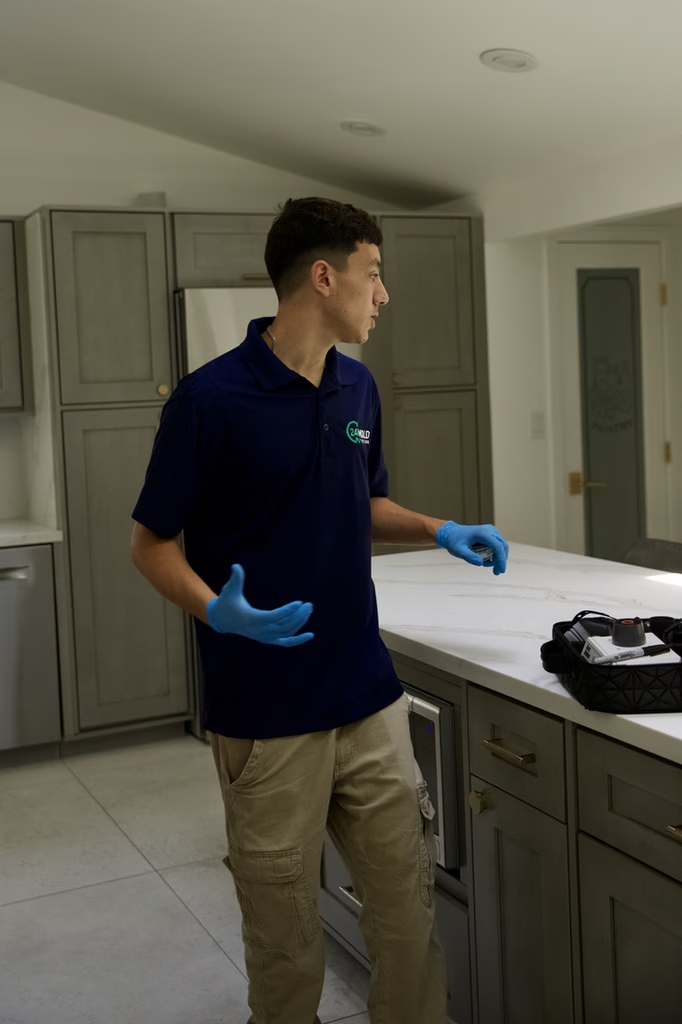
Mold inspector at work

Checklist

Is an Environmental Risk Assessment Right for You?

This service is ideal if:

  • You've had recent remediation or water damage
  • You're buying, selling, or managing a property
  • You need proof your space is safe to occupy

Still unsure? Let's talk. We'll help you decide if an assessment is the right step for your property.

Overview

What You'll Get

Certified results, safety clarity, and clear next steps—delivered fast.

1

Comprehensive Risk Report

State-certified results that summarize mold levels, moisture issues, and remediation needs.

2

Occupancy Safety Verification

Peace of mind that your property is safe to inhabit—especially critical for buyers, renters, and businesses.

3

Actionable Recommendations

If risks are found, we provide clear guidance on next steps. If not, your report becomes a safety asset.

Mold inspection Santa Ana FAQ

Call For An Inspection
No. 24H Mold Inspection of Santa Ana inspects and tests only, and we never perform remediation or removal — that separation is deliberate. In Santa Ana's older housing, the pre-1960 bungalows in Heninger Park, Wilshire Square, and Washington Square and the dense apartment stock across the central neighborhoods, the visible patch is usually the smaller half of the problem, and a company that bills for the cleanup has a financial reason to keep finding more of it. What we produce is the diagnosis: what is growing, which moisture source is feeding it, how far it extends behind walls or under flooring, and lab confirmation of what the samples contain. You take that report to remediation contractors and get comparable bids on a defined scope instead of a walkthrough guess. When the work is done, we can return for independent verification — which carries weight with insurers, landlords, and buyers precisely because we had no part in the removal.
Santa Ana is the county seat and sits at the geographic center of Orange County, so our team works well past the city limits. Orange, Tustin, Garden Grove, Costa Mesa, Fountain Valley, Irvine, and Anaheim are all a short drive from a Santa Ana dispatch, which is what makes same-day appointments realistic across central OC. Several of those cities have their own 24H Mold Inspection page with coverage written for that city's housing stock, so if your property is in one of them, start there. Inside Santa Ana we cover the whole city — Floral Park and West Floral Park, Downtown and French Park, Heninger Park, Wilshire Square, Washington Square, Park Santiago and Cabrillo Park, the west-side neighborhoods along the river, and the South Coast Metro towers. If you are not sure which team fits your address, call the number on this page and we will point you to the right one.
Spore testing means drawing a measured volume of air through a spore trap in each area of concern and taking a matching outdoor sample as the baseline. That outdoor comparison is what makes the numbers readable — spores are always present in the air, and it is an indoor count elevated above the outdoor count that points to an indoor source. The baseline matters more here than people expect, because Santa Ana sits in the flat middle of the county under the marine layer, and a Santa Ana wind event days earlier can load the outdoor air with dust and spores that skew a raw indoor number. Samples go to a state-certified lab that identifies the genera present and their concentrations, typically back within 24 to 72 hours. Air testing is the right call when someone has symptoms or there is a musty smell with nothing visible, which in the city's raised-foundation homes and shared-wall apartments usually means the source is a crawl space or wall cavity rather than the room you are standing in.
No. A general home inspection is a broad condition survey — roof, electrical, plumbing, appliances — and its mold coverage stops at what is visible in accessible areas; most contracts exclude mold outright. A mold inspection is narrow and instrument-driven: thermal imaging and moisture meters to find wet material behind stucco, tile, and drywall, entry into crawl spaces and attics, and lab-analyzed air or surface samples when something turns up. That gap matters in Santa Ana because so much of the for-sale inventory is pre-1960 — bungalows in Wilshire Square, Heninger Park, and Floral Park sitting on raised foundations, with decades-old galvanized supply lines and additions built across several eras. Those are precisely the conditions a visual-only walkthrough misses. Most buyers here do both: the home inspection for overall condition, and a separate mold inspection when the general report notes staining, a musty odor, past water damage, or an unvented crawl space.
Start by documenting it. About half of Santa Ana households rent, and much of that stock is dense mid-century apartment and duplex construction where a leak in one unit surfaces in a neighbor's wall — so where the water is coming from is a real question, and an independent inspection answers it with moisture mapping and lab results instead of opinion. California law puts habitability on the owner: Health and Safety Code section 17920.3, as amended by SB 655, treats visible mold as a substandard condition, and a building's age is not an excuse. Santa Ana also has a rent stabilization and just-cause ordinance and a code enforcement division that responds to habitability complaints, so a written third-party report supports both a city complaint and any later dispute over repairs, rent, or a deposit. Tenants can arrange an inspection of their own unit directly; you do not need the owner to participate.
If water got in, yes. Santa Ana sits low on the coastal plain with the river channel along its west side and Santiago Creek cutting through the east, and the flat central and west-side neighborhoods have a long history of street flooding in heavy rain — the recent atmospheric-river winters pushed water into garages, ground-floor units, and slab homes across the city. Mold can start within 24 to 48 hours of that kind of wetting, and the water that matters is what wicked into the bottom of drywall, under flooring, and into the crawl spaces beneath the older raised-foundation homes. Restoration crews dry what their equipment can reach; independent moisture testing verifies whether the structure actually dried, using meters and thermal imaging on wall cavities and subfloor. It also creates a dated written record for an insurance claim. Because we do not perform restoration or remediation, that verification stays independent of whoever did the drying.
Leave it alone. Do not scrub it, bleach it, or cut it out — disturbing growth pushes spores through the rest of the house and destroys the evidence needed to scope the cleanup. Close off the room, shut down any HVAC that circulates through it so the ductwork does not spread it, and photograph what you see. Then have it sampled: dark growth is frequently a common species such as Cladosporium or Aspergillus rather than Stachybotrys, and no one can tell them apart by eye, so a surface sample for identification plus air samples for spread is what turns a guess into a plan. The water source matters just as much. In Santa Ana's pre-1960 homes it is usually original galvanized or cast-iron plumbing failing behind a wall, an unvented crawl space under a raised foundation, or a roof-to-wall detail on an old addition; in an apartment or duplex it is often a neighbor's plumbing on the far side of a shared wall. Cleanup that skips the water source only buys time.

Contact

Book your Santa Ana mold inspection today

Tell us what's going on and we'll respond the same day

Location

24H Mold Inspection of Santa Ana

Service area neighborhoods

  • Floral Park
  • Park Santiago
  • French Park
  • Downtown Santa Ana
  • South Coast Metro
  • Willard
  • Cabrillo Park
  • West Floral Park
Call For Service(657) 655-7779