
Collects airborne mold spores to assess air quality and detect hidden contamination.
our services
Mold Testing
State-certified testing that spots hidden mold—so you can act early, stay safe, and avoid costly repairs.
About
Why Mold Testing Matters
Mold isn't always visible. It hides in air vents, under floors, and inside walls. The only way to know what you're breathing—or what's spreading—is through lab-grade testing.
- —Identify mold species and spore levels
- —Detect hidden growth in "clean" areas
- —Assess the health risk to occupants
- —Decide on the right next steps
Methodology
How our mold testing works
The three sampling methods we use, chosen for what your property is showing
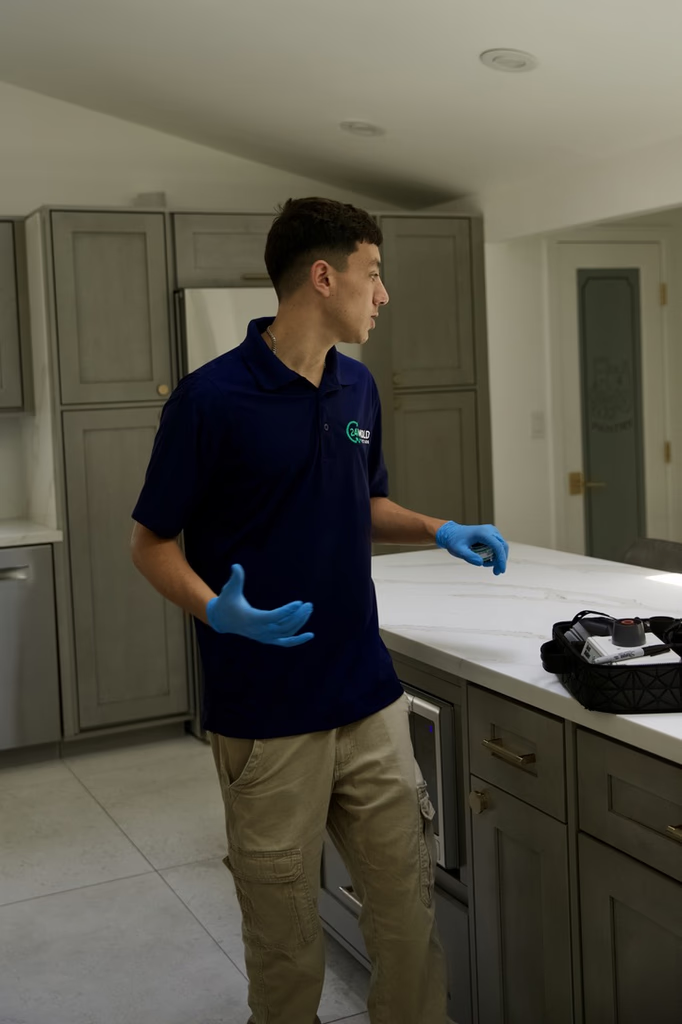
Sterile swabs and clear adhesive tape collect mold from visible spots on dry surfaces, giving the lab a clean sample for species identification. Suitable for walls, ceilings, baseboards, and furniture where the residue is what you're checking.
For damp or recently water-damaged areas, the sampling approach changes. Wet sampling captures live, actively growing colonies that dry methods underrepresent, which matters under flooring, behind tile, and around recent leaks.
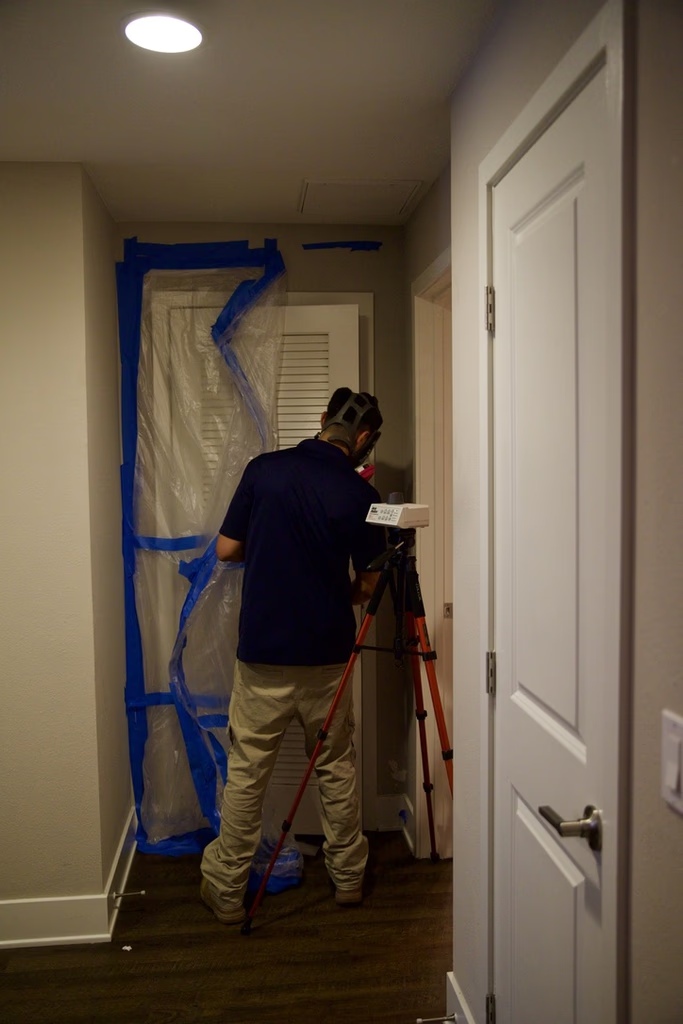
A calibrated pump pulls a controlled volume of air through a spore trap cassette, capturing viable and non-viable spores from the breathing zone. The lab counts species and compares concentrations to outdoor levels, telling you whether your indoor air is healthy.
Checklist
Is Testing Right for You?
Mold testing is ideal if:
- —You suspect mold but can't see it
- —You've had water damage
- —Residents or tenants are reporting health symptoms
- —You're buying, selling, or managing a property
- —You need peace of mind after remediation
Still unsure? Let's talk. We'll help you decide which method suits your case best.
Testing Overview
Our Testing Methods
Techniques we use to collect accurate mold samples from air and surfaces.
Lifts mold samples from surfaces using clear adhesive—quick and non-destructive.
Gathers samples from damp or textured areas to identify active mold growth.
Mold inspection Palos Verdes FAQ
Call For An InspectionSame-day and next-day appointments are usually available across our Palos Verdes service area, with 24/7 emergency response for active leaks, recent water damage, or urgent real estate timelines. Standard scheduling runs 1 to 3 business days depending on availability.
Our certified mold inspectors assess bathrooms, kitchens, laundry rooms, basements, attics, crawl spaces, HVAC components, and any area showing signs of past or current water issues. Thermal imaging and moisture meters identify hidden moisture behind walls and under floors.
Ocean exposure increases both humidity and salt-related deterioration of exterior building materials. Marine air can keep surfaces damp for longer periods, while salt accelerates wear on roofing, windows, flashing, and exterior finishes. Over time, this combination can create additional pathways for moisture intrusion and hidden mold development within the building envelope.
Pricing varies based on the size of the property, the scope of testing required, and whether any lab work is included. Most residential mold inspections in Palos Verdes fall within the standard industry range of $300 to $600, with a clear quote provided before any work begins.
Air sampling, swab testing, tape lift testing, wall cavity sampling, and HVAC mold testing. The inspector recommends the right method on-site based on what's found. Samples go to a state-certified lab, with results typically back in 24 to 72 hours.
Mold needs water to grow, so finding the moisture source is what prevents the same problem from coming back after any cleanup. Moisture detection during the inspection identifies plumbing leaks, roof leaks, condensation issues, and humidity buildup that's feeding any growth.
Yes. Post-remediation verification confirms the remediation contractor's work succeeded and the space is safe to reoccupy. Because we don't perform remediation ourselves, the verification stays independent of the remediation contractor's interests, which is what insurers and tenants look for.
No. We inspect, test, and document, and we do not perform remediation or removal on any property. On the Peninsula that separation carries extra weight, because so many moisture problems here trace back to ground movement rather than a burst pipe. In Portuguese Bend, and along the canyon rims in Rolling Hills Estates, structures get pulled out of square by seasonal land movement that shears supply lines, cracks slabs, and opens joints where an addition meets original framing. A company paid by the square foot of demolition is not the right party to decide how much of that wall is actually wet. Our report maps the moisture, names the source, and defines a scope several remediation firms can bid on identical terms, which matters when a claim, a geotechnical report, and an insurer are all looking at the same house. If the work is already finished, we can verify it independently, which the firm that performed it cannot.
Across the Peninsula we cover Palos Verdes Estates, Rolling Hills, Rolling Hills Estates, and Rancho Palos Verdes, including Lunada Bay, Valmonte, Portuguese Bend, and Miraleste. Gated addresses need the inspector added to a gate list before the visit — worth arranging when you book, since Rolling Hills is entered only through its three staffed gates. Off the hill, Torrance, Redondo Beach, Manhattan Beach, Gardena, Harbor City, Carson, and Long Beach each have their own 24H Mold Inspection page written for that city's housing stock, so start there if your property sits in one of them. Standard appointments run same-day to three business days depending on availability, and emergencies — an active leak, a failed supply line, water standing in a lower level after a storm — are handled 24/7, including in the slide area where access routes change. If you are unsure which page covers your address, call the number on this page.
They answer different questions, and the gap between them is wider here than in most of the county. A general home inspection is a visual survey of the whole property by a generalist, and on the Peninsula the line that sends people here usually reads evidence of past moisture or movement, recommend evaluation by a specialist. A mold inspection is narrow and instrumented: thermal imaging and moisture meters to locate water inside assemblies, then lab samples to identify what is growing. That gap matters on a Rancho Palos Verdes or Palos Verdes Estates house because the two most common intrusion paths are invisible from inside a room — failed underlayment beneath clay barrel tile that still looks perfect from the street, and a below-grade wall on a stepped hillside pad taking slope seepage. In escrow, book both in the same week: the general inspection frames the questions, and a moisture map with lab results is the document that supports a repair credit before the contingency expires.
It changes what we look for, not whether an inspection is worth doing. The slide has been moving since 1956, when fill placed for the Crenshaw Boulevard extension loaded an existing landslide complex, and after the heavy winters of 2023 and 2024 measured movement reached roughly nine to thirteen inches a week before slowing again. Gas service was shut off to homes in the slide area in 2024. Ground movement does not create mold on its own; what it does is open water paths. The recurring findings are sheared or strained supply and drain lines feeding a slab or crawl space, cracked slabs wicking ground moisture, racked window and door frames leaking at the head, and separations where an addition meets original framing. Geotechnical monitoring answers where the land is going. A moisture map answers what is wet inside the house right now. If your property sits in the slide area, pair the two and re-check after each wet winter rather than waiting for a stain to appear.
Detection locates the water and the growth. Testing identifies what the growth is. Detection is instrument work done on site: thermal imaging to flag the temperature signature wet material leaves behind a finished wall, pin and pinless meters to confirm the material is genuinely damp and map how far the damp area extends, and a borescope into a cavity when there is reason to open one. Testing is the lab half, with air cassettes, swabs, or tape lifts analyzed for genera and concentration. Peninsula homes need both, in that order, and the order matters more here because the coastal background moves: a sample taken on a foggy morning near the bluff line does not read like one taken on a clear afternoon inland, so an indoor number with no same-visit outdoor comparison and no located moisture source tells you very little. A useful report names where water is entering, shows where the wet material starts and stops, and pairs that with lab results.
Three things, and they are specific to this terrain. First, independence: we inspect and test only, so nobody in our company is quoting the demolition our own report would justify, and on Peninsula homes that separation is what makes a report usable in a claim or a disclosure. Second, hillside and slide-area experience. An inspector who works flat tract housing heads for the bathroom and the water heater; here the recurring findings are stepped pads with rooms partly below grade, retaining walls with crushed or silted subdrains, and clay barrel tile roofs whose underlayment failed decades before the tile will. Third, sampling discipline, meaning same-visit outdoor comparison samples analyzed by an accredited lab, with results back in 24 to 72 hours. Ask anyone you call whether they also perform remediation, and if the answer is yes, have the moisture mapping done by someone who is not bidding on the repair.
It can, and it is the moisture source people here least expect. Most of Rolling Hills has never been connected to a sanitary sewer, so homes run on septic tanks and seepage pits, and the equestrian properties across Rolling Hills Estates add stables, wash racks, and tack rooms that are wet by design and rarely ventilated for it. A seepage pit that has stopped percolating saturates the soil around it, and on a sloped multi-acre lot that water travels downhill toward whatever sits below it: a crawl space, a stepped-down guest wing, a barn slab. Indoors the symptom is usually a musty smell with no visible source and no plumbing leak anyone can find, because the water never came through the house's plumbing at all. If a system has been running slow, or there is irrigated pasture uphill of the residence, have the crawl space and the lower-level walls mapped before assuming the problem is condensation.
Two to three hours for a typical house, longer for an estate parcel or a property with a guest house, pool house, or stable. What the inspector needs open is the attic hatch, any crawl space, the mechanical space, and the rooms set partly below grade on a stepped hillside pad, which is where slope seepage shows up first. On a tile roof we work from the underside and from the ground rather than walking the field, because clay barrel tile breaks under foot traffic and a cracked tile is a new leak. Gated addresses need the inspector added to a gate list before the visit — Rolling Hills is entered only through its staffed gates, and several Rancho Palos Verdes and Palos Verdes Estates tracts have their own. Lab results come back in 24 to 72 hours, followed by a written report with photographs, readings, and sample locations.
Yes, because on the Peninsula the extent of a wet area is genuinely contested. We inspect and test only and perform no removal, so nothing in the report is scoped to work we would then sell. That independence matters when a claim involves ground movement: in Portuguese Bend and along the canyon rims in Rolling Hills Estates, an insurer, a geotechnical engineer, and a remediation contractor may all be reading the same house, and the question of what is wet needs to be answered by measurement rather than by the party billing for demolition. Once the moisture source, the extent behind the finish, and the lab results are in writing, two or three licensed remediation contractors can bid identical scope. Where the finding is a repaired supply line and a limited cleaning, that is what the report says, and that smaller scope is what everyone prices.
Photographs, thermal images where they show something, moisture and humidity readings by location, a description of the moisture source, the mapped extent of affected material, sample locations, and the accredited lab's results with genera and concentrations. It is written to be read by someone who was not present: an insurer, an escrow file, a community association board, a geotechnical consultant, or a remediation contractor preparing a bid. That audience is the reason we keep remediation out of the business — a report from a company with no cleanup to sell carries weight in a dispute that a free walkthrough from a removal contractor does not. On the Peninsula the two most common destinations are an escrow disclosure package on a high-value listing and an association file where the question is whether a leak crossed a boundary between a unit and common area.
Yes — the retail centers around the Peninsula Center in Rolling Hills Estates and Golden Cove in Rancho Palos Verdes, professional and medical offices, schools, clubhouses, and the common areas and shared structures of the community associations that govern much of the Peninsula's housing. Commercial and common-area work differs mainly in where the water hides and who reads the result. Low-slope roofs over retail drain through a small number of interior drains and spread water sideways above a ceiling grid, and association buildings often carry decades of alterations approved in stages, so old damage sits behind newer finishes. For association work the operative question is usually jurisdictional — whether the wet assembly is a unit's or the association's — and that is settled by a moisture map from someone who is not bidding the repair.
Hand the same document to three of them so they bid identical scope instead of writing their own findings. Ask each whether they will correct the water source or only remove material; on the Peninsula that source is frequently a roof underlayment replacement beneath clay barrel tile, a crushed or silted subdrain behind a retaining wall, or a line strained by ground movement, none of which a remediation crew handles, so plan for a second trade and a sequence. In Palos Verdes Estates, exterior repairs also go before the Art Jury, which is one more reason to know the exact extent before anyone applies. Confirm license classification and insurance, ask for containment and negative air on anything beyond a small area, and require a written scope rather than a lump sum. Have clearance testing done afterward by someone who had no part in the removal.
If water sat for more than a day, or if you cannot confirm the structure dried through, yes. Growth can begin within 24 to 48 hours, and the water that matters is inside the assembly rather than on the floor that got mopped. Peninsula water damage arrives in a few recognizable forms: a winter storm driving rain past failed underlayment on a tile roof, slope seepage reaching a below-grade wall on a stepped pad, a supply line strained where the ground has moved, and irrigation running against a foundation for months. Restoration crews dry what they can reach, but the bottom plate behind baseboard and the cavity of a below-grade wall routinely stay wet. An independent moisture assessment verifies the drying actually worked and creates a dated record for a claim, and it stays independent because we did not perform the drying.
Contact
Book your Palos Verdes mold inspection today
Tell us what's going on and we'll respond the same day
Location
24H Mold Inspection of Palos Verdes
Phone
(424) 777-8848Service area neighborhoods
- Palos Verdes Estates
- Rolling Hills
- Rolling Hills Estates
- Rancho Palos Verdes
- Lunada Bay
- Valmonte
- Portuguese Bend
- Miraleste