1
Mold inspection
- Moisture detection
- Infrared technology
- Certified mold inspectors
- No conflict of interest

Certified mold inspection and testing in Ontario. Same-day appointments, lab-verified reports, and no financial stake in any remediation work that follows.
(909) 914-4552What We Do
Air and surface samples analyzed in a state-certified lab. You receive mold species ID, spore count data, and lab-verified documentation that holds up with insurers, attorneys, or counsel.
About
At 24H Mold Inspection of Ontario, we know no two buildings respond to moisture the same way.
Ontario serves as one of the Inland Empire’s largest residential, commercial, and logistics hubs, combining established neighborhoods, master-planned developments, industrial facilities, and major transportation infrastructure. While the region’s climate is relatively dry, moisture issues remain common due to slab foundations, plumbing leaks, roof failures, and extensive air-conditioning use during prolonged periods of hot weather. The city’s rapid growth has created a diverse building inventory ranging from older residential areas to newly constructed developments, each presenting distinct moisture challenges. As a result, mold concerns in Ontario are often driven by building-specific conditions rather than outdoor humidity alone.
Ontario contains suburban homes, master-planned communities, apartment developments, industrial facilities, warehouses, and commercial properties. HVAC systems, slab construction, and rapid-growth development patterns frequently influence moisture conditions.
Services
Mold inspection, mold testing, and environmental risk assessments for Ontario properties. Available 24/7, with no remediation work to bias the findings.

Why Us
24H Mold Inspection of Ontario combines local field experience with state-certified methods and lab analysis. Reports get back to you quickly and clearly, with no upsell tacked on to the findings.
We don't stop at surface-level findings. Active leaks, health symptoms, post-remediation work, and pre-purchase due diligence each call for a different inspection approach. Our certified mold inspectors guide you through the specific situation rather than running a generic checklist.
Strengths
We check every box, then go further. Book your inspection today
Licensed inspectors with proven field experience in Ontario.
FLIR thermal cameras, calibrated moisture meters, and lab-verified sampling.
Straightforward updates and honest reporting throughout the process.
Highly rated by Ontario homeowners and businesses.
5 Step Process
Choose a date and time that fits your schedule.
Flexible scheduling means same-day and next-day appointments are usually available, with 24/7 emergency response when the situation needs it.
Our certified mold inspectors assess every mold-prone area.
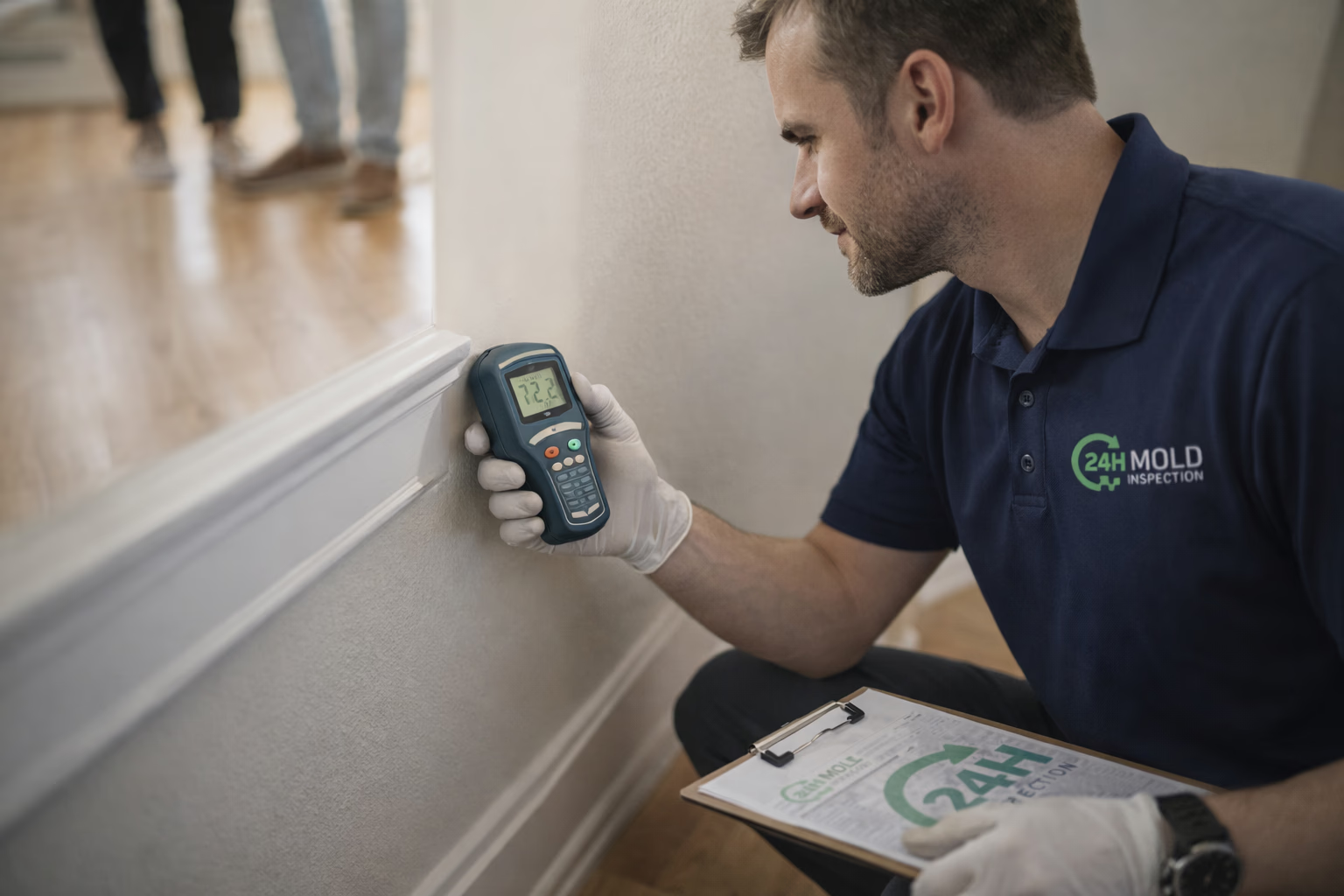
We walk the property identifying visible mold and moisture issues, using thermal imaging and moisture meters to catch what's hidden behind walls and under flooring.
Air and surface samples collected for lab analysis.
Our certified mold inspectors collect targeted samples from key areas to find mold spores both visible and hidden, with sample sites documented on a property map.
Lab testing returns precise results.
Samples go to a state-certified lab for detailed analysis identifying mold species and contamination levels, typically returned within 24 to 72 hours.
Insights and clear next steps from our experts.
You receive a written report with lab results, inspector findings, and specific recommended action steps to resolve any mold issues safely.
Who We Serve
24H Mold Inspection of Ontario brings clear answers to HOAs, hotels, commercial buildings, and homes through certified mold inspection and testing services.
George Chaffey bought 6,218 acres with water rights in August 1881, and when the Ontario colony lands went on sale in November 1882 the centerpiece was Euclid Avenue — eight miles long and 200 feet wide, with twin driveways separated by a parkway planted with pepper trees. A severe windstorm in December 1953 brought down so many of those trees that schoolchildren planted replacements the next year. The older homes along and near the avenue include some of the city's earliest houses, many on raised foundations with crawl spaces, where damp soil, aging plumbing, roots in sewer laterals, and leaf-clogged gutters drive moisture.
Downtown grew around Euclid Avenue and the rail line on the original colony grid, and its blocks hold Ontario's oldest commercial buildings alongside early-twentieth-century cottages and bungalows. The storefronts are masonry with flat roofs behind parapets, where drains clog and flashing fails, and many of the surrounding houses have been enlarged, re-roofed, and re-plumbed several times. Original galvanized supply lines, cast-iron drains, crawl spaces under raised floors, and the seams where additions meet original walls are the recurring sources of hidden moisture, and in mixed-use buildings a leak above becomes the business's problem below.
Much of central Ontario filled in during the postwar decades with single-story stucco homes on concrete slabs, now 60 to 70 years old. They share a predictable set of aging systems: copper or galvanized supply lines leaking inside walls or under the slab, cast-iron drains cracking beneath bathrooms, roofs re-covered over older layers, and roof-mounted evaporative coolers leaking at their curbs or run during humid late-summer weather. Garage conversions built directly on unsealed slabs are common on these lots, and bathroom fans that were never installed or that vent into the attic leave growth concentrated above wet rooms.
Ontario International Airport anchors a broad industrial and logistics corridor of tilt-up warehouses, distribution centers, and business parks across the middle of the city. These buildings carry their own moisture pattern: acres of low-slope roof with internal drains that clog with wind-blown dust and debris, rooftop units and skylights with failing curb seals, leaks that travel across the roof deck before dripping far from where they entered, and slabs where moisture migrates into stored inventory and packaging. Dock doors and constant trailer traffic bring rain in at the perimeter, and conditioned offices inside hot warehouse shells condense at the boundary.
South of the older city, the dairy land of the former agricultural preserve was annexed in 1999 under the working name New Model Colony, a nod to the Chaffeys' original plan, and has since been built out as Ontario Ranch, a master-planned community intended for tens of thousands of homes. The houses are new and tight — two-story stucco over slab, energy-efficient windows, attic HVAC, many attached townhomes. Their moisture risks are newer-construction ones: shower and cooking humidity trapped when ventilation is undersized, ducts sweating in hot attics, framing closed in before fully dry, and irrigation directing water toward slab edges.