
Collects airborne mold spores to assess air quality and detect hidden contamination.
our services
Mold Testing
State-certified testing that spots hidden mold—so you can act early, stay safe, and avoid costly repairs.
About
Why Mold Testing Matters
Mold isn't always visible. It hides in air vents, under floors, and inside walls. The only way to know what you're breathing—or what's spreading—is through lab-grade testing.
- —Identify mold species and spore levels
- —Detect hidden growth in "clean" areas
- —Assess the health risk to occupants
- —Decide on the right next steps
Methodology
How our mold testing works
The three sampling methods we use, chosen for what your property is showing
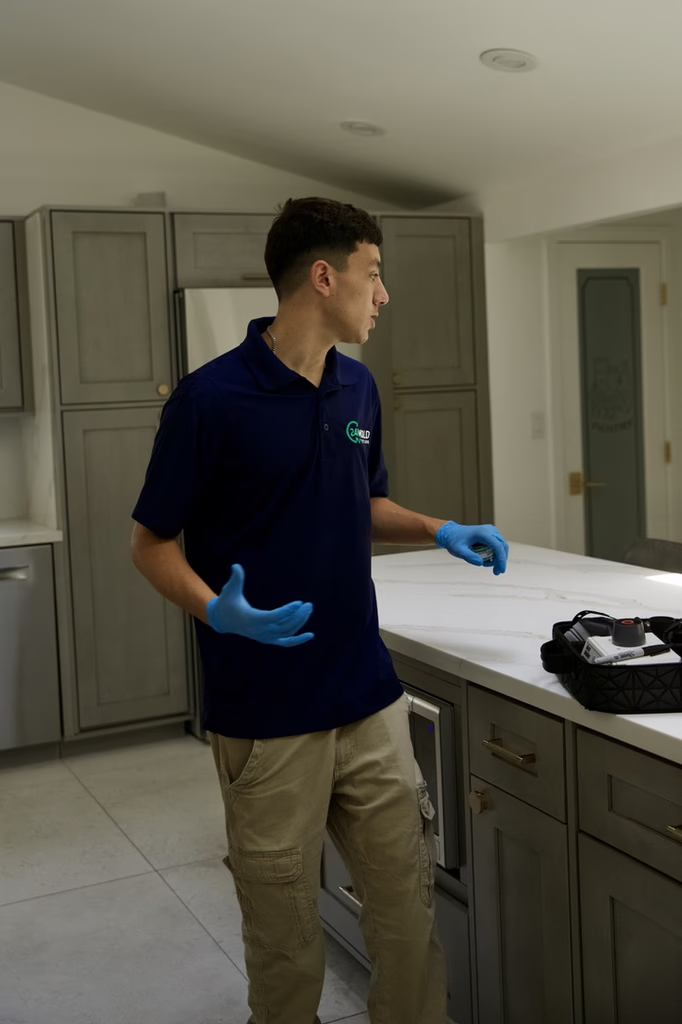
Sterile swabs and clear adhesive tape collect mold from visible spots on dry surfaces, giving the lab a clean sample for species identification. Suitable for walls, ceilings, baseboards, and furniture where the residue is what you're checking.
For damp or recently water-damaged areas, the sampling approach changes. Wet sampling captures live, actively growing colonies that dry methods underrepresent, which matters under flooring, behind tile, and around recent leaks.
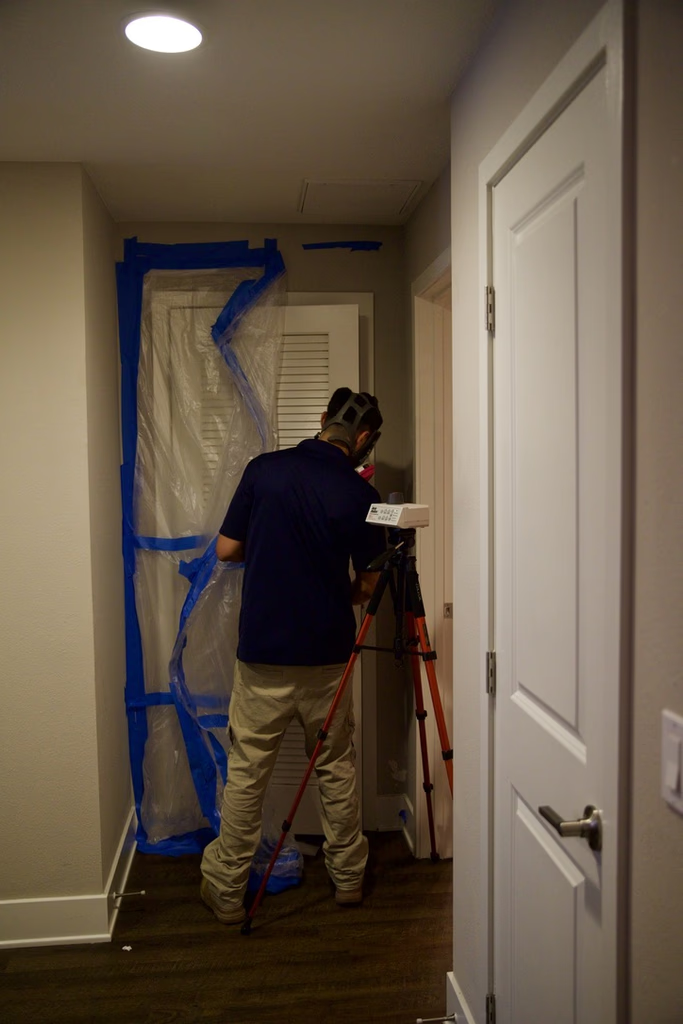
A calibrated pump pulls a controlled volume of air through a spore trap cassette, capturing viable and non-viable spores from the breathing zone. The lab counts species and compares concentrations to outdoor levels, telling you whether your indoor air is healthy.
Checklist
Is Testing Right for You?
Mold testing is ideal if:
- —You suspect mold but can't see it
- —You've had water damage
- —Residents or tenants are reporting health symptoms
- —You're buying, selling, or managing a property
- —You need peace of mind after remediation
Still unsure? Let's talk. We'll help you decide which method suits your case best.
Testing Overview
Our Testing Methods
Techniques we use to collect accurate mold samples from air and surfaces.
Lifts mold samples from surfaces using clear adhesive—quick and non-destructive.
Gathers samples from damp or textured areas to identify active mold growth.
Mold inspection Northridge FAQ
Call For An InspectionSame-day and next-day appointments are usually available across our Northridge service area, with 24/7 emergency response for active leaks, recent water damage, or urgent real estate timelines. Standard scheduling runs 1 to 3 business days depending on availability.
Our certified mold inspectors assess bathrooms, kitchens, laundry rooms, basements, attics, crawl spaces, HVAC components, and any area showing signs of past or current water issues. Thermal imaging and moisture meters identify hidden moisture behind walls and under floors.
Absolutely. HVAC systems generate condensation as part of normal operation. If condensate drainage is blocked, ductwork is poorly insulated, or cooling equipment is not properly maintained, moisture can accumulate inside attics, wall cavities, or mechanical spaces where mold growth may develop despite the region’s dry outdoor climate.
Pricing varies based on the size of the property, the scope of testing required, and whether any lab work is included. Most residential mold inspections in Northridge fall within the standard industry range of $300 to $600, with a clear quote provided before any work begins.
Air sampling, swab testing, tape lift testing, wall cavity sampling, and HVAC mold testing. The inspector recommends the right method on-site based on what's found. Samples go to a state-certified lab, with results typically back in 24 to 72 hours.
Mold needs water to grow, so finding the moisture source is what prevents the same problem from coming back after any cleanup. Moisture detection during the inspection identifies plumbing leaks, roof leaks, condensation issues, and humidity buildup that's feeding any growth.
Yes. Post-remediation verification confirms the remediation contractor's work succeeded and the space is safe to reoccupy. Because we don't perform remediation ourselves, the verification stays independent of the remediation contractor's interests, which is what insurers and tenants look for.
No. 24H Mold Inspection of Northridge inspects and tests only, and we never perform remediation — that separation is deliberate. Most of what we find here traces back to the same building stock: 1950s and 1960s slab-on-grade ranch houses with supply lines running under the concrete, attic-mounted air handlers working through 100-degree summers, and stucco patched in volume after the 1994 earthquake that has been cracking along those repairs ever since. The visible growth is rarely the whole job, and a company paid for the cleanup has a financial reason to keep finding more of it. What we produce is the diagnosis — what is growing, which moisture source feeds it, how far it extends behind the wall or under the flooring, and lab confirmation of what the samples contain. You take that report to remediation contractors and collect comparable bids on a defined scope instead of three walkthrough guesses. When the work is done we can return for independent post-remediation verification, which carries weight with insurers, landlords, and buyers precisely because we had no part in the removal.
All of Northridge and the west Valley around it. Inside the city that covers Northridge Estates, Sherwood Forest, the CSUN district, the Devonshire and Reseda Boulevard corridors, the Tampa Avenue area, and the blocks running up to the Granada Hills line. The boundaries here are soft: 91324, 91325, and 91326 addresses regularly carry a mailing city that does not match the neighborhood people actually searched for, and a house a block either side of Devonshire can be Northridge on the tax roll and something else in conversation. Granada Hills, Porter Ranch, Chatsworth, Reseda, North Hills, Winnetka, Canoga Park, West Hills, Van Nuys, and Pacoima each have their own 24H Mold Inspection page written around that community's housing stock and moisture patterns, so if your property sits on the far side of one of those lines, start there. It all dispatches from the same Valley team, which is what makes same-day appointments realistic, and emergency response for an active leak or a flooded unit runs 24/7 — the night it happens, not the next business morning.
Detection is the part that happens before anyone takes a sample. Growth you can already see needs identification, not detection; the harder question is where water is sitting in a house that only smells wrong. That starts with the water history — what leaked, when, what was repaired — then an exterior walk for grade and drainage, a moisture meter along baseboards and slab-adjacent walls, and thermal imaging across ceilings and wall cavities to find the temperature signature wet material leaves behind. In Northridge the search has a predictable shortlist. The air handler and duct runs sit in a vented attic that passes 130 degrees in August, so condensation drips onto ceiling drywall and reads as a roof leak in entirely the wrong season. Copper supply lines run under 1960s slabs and announce themselves as a warm spot underfoot or a meter that will not stop turning. And stucco repaired at speed after 1994 splits along the old patch lines. Sampling comes last, only where the walk-through justifies it and always against an outdoor baseline — a spore count with no moisture source attached is not something a contractor can bid on.
Thirty years on, yes — not from the shaking, but from what it broke and how fast it got fixed. The magnitude 6.7 quake hit at 4:31 a.m. on January 17, 1994, with the epicenter a couple of miles from the center of town, and it cracked stucco, split slabs, sheared plumbing joints, twisted roof-to-wall connections, and toppled chimneys across every neighborhood on this page. Repairs came as a wave: tens of thousands of west Valley homes were patched, re-stuccoed, re-roofed, and re-plumbed within a couple of seasons by crews moving fast through an enormous backlog. Much of that work was good. Some of it closed wet framing back up, skipped flashing at a roof-to-wall seam, or floated a patch over a crack that kept moving. Those are the paths winter rain follows today. If you own a house that was repaired in 1994 or 1995 and nobody has checked the attic and the base of the stucco since, that is the inspection to book — and the original permit or insurance paperwork, if you still have it, tells us where to look first.
No, and the two answer different questions. A general home inspection is a broad condition survey: roof, electrical, plumbing, appliances, structure. Its mold coverage stops at what is visible from accessible areas, most contracts exclude mold outright, and none of them include lab work. A mold inspection is narrow and instrument-driven — thermal imaging and moisture meters over stucco and drywall, attic and crawl space entry, and air or surface samples read by a state-certified lab. Two things make that gap wide in Northridge. First, the air conditioning lives in the attic, so a condensate pan overflowing onto insulation above a bedroom stays invisible from the room below until the drywall stains, and an attic running past 130 degrees in summer rarely gets a long look. Second, a large share of this housing was repaired at speed after 1994, and what a fast stucco patch or a re-taped ceiling covered is not something a condition survey is scoped to open up. Most buyers here do both: the home inspection for overall condition, then a mold inspection when it flags staining, odor, past water damage, or an attic nobody entered.
We do not perform removal, so we have no price list to defend — which is exactly why this answer is worth reading. Remediation bids swing wildly because the scope is usually undefined at the moment the contractor writes one. Containing a single bathroom wall is a different job from an attic where the duct system has been wet through three summers, and both get sold as mold removal. In Northridge the cost drivers are consistent: whether the water is coming from under a slab, which turns a wall job into a plumbing job plus flooring; whether growth reached attic sheathing and the ductwork serving the entire house; and whether the affected assembly is part of a post-1994 repair that has to come apart before anyone reaches original framing. An assessment that maps the moisture source and the extent before bidding starts is what turns three unrelated numbers into three comparable ones. Get the inspection first, hand the identical report to every contractor you call, require each to price the same defined scope — then have the finished work verified by someone who did not perform it.
Yes, because on those parcels the water usually starts outside the house. Sherwood Forest kept the big lots the rest of Northridge subdivided away, and horse keeping is still normal on them. That means detached structures nobody enters for months — stables, tack rooms, wash racks, workshops, pool houses — plus long irrigation runs feeding lawn, orchard, and paddock through sprinkler lines that are decades old and buried. A cracked lateral under a lawn keeps a band of soil saturated against a foundation all year without ever showing a wet spot on the surface. The mature canopy compounds it: a north-facing wall under old trees never dries between waterings, and roof valleys packed with leaf litter hold water in one spot season after season. So an inspection here runs longer and begins at the property line — grade and drainage across the whole lot, the outbuildings and their slabs, the crawl space or slab perimeter, then the house. If you have a barn or a wash rack, say so when you book so we schedule the time to open it up.
The assessment is the on-site evaluation — the visual inspection, the moisture mapping with thermal imaging and meters, and the diagnosis of what is actually driving the growth. Testing is the laboratory component within it: air samples collected on spore traps, or surface samples taken by swab, tape lift, or bulk, analyzed by an accredited independent lab for species identification and spore counts. The assessment produces the answer; the testing confirms and quantifies it. Not every Northridge property needs both. Where the growth is visible and the source is plain — a failed water heater, an air handler flooding its pan, a roof leak above a known stain — sampling frequently adds cost without changing what you do next. Where there is odor or symptoms with nothing visible, or where the findings will be read by a landlord, a tenant, an insurer, or a buyer, lab results are what make them defensible. The inspector recommends one or both on site rather than selling a package in advance, and lab turnaround runs twenty-four to seventy-two hours.
There is no statewide license to check, which catches most people by surprise. California's Toxic Mold Protection Act of 2001 directed the state to set permissible exposure limits for indoor mold, those limits were never established, and no agency issues or revokes a mold inspector credential as a result. What you can verify is more useful anyway. Confirm recognized third-party industry certification and current liability insurance. Confirm that samples go to an accredited independent laboratory rather than being read on site by the person selling you something. Confirm the company does not also perform remediation, since an inspector who earns money from the cleanup has a direct financial reason to find more of it. And confirm you will receive a written report with photographs, instrument readings, and marked sample locations rather than a verbal summary at the door. Ask to see a redacted sample report before you schedule — anyone working to a real standard has one ready, and comparing two reports tells you more than comparing two prices.
Yes, and the rental stock around the CSUN district is a steady part of the work. Multi-unit buildings need a different approach than houses because the plumbing is shared: stacks and supply lines serve several units, so a failure inside one wall migrates into the ceiling and wall cavities next door or below, and the tenant who reports the odor is frequently not the tenant with the leak. Inspecting only the unit that complained documents the symptom and misses the source. Student housing adds a pattern of its own — high occupancy in units built for smaller households, bathroom exhaust fans that were never adequate for the actual use, and turnover cycles that hide slow problems between tenancies. On the commercial side, the office and retail buildings along the Reseda Boulevard and Devonshire corridors bring low-slope roof drainage and rooftop HVAC condensation above ceiling systems, where damage develops unseen between service calls.
The report is what makes the choice manageable. Give every contractor the same document and ask them to bid the scope it defines — the affected area, the moisture source, and the containment and verification steps — so the quotes differ on price and method rather than on how much mold each company claims to see. Confirm a current CSLB license, required on any job over five hundred dollars in combined labor and materials, along with workers compensation and liability coverage. Ask how containment will be built and how the HVAC system will be shut down or isolated during the work, because running a system that serves the whole house while an uncontained area is being demolished is the fastest way to distribute spores into rooms that were never affected. And confirm the moisture source repair is inside the scope. Be cautious with any company that inspects free, finds extensive mold, and offers to begin the same day — that sequence is where most complaints start.
It is the independent check after the cleanup and before containment comes down and finishes go back on: confirmation that the affected material was genuinely removed, meter verification that the framing and substrate dried to a normal moisture content, and clearance air sampling compared against an outdoor control taken the same day. The reason it has to come from someone other than the remediation company is obvious once stated — a contractor verifying their own work is grading their own exam. In Northridge it earns its cost most clearly in two places. In a rental, where an owner and a tenant have disagreed about a condition, an independent clearance report ends the dispute because it comes from a party with no stake in the cleanup invoice or the tenancy. And at resale, where a buyer's agent who learns of a past mold event wants documentation that the problem was resolved, not simply that money was spent.
The report documents four things: what was found and where, the photographs and instrument readings that support it, the moisture source driving the growth, and any laboratory results with sample locations marked. That combination is what makes it useful to someone other than you. Adjusters want the moisture source and a dated record of the condition, because policies distinguish sharply between a sudden failure and long-term seepage and that distinction usually decides coverage. Remediation contractors want a defined scope so their bids are comparable — which is also why quotes vary so widely when there is no report behind them. Buyers, sellers, and agents want findings from a party with no stake in the transaction. Landlords and tenants want a record neither of them produced. Laboratory results generally return within twenty-four to seventy-two hours, so the complete report follows within a few days of the visit rather than weeks.
Contact
Book your Northridge mold inspection today
Tell us what's going on and we'll respond the same day
Location
24H Mold Inspection of Northridge
Phone
(818) 671-1336Service area neighborhoods
- Northridge Estates
- Sherwood Forest
- Porter Ranch adjacent area
- CSUN district
- Devonshire corridor
- Reseda Boulevard corridor
- Tampa Avenue area
- Granada Hills border area