
Collects airborne mold spores to assess air quality and detect hidden contamination.
our services
Mold Testing
State-certified testing that spots hidden mold—so you can act early, stay safe, and avoid costly repairs.
About
Why Mold Testing Matters
Mold isn't always visible. It hides in air vents, under floors, and inside walls. The only way to know what you're breathing—or what's spreading—is through lab-grade testing.
- —Identify mold species and spore levels
- —Detect hidden growth in "clean" areas
- —Assess the health risk to occupants
- —Decide on the right next steps
Methodology
How our mold testing works
The three sampling methods we use, chosen for what your property is showing
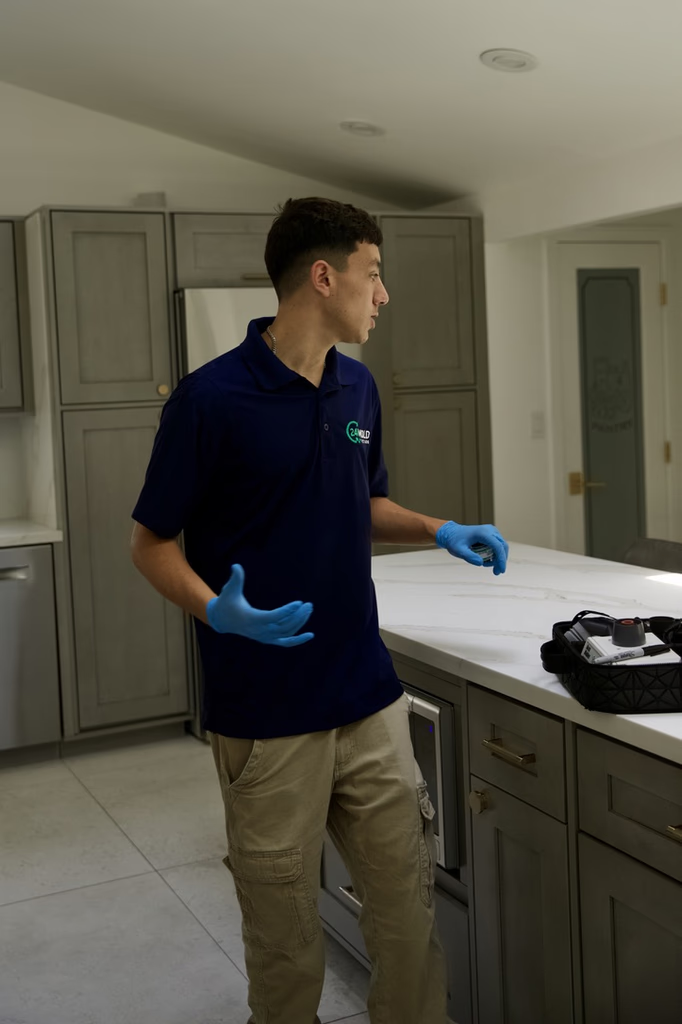
Sterile swabs and clear adhesive tape collect mold from visible spots on dry surfaces, giving the lab a clean sample for species identification. Suitable for walls, ceilings, baseboards, and furniture where the residue is what you're checking.
For damp or recently water-damaged areas, the sampling approach changes. Wet sampling captures live, actively growing colonies that dry methods underrepresent, which matters under flooring, behind tile, and around recent leaks.
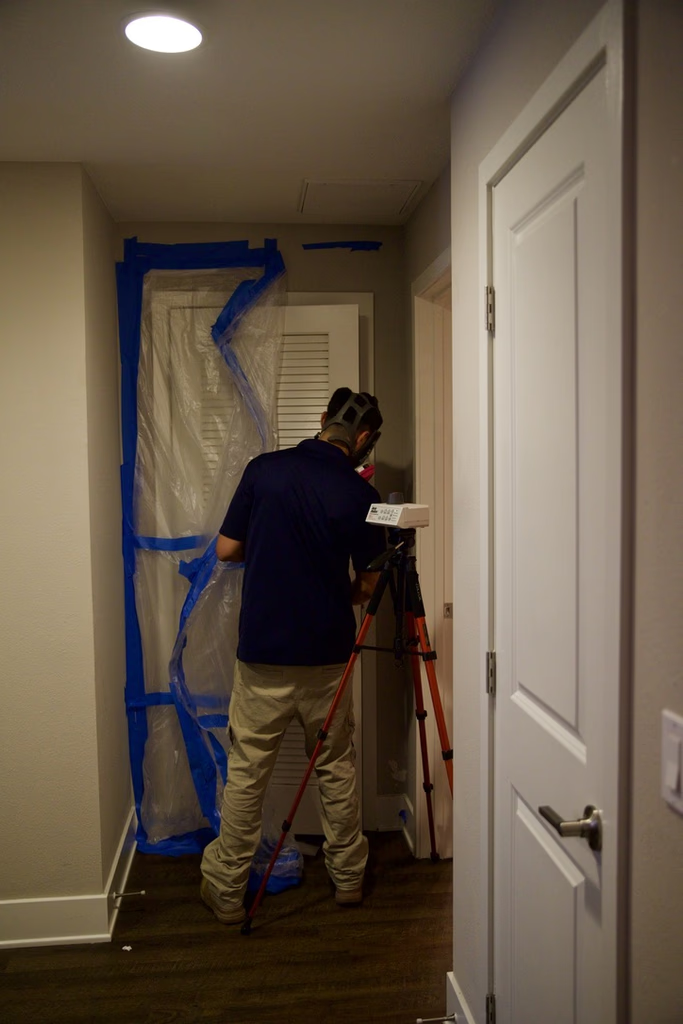
A calibrated pump pulls a controlled volume of air through a spore trap cassette, capturing viable and non-viable spores from the breathing zone. The lab counts species and compares concentrations to outdoor levels, telling you whether your indoor air is healthy.
Checklist
Is Testing Right for You?
Mold testing is ideal if:
- —You suspect mold but can't see it
- —You've had water damage
- —Residents or tenants are reporting health symptoms
- —You're buying, selling, or managing a property
- —You need peace of mind after remediation
Still unsure? Let's talk. We'll help you decide which method suits your case best.
Testing Overview
Our Testing Methods
Techniques we use to collect accurate mold samples from air and surfaces.
Lifts mold samples from surfaces using clear adhesive—quick and non-destructive.
Gathers samples from damp or textured areas to identify active mold growth.
Mold inspection El Cajon FAQ
Call For An InspectionSame-day and next-day appointments are usually available across our El Cajon service area, with 24/7 emergency response for active leaks, recent water damage, or urgent real estate timelines. Standard scheduling runs 1 to 3 business days depending on availability.
Our certified mold inspectors assess bathrooms, kitchens, laundry rooms, basements, attics, crawl spaces, HVAC components, and any area showing signs of past or current water issues. Thermal imaging and moisture meters identify hidden moisture behind walls and under floors.
Often, yes. Mid-century and older homes may have galvanized plumbing, aging roof assemblies, and crawl spaces with limited ventilation. Newer properties more commonly show moisture from HVAC condensation, stucco cracking, or landscape drainage — each calls for a tailored inspection scope.
Pricing varies based on the size of the property, the scope of testing required, and whether any lab work is included. Most residential mold inspections in El Cajon fall within the standard industry range of $300 to $600, with a clear quote provided before any work begins.
Air sampling, swab testing, tape lift testing, wall cavity sampling, and HVAC mold testing. The inspector recommends the right method on-site based on what's found. Samples go to a state-certified lab, with results typically back in 24 to 72 hours.
Mold needs water to grow, so finding the moisture source is what prevents the same problem from coming back after any cleanup. Moisture detection during the inspection identifies plumbing leaks, roof leaks, condensation issues, and humidity buildup that's feeding any growth.
Yes. Post-remediation verification confirms the remediation contractor's work succeeded and the space is safe to reoccupy. Because we don't perform remediation ourselves, the verification stays independent of the remediation contractor's interests, which is what insurers and tenants look for.
A general home inspection surveys the whole property visually, and when it finds staining, mineral deposits, or a musty smell, the report usually recommends a specialist — that is where a mold inspection comes in. We use thermal imaging and moisture meters to find water inside walls, under floors, and in the attic or crawl space, and send air or surface samples to an accredited lab. In El Cajon the gap between the two matters in a few places in particular: the crawl spaces under mid-century Fletcher Hills homes, the underbelly of a manufactured home in one of the city's mobile home parks, and the uphill wall of a house cut into the slope in Granite Hills. A general inspection rarely gets into any of those in depth. If your inspector flagged moisture, book the mold inspection within your contingency period so the findings can still change the price, the repair requests, or your decision.
Yes, and in El Cajon the cause is often the cooling system. The valley runs much hotter and drier than the coast in summer, and many older homes here still use evaporative coolers, which cool by adding water to the air. Run on a humid day, or with the windows closed so the moist air can't exhaust, a cooler can push indoor humidity well above the level where mold grows on closet walls, behind furniture, and inside the ductwork. A leaking cooler pan or failed roof curb adds water directly to the attic. In homes with central air, the opposite problem appears: oversized units that cool quickly but don't run long enough to dehumidify, and condensate lines that clog and overflow. A hygrometer reading over a few days tells you whether indoor humidity sits consistently above 60 percent. If it does, an inspection of the cooler or air handler, the ducts, and the rooms that smell musty usually finds the source.
They can be, particularly after heavy storms. Forester Creek drains much of the valley northward toward the San Diego River, and today much of it runs through concrete-lined channel; the city maintains roughly 17 miles of stormwater channel in all. El Cajon sits in a bowl — the name means 'the box' — so during intense rain, water collects on the low valley floor faster than the channels and street drains can carry it away, and properties near the channels and in low spots take on water at the slab edge, under garage doors, and into crawl spaces. Debris that builds up in the channels between storms makes that worse. After the water recedes, the damage that matters is inside the bottoms of walls, under flooring, and beneath the house, where it dries slowly. A moisture assessment after any storm that put water against or into the house catches that before mold sets in.
They do, mainly because of how they are built underneath. El Cajon has a large number of mobile home parks, and a manufactured home's plumbing runs through the floor system inside a sealed underbelly wrap. A slow leak there soaks the insulation, and the wrap holds the water against the floor decking, out of sight, until the floor softens or a musty smell comes up through the vents. Skirting around the base traps humid air beneath the home, especially where irrigation or downspouts drain toward it. Roofs on older units often have seams, vents, and add-on roofovers that leak at the joints, and attached porches and awnings channel rain against the walls. An inspection here goes beneath the home — checking the underbelly for sagging or wet sections, the subfloor at the bathrooms and kitchen, and the ventilation under the floor — rather than stopping at the living areas.
It can. Stucco is the dominant exterior finish across El Cajon's mid-century and newer homes, and on commercial buildings along Broadway and Main Street, and it is durable enough to hide a problem behind it for years. Cracks from settlement, expansive soil, or simple age let rain into the wall; failed or missing flashing at windows and doors lets in more; and once water is behind the stucco, the building paper and sheathing can stay wet with no path to dry. The valley's long hot summers bake the surface, which looks fine, while the inside of the wall cycles through wet winters. Signs include staining beneath window corners, bubbling or crumbling near the base of the wall, and musty air in rooms on that side of the house. Thermal imaging and moisture readings from the interior, with probing at suspect spots, find it without tearing off the finish.
Often both: a mold inspection finds where the water is going and what it has affected, and a plumber repairs the line. Many of El Cajon's homes were built from the 1950s through the 1970s, when galvanized steel and early copper supply lines were standard and drains were cast iron. Galvanized pipe corrodes from the inside and starts weeping at threaded joints; copper in a slab can pinhole; cast iron cracks along the bottom where no one sees it. Those leaks rarely announce themselves. They show up as a warm spot on the floor, a water bill creeping up, a musty bathroom, or swelling at a baseboard. Thermal imaging and moisture mapping trace the wet area back toward its source and show how far the water has spread — information a plumber doesn't typically provide and an insurer will want. If growth has started, the report scopes what needs to come out before the walls are closed again.
Start by documenting the condition independently. California law applies in El Cajon as it does everywhere in the state: Health and Safety Code section 17920.3, as amended by SB 655, lists visible mold as a substandard housing condition, and a building's age is no excuse. A large share of El Cajon households rent — in apartment complexes along Main Street, Broadway, and Madison Avenue as well as in houses and mobile home parks — and disputes usually turn on whether the mold is a building defect or a household habit. A third-party report answers that with moisture readings, photographs, lab results, and an identified source: a plumbing leak, a failed roof, a missing exhaust fan. Because we don't do remediation, the report has no reason to inflate the problem. Attach it to a written repair request; if nothing changes, it is the document you would bring to the city's code enforcement office or to court.
No — we inspect and test only, and we keep removal out of our business on purpose. A company that inspects and then performs the cleanup is setting the size of its own job. We locate the growth, find the moisture source behind it, and document the extent with thermal imaging, moisture meters, and lab-analyzed samples. In El Cajon the source is often somewhere the cleanup doesn't reach: a galvanized supply line weeping inside a 1950s wall, an evaporative cooler leaking at its roof curb, storm water collecting at the slab edge on the valley floor, or a leak hidden under a manufactured home's underbelly. Remove the mold without fixing that and it grows back. The report gives you a defined scope that several remediation contractors can bid on the same terms, which usually means a smaller job. Once remediation is finished, we can come back for independent clearance testing before the area is closed up.
Detection finds the water and the growth; testing identifies what it is and how much is in the air. Detection is instrument work — thermal imaging to locate wet or cool areas behind walls, ceilings, and floors, moisture meters to confirm and map them, and a borescope where a wall cavity needs a look. Testing is the lab side — air samples measured against an outdoor baseline, swabs, and tape lifts — identifying genera and concentrations. Most El Cajon inspections need both, in that order, because a spore count without a moisture source tells you something is wrong but not where. In Fletcher Hills, detection often leads to the crawl space; in a manufactured home, to the underbelly; on the valley floor, to the slab edge after a storm. The outdoor baseline matters here too: in dry, windy weather the valley's outdoor spore and dust levels shift, so indoor numbers are only judged against a sample taken the same day.
If water sat for more than a day or you can't confirm everything dried, yes. The common triggers in El Cajon are an aging supply line or water heater failing in a mid-century house, an evaporative cooler or air conditioner condensate line overflowing in summer, storm water reaching the slab or crawl space on the valley floor, and a leak beneath a manufactured home's floor. Drying equipment handles the surfaces it can reach, but the moisture that matters lingers inside wall cavities, beneath flooring, in crawl spaces, and in underbelly insulation. Mold can start within 24 to 48 hours. An independent moisture assessment confirms whether the drying actually finished, documents any growth that started, and gives you a dated record for your insurance claim. Because we don't do restoration, that verification stays separate from the company that did the drying, which is what an insurer or a future buyer will look for.
Yes. Commercial work in El Cajon runs from older storefronts and mixed-use buildings along Main Street to retail along Broadway and Magnolia and the industrial parks and hangars around Gillespie Field. These buildings tend to fail in a few predictable ways: flat roofs behind parapets whose flashing and drains give out, leaks that travel across a roof deck or above a suspended ceiling before dripping far from where they entered, stucco cladding cracked by settlement and age letting water into the wall, and slabs poured without vapor retarders under offices and stored goods. Restaurant kitchens and walk-in coolers add a constant moisture load. We schedule around business hours, sample occupied space with minimal disruption, and provide documentation suited to owners, tenants, and insurers — with independent clearance testing after any remediation, before a space reopens.
Our El Cajon team covers the whole city — downtown and the Main Street district, Fletcher Hills, Bostonia, Granite Hills, the Gillespie Field area, the Madison Avenue corridor, the Pepper Drive area, and the neighborhoods around Grossmont College — with same-day and next-day appointments and 24/7 response for active leaks and water damage. Several nearby communities have their own 24H Mold Inspection page written for their own housing, including La Mesa, Santee, Lakeside, Spring Valley, and Alpine. If your property is in one of those, start with that page. Some East County addresses sit in unincorporated areas that carry an El Cajon mailing address; if you aren't sure which team covers you, call the number on this page and we'll route you to the right one.
Contact
Book your El Cajon mold inspection today
Tell us what's going on and we'll respond the same day
Location
24H Mold Inspection of El Cajon
Phone
(858) 742-1217Hours
- MondayOpen 24 hours
- TuesdayOpen 24 hours
- WednesdayOpen 24 hours
- ThursdayOpen 24 hours
- Friday6 AM – 6 PM
- SaturdayClosed
- SundayOpen 24 hours
Service area neighborhoods
- Fletcher Hills
- Bostonia
- Granite Hills
- Gillespie Field area
- Madison Avenue corridor
- Main Street district
- Grossmont College area
- Pepper Drive vicinity