24H Mold Inspection
North Hollywood24/7 EMERGENCY(818) 861-0010
HomeOur ServicesMold TestingAir Testing
Mold Testing

Air Testing

Mold air testing detects airborne spores and assesses indoor air quality, even in spaces where no visible contamination has shown up yet.

Overview

Why mold air testing matters

Most mold is invisible. Spores float undetected through ducts and doorways, spreading from room to room with the air itself. Air testing reveals the species and concentration of what's airborne, even when no visible growth is found on any surface.

Mold air testing detects:

  • —Invisible mold spores circulating through the air
  • —Differences in spore levels from one room to the next
  • —Contamination inside HVAC systems and hard-to-reach areas
  • —Early warning signs in rooms that appear unaffected
Why mold air testing matters
Mold inspector at work

Benefits

What you get from air testing

Understand the air quality and find what your eyes can't

  • —Non-invasive: No drilling, no surface damage, no demolition needed.
  • —Early detection: Catch contamination before it spreads or symptoms start.
  • —Data-driven: Measure and compare spore counts room by room with lab-verified results.
  • —Defensible documentation: State-certified lab results that hold up for insurance and real estate use.

About

How mold air testing works

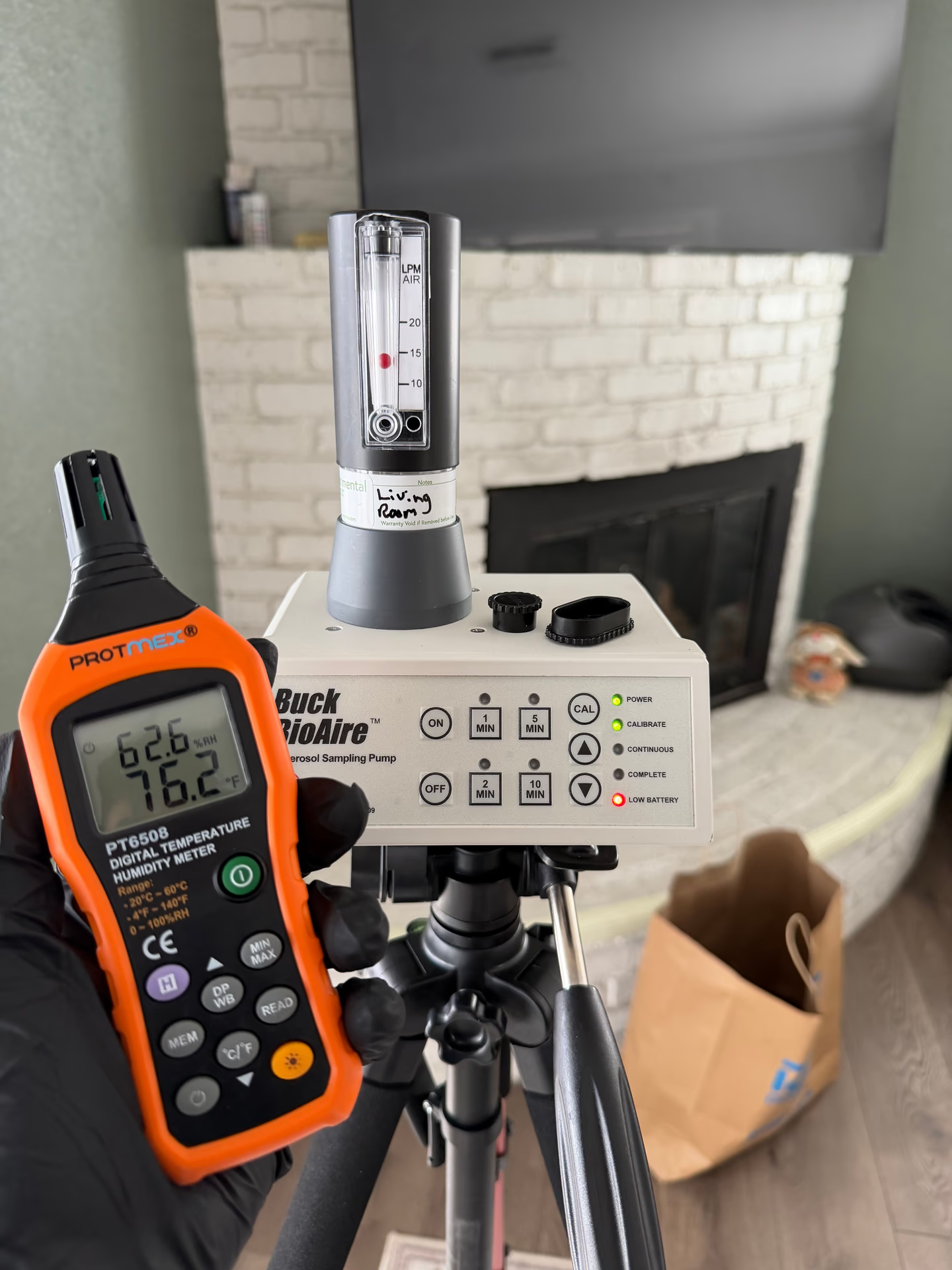
Our certified mold inspectors use calibrated sampling pumps to draw air through a spore trap cassette, capturing airborne mold spores. The lab identifies the mold species under a microscope, including any HVAC contamination if the system is implicated.

Our process includes:

  • —Targeted sampling in problem areas and comparison sampling outdoors
  • —Spore traps or impactor cassettes calibrated for accurate collection
  • —Lab-verified results identifying species and spore counts
  • —A written mold inspection report with the numbers and next steps
How mold air testing works

Mold inspection North Hollywood FAQ

Call For An Inspection
A general home inspection is a visual survey of the whole property — roof, structure, electrical, plumbing — and when it finds staining, a musty odor, or signs of past leaks, the standard line in the report is a referral to a specialist. A mold inspection is that specialist step: thermal imaging and moisture meters to find water inside walls and under floors, and lab-analyzed air or surface samples to identify what is growing. In North Hollywood the gap between the two shows up most in the 1950s and 1960s apartment buildings off Lankershim and Vineland, where a leak in an upstairs unit can sit inside the floor framing without leaving a mark, and in the 1940s houses of Toluca Woods, where the crawl space is the part a walkthrough rarely reaches. If your home inspector flagged moisture, book the mold inspection inside your contingency window so the findings can still shape the negotiation.
In many buildings, yes, and some of it is still surfacing. North Hollywood took heavy damage on January 17, 1994 — the El Portal Theatre on Lankershim lost its ceiling and cracked its side walls, and the Laurel Plaza mall at Laurel Canyon and Oxnard closed except for its department store. Homes and apartments that stayed standing often came out of it with cracked stucco, shifted foundations, and plumbing joints strained inside the walls, which are exactly the openings that let rain and slow leaks in over the following decades. Since 2015 the city's soft-story retrofit ordinance has sent crews into thousands of pre-1978 tuck-under apartment buildings, and opening those ground-floor walls regularly exposes old water damage nobody knew was there. If your building has been retrofitted, or still carries patched 1994-era stucco, a moisture survey of the wall cavities and the framing above the parking level is the useful next step.
The recurring issue is that many of these buildings were never designed for people to live, shower, and cook in. A lot of the Arts District's lofts, studios, and rehearsal spaces around Lankershim and Magnolia occupy older brick, concrete block, and flat-roofed commercial shells built for storage or retail, later converted with bathrooms and kitchens added over a slab that has no vapor barrier. Flat roofs pond and leak along parapets and around rooftop HVAC curbs; masonry walls wick water and hold it; and exhaust fans in converted units are often undersized or vented into a ceiling space instead of outdoors. Dense occupancy and rehearsal or recording rooms sealed for sound add humidity with nowhere to go. An inspection in these spaces focuses on the roof-to-wall transitions, the slab perimeter, and the ceiling cavity above wet rooms — and the report serves tenants and owners alike when the question is who is responsible for the repair.
Yes, and in North Hollywood's stacked apartment stock it is one of the most common explanations for growth that keeps coming back. Most of the two- and three-story buildings on the side streets off Lankershim, Cahuenga, and Vineland date from the 1950s and 1960s, with bathrooms and kitchens stacked directly over one another and plumbing chases running between floors. A failed toilet wax ring, a cracked tub surround, or a balcony membrane letting water into the framing upstairs travels down through the floor assembly and the wall cavity before it shows — often as a ceiling stain or a musty closet one or two units below, and often weeks after the leak started. Cleaning the surface in your unit does nothing while the source is still active upstairs. A moisture map that traces the water path across both units gives the building owner something specific to fix, and gives you documentation if the repair stalls.
They carry a specific set of risks rather than a general one. Most of the traditional houses on Arcola, Biloxi, Denny, and the surrounding streets went up between about 1940 and 1948, and Valley homes of that era typically sit on raised wood foundations over a shallow, lightly ventilated crawl space. Original or first-replacement galvanized supply lines corrode from the inside and start weeping at the joints, cast-iron drains crack beneath the floor, and the crawl space stays damp after a wet winter because nothing moves air through it. Growth on the subfloor and joists can run for years without a visible sign upstairs beyond a closet that smells musty or a floor that softens near the bathroom. Many of these homes have also been remodeled several times, so newer finishes can sit over older water damage. An inspection that goes into the crawl space with a moisture meter is the part that matters most here.
Document it independently first. A large share of North Hollywood renters live in buildings constructed before October 1978, which places them under the City of Los Angeles Rent Stabilization Ordinance and within the Housing Department's code enforcement system. California law treats visible mold as a substandard housing condition under Health and Safety Code section 17920.3, as amended by SB 655, and a building's age is not a defense. What landlords and city inspectors respond to is evidence: a written third-party report with moisture readings, photographs, lab results, and an identified source — often a leak from an upstairs unit or a failed bathroom exhaust in these 1950s and 1960s buildings. Because we do no remediation, the report carries no incentive to inflate the problem. Send it with a written repair request; if nothing happens, it is the same document you would attach to a complaint with the Los Angeles Housing Department.
Because summer is when North Hollywood's air conditioners work hardest, and air conditioning makes water. The east Valley regularly climbs into the high 90s and past 100 from July through September, and a cooling system running most of the day pulls gallons of condensate out of the air that has to drain somewhere. In older apartments that often means a wall or window unit dripping into the wall below it, or an air handler in a hallway closet whose drain line has clogged and is overflowing into the subfloor. In newer buildings, ducts running through unconditioned spaces sweat where hot air meets cold metal, and supply registers condense on ceilings when the thermostat is set low. The growth that follows tends to appear around vents, behind furniture on exterior walls, and in closets that share a wall with the mechanical space. Checking the condensate path is usually the fastest way to find the source.

Contact

Book your North Hollywood mold inspection today

Tell us what's going on and we'll respond the same day

Location

24H Mold Inspection of North Hollywood

Hours

  • MondayOpen 24 hours
  • TuesdayOpen 24 hours
  • WednesdayOpen 24 hours
  • ThursdayOpen 24 hours
  • Friday6 AM – 6 PM
  • SaturdayClosed
  • SundayOpen 24 hours

Service area neighborhoods

  • NoHo Arts District
  • Lankershim corridor
  • Chandler Boulevard corridor
  • Mid-Town North Hollywood
  • Toluca Woods
  • Toluca Terrace
  • NoHo West
  • Victory Boulevard corridor
Call For Service(818) 861-0010